Pay the same, get less: How ‘shrinkflation’ masks price increases
Advertisement
Read this article for free:
or
Already have an account? Log in here »
To continue reading, please subscribe:

Digital Subscription
One year of digital access for only $205*
- Enjoy unlimited reading on winnipegfreepress.com
- Read the E-Edition, our digital replica newspaper
- Access News Break, our award-winning app
- Play interactive puzzles
*First annual payment billed as $205.00 + GST for one year. This annual subscription will automatically renew at $233.00 + GST every 52 weeks (10% off the regular annual price of $259.35). Offer available to new and qualified returning subscribers only. Cancel any time.
To continue reading, please subscribe:
Add Free Press access to your Brandon Sun subscription for only an additional
$1 for the first 4 weeks*
- Enjoy unlimited reading on winnipegfreepress.com
- Read the E-Edition, our digital replica newspaper
- Access News Break, our award-winning app
- Play interactive puzzles
*Your next Brandon Sun subscription payment will increase by $1.00 and you will be charged $17.95 plus GST for four weeks. After four weeks, your payment will increase to $24.95 plus GST every four weeks.
Read unlimited articles for free today:
or
Already have an account? Log in here »
Hey there, time traveller!
This article was published 02/09/2021 (1785 days ago), so information in it may no longer be current.
As increasing commodity prices, higher shipping fees and labour shortages drive up costs for food manufacturers, experts say reducing the amount of food in a package is a subtle way to adjust for inflation without raising prices.
Food makers are steadily shrinking package sizes to offset rising input costs while keeping prices stable, a retail strategy known as “shrinkflation.”
“Food processors tend to be hit hard by higher input costs,” said Sylvain Charlebois, director of the Agri-Food Analytics Lab at Dalhousie University.
“They want to remain competitive in an inflationary market, and in order to do that they play around with quantities instead of charging more for products.”
The shrinking-package strategy ultimately leaves consumers with less for their money for everything from cookies and chips to cheese and orange juice.
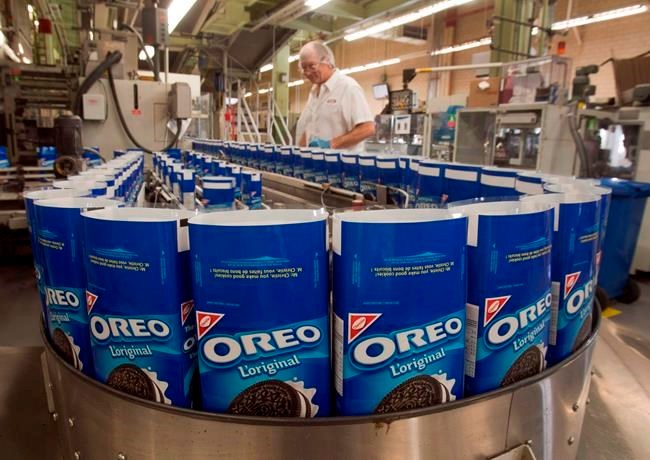
An original package of Oreo cookies, for example, has shrunk by about three cookies to 270 grams from 303 grams, a roughly 10 per cent reduction by weight.
A spokesman for Mondelēz Canada Inc., which makes the iconic cookie brand, said the company reduced the size of some Oreo packages earlier this year.
“It’s important to note that this change was a result of several factors, most significantly higher commodity costs which have been a challenge across the industry for some time,” Noah Farber said in an email.
“We work hard to ensure we offer value for money for our consumers, but we will never compromise on the taste or quality of Oreo which is loved by millions of consumers around the world.”
Consumers may also notice fewer chips in a bag, crackers in a box or granola bars in a package. A bag of Lay’s potato chips now weighs 165 grams, down from 180 grams, Quaker Chewy granola bars come with five bars rather than six or 120 grams instead of 156 grams, and Armstrong cheese is 600 grams rather than 700 grams, according to data compiled by Charlebois.
Food producers have also redesigned orange juice bottles to create a larger hollow bubble of space on the bottom, giving consumers the impression that the bottle is the same size while in fact reducing the amount of juice, he said.
Oasis orange juice containers, for example, now fit 1.5 litres rather than 1.65 litres, while Tropicana juice containers have 1.54 litres of juice rather than 1.75 litres, Charlebois said.
“It is subtle because they do alter the packages,” he said. “It gives you the illusion that you’re actually buying the same amount for the same price but you’re not.”
The “shrinkflation” retail tactic irks consumers, with recent social media posts calling out the stealth price hike strategy as sneaky.

But Charlebois said the price per 100 grams or 100 millilitres is disclosed to consumers in grocery stores, and that shrinking package sizes might have a positive impact on food waste.
“My biggest concern with shrinkflation is how we track food inflation rates in Canada,” he said, noting that we might be underestimating food inflation if shrinking package sizes aren’t accounted for.
Statistics Canada said its consumer price index compares the cost of a fixed basket of goods and services over time. The federal agency said its commodity specialists are able to do a quantity adjustment that accounts for changes in package size to ensure price increases are reflected in CPI.
A spokesperson with the Food, Health & Consumer Products of Canada, an industry group representing food manufacturers in Canada, was unavailable for an interview.
This report by The Canadian Press was first published Sept. 2 , 2021.
Advertisement Advertise With Us
Advertisement Advertise With Us