Casabe, Cuba’s little-known traditional bread, seeks world recognition

Advertisement

Advertise with us

QUIVICÁN, Cuba (AP) — When Julio César Núñez was a child, he helped his grandmother make casabe from scratch, using artisanal tools — and an ancient cooking method — to turn grated yuca root into a thin, white, crispy flatbread.

Read this article for free:


or

Already have an account? Log in here »

To continue reading, please subscribe:

Subscribe and receive a limited-edition Free Press branded hat or tote.

Digital Subscription

One year of digital access for only $205*

  • Enjoy unlimited reading on winnipegfreepress.com
  • Read the E-Edition, our digital replica newspaper
  • Access News Break, our award-winning app
  • Play interactive puzzles

*First annual payment billed as $205.00 + GST for one year. This annual subscription will automatically renew at $233.00 + GST every 52 weeks (10% off the regular annual price of $259.35). Offer available to new and qualified returning subscribers only. Cancel any time.

To continue reading, please subscribe:

Add Free Press access to your Brandon Sun subscription for only an additional

$1 for the first 4 weeks*

  • Enjoy unlimited reading on winnipegfreepress.com
  • Read the E-Edition, our digital replica newspaper
  • Access News Break, our award-winning app
  • Play interactive puzzles
Start now

*Your next Brandon Sun subscription payment will increase by $1.00 and you will be charged $17.95 plus GST for four weeks. After four weeks, your payment will increase to $24.95 plus GST every four weeks.

Hey there, time traveller!
This article was published 05/06/2023 (1214 days ago), so information in it may no longer be current.

QUIVICÁN, Cuba (AP) — When Julio César Núñez was a child, he helped his grandmother make casabe from scratch, using artisanal tools — and an ancient cooking method — to turn grated yuca root into a thin, white, crispy flatbread.

Today, Núñez, 80, and a younger generation of family members in this town south of Havana, continue the tradition of harvesting and preparing casabe the ancestral way, but it’s no longer just for their own consumption. They sell it to small businesses and restaurants in the capital.

Casabe, a flatbread made of yuca root, which is also called cassava, is one of Cuba’s oldest Indigenous meals. It is making a comeback on the island nation, with promoters and restaurants hyping its benefits as a gluten-free alternative to bread and officials seeking its addition to the prized intangible cultural heritage list of UNESCO, the U.N.’s cultural agency.
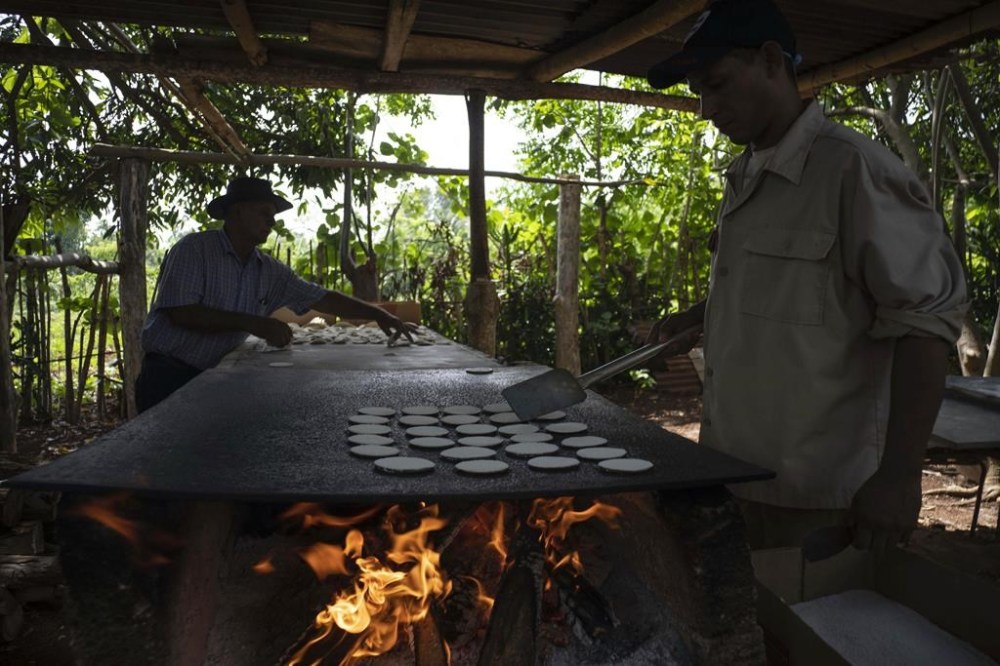
Casabe producer Julio Cesar Nunez, left, and his nephew Agustin cook small cakes of casabe on a griddle over a wood fire, in Quivican, Cuba, Monday, May 28, 2023. When Nunez, 80, was a child, he helped his grandmother make casabe from scratch, using artisanal tools — and an ancient cooking method — to turn grated yuca root into a thin, white, crispy flatbread. (AP Photo/Ramon Espinosa)

“Casabe is an Amerindian tradition that came from northern South America and made its way to the Antilles,” Sonia Virgen Pérez, president of Cuba’s National Heritage Council, told The Associated Press. “It arrived through the eastern part of Cuba and became an important food that has been passed down from generation to generation.”

In March, Pérez led a delegation of countries including Cuba, Dominican Republic, Venezuela, Honduras and Haiti, to formally request that UNESCO include the tradition of harvesting yuca, and preparing and consuming casabe to its cultural heritage list.

Casabe was a key part of the diet of Indigenous peoples in the Caribbean. It was also among the first native products embraced by the Spaniards upon their arrival. They incorporated it into their diet, partly because of its durability. It can last months once baked.

Less popular than its Latin American cousins — the Mexican tortilla, traditionally made of corn, or the Venezuelan arepa, which tends to be thicker – casabe is increasingly finding its way into culinary festivals and even casabe-themed merchandising. Among its advantages, says Pérez, is that its main ingredient, the yuca root, can be found virtually anywhere in the Cuban countryside.

“Casabe is a synonym for strength and resilience,” she says.

When eaten, casabe resembles a crunchy, somewhat dry cookie that can be accompanied with either sweet foods, such as sugary coconut, or meat and poultry, as long as the addition is moist enough to compensate for casabe’s natural dryness.

“It is one of the oldest dishes in our cuisine,” says Yudisley Cruz, a 45-year-old economist who co-owns Yucasabi, a restaurant in Havana that specializes in dishes based on casabe flatbread. “It goes with everything.”

Back in Quivicán, Núñez walks around the farm, showing a reporter some of the traditional tools he uses to make casabe the way his grandmother did, including a sifter made of natural fibers. A few meters away, his 40-year-old nephew Agustín grates the yuca root while Agustín’s son, Eriel, 15, carefully prepares the small cakes that are then cooked on a griddle over a wood fire.

In addition to seeking UNESCO recognition, casabe enthusiasts hope it will be widely embraced as a healthy, sustainable meal that delights the palate of more people while preserving an Indigenous tradition.

“We’re not going to war against bread. We just want people to also eat casabe,” says Cruz, the restaurateur.


Report Error Submit a Tip

More Stories

Ferraro gets call-up to the Jets

Mike McIntyre 6 minute read Preview

Ferraro gets call-up to the Jets

Mike McIntyre 6 minute read Updated: Yesterday at 6:56 PM CDT

Landon Ferraro vividly recalls the moment his NHL career came to an extremely painful end — Oct. 20, 2017, in downtown Winnipeg.

“My last play was a breakaway on Connor Hellebuyck,” Ferraro told the Free Press this week.

“I tried to poke the puck past the first D. It was me and (Dustin) Byfuglien chasing it down. I thought he was going to throw me across the ice, so I tried to cut in on him, and he moved. I overextended, and I literally ripped my abductor off the bone and gave myself a hernia.”

Ferraro — at the time playing forward for the visiting Minnesota Wild — said he managed to get off a weak shot that hit the Jets goaltender square in the chest. But his 77th appearance in the big leagues would be his last following previous stops with Detroit (which drafted him 32nd overall in 2009) and Boston.

Read
Updated: Yesterday at 6:56 PM CDT

Bombers coach happy to be back at work after backbreaking loss to Argos

Taylor Allen 6 minute read Preview

Bombers coach happy to be back at work after backbreaking loss to Argos

Taylor Allen 6 minute read Tuesday, Sep. 29, 2026

It’s the first practice day after a backbreaking loss.

The Winnipeg Blue Bombers are in a challenging predicament with four games remaining — starting Saturday on the road against the Montreal Alouettes (11-3) — that leaves their playoff aspirations far from solidified.

And yet, head coach Mike O’Shea makes his way behind the podium, looks out at a room of reporters and is grinning ear to ear.

Why so happy?

Read
Tuesday, Sep. 29, 2026

What’s open, what’s closed, what’s up in Winnipeg on National Day for Truth and Reconciliation Sept. 30, 2026

Free Press staff 4 minute read Preview

What’s open, what’s closed, what’s up in Winnipeg on National Day for Truth and Reconciliation Sept. 30, 2026

Free Press staff 4 minute read Sunday, Sep. 27, 2026

The National Day of Truth and Reconciliation, or Orange Shirt Day, as it's known in Manitoba, happens Sept. 30 with many commemorative community events scheduled.

Read
Sunday, Sep. 27, 2026

Port of Churchill signs agreement with Dutch port

Aaron Epp 2 minute read Preview

Port of Churchill signs agreement with Dutch port

Aaron Epp 2 minute read Tuesday, Sep. 29, 2026

Arctic Gateway Group, operator of the Port of Churchill, has signed an agreement with the Port of Rotterdam in the Netherlands to attract business and strengthen supply chains linking Western Canada and Europe.

The agreement enables the two ports to work together to develop new trade in critical minerals and energy products, connect Canadian producers with European buyers, and identify opportunities to improve the supply chain from Western Canadian resource projects through Churchill and into European markets.

The Port of Rotterdam is Europe’s largest port and home to more than 3,000 businesses across its industrial complex, serving as a major gateway for critical raw materials and energy.

Meanwhile, the Port of Churchill has been identified as a transformative national strategy for Canada and is emerging as a northern trade corridor connecting Western Canada’s resources to global markets.

Read
Tuesday, Sep. 29, 2026

Collisions send people to hospital; one fatality

2 minute read Yesterday at 10:42 AM CDT

Five people are in hospital following a two-vehicle collision on Monday at the corner of Pembina Highway and Plaza Drive in which three pedestrians were struck.

On Sept. 28, just after 4:30 p.m., a Ford Fusion was travelling northbound on Pembina Highway through the Plaza Drive intersection with a green light when it was struck by a westbound Honda Fit that failed to stop for a red light at Plaza Drive. The Honda Fit mounted the sidewalk, striking three young children who were with an adult.

The three children were transported to hospital in stable condition with minor injuries. The driver of the Honda, a woman in her 70s, and the passenger, a man in his 80s, were transported to hospital in unstable condition. They were both upgraded to stable condition. The driver was issued a ticket under the Highway Traffic Act.

The Winnipeg Police Service’s Traffic Division is investigating.

Truck carrying mail, milk and alcohol to isolated N.B. island held at U.S. border

The Canadian Press 4 minute read Preview

Truck carrying mail, milk and alcohol to isolated N.B. island held at U.S. border

The Canadian Press 4 minute read Updated: Yesterday at 3:14 PM CDT

CAMPOBELLO ISLAND - A truck carrying supplies for an isolated New Brunswick island linked to the rest of Canada by U.S. roads was turned back at the international border Tuesday, says the local member of Parliament. 

New Brunswick South MP John Williamson said U.S. border officials stopped the truck bound for Campobello Island, N.B., because it was carrying milk and alcohol. Importing those items into the United States is prohibited under new rules that went into effect Tuesday as part of the ongoing trade war.

The only land link to the picturesque island, best known as the summer retreat of former U.S. president Franklin Delano Roosevelt, is a bridge to the town of Lubec, Maine. From there it's an 80-kilometres drive to the next border crossing at Calais, Maine, where the truck was stopped.

Williamson said the truck typically travels to the island every weekday, carrying mail and goods for the island's less than 1,000 residents under a special Canada Border Services Agency licence. The truck is sealed with a customs tag guarantying it will not stop on the way to the island.

Read
Updated: Yesterday at 3:14 PM CDT