Kids share the bounty
Young people explain their reasons for becoming vegan
Advertisement
Read this article for free:
or
Already have an account? Log in here »
To continue reading, please subscribe:

Digital Subscription
One year of digital access for only $205*
- Enjoy unlimited reading on winnipegfreepress.com
- Read the E-Edition, our digital replica newspaper
- Access News Break, our award-winning app
- Play interactive puzzles
*First annual payment billed as $205.00 + GST for one year. This annual subscription will automatically renew at $233.00 + GST every 52 weeks (10% off the regular annual price of $259.35). Offer available to new and qualified returning subscribers only. Cancel any time.
To continue reading, please subscribe:
Add Free Press access to your Brandon Sun subscription for only an additional
$1 for the first 4 weeks*
- Enjoy unlimited reading on winnipegfreepress.com
- Read the E-Edition, our digital replica newspaper
- Access News Break, our award-winning app
- Play interactive puzzles
*Your next Brandon Sun subscription payment will increase by $1.00 and you will be charged $17.95 plus GST for four weeks. After four weeks, your payment will increase to $24.95 plus GST every four weeks.
Read unlimited articles for free today:
or
Already have an account? Log in here »
Hey there, time traveller!
This article was published 20/01/2024 (987 days ago), so information in it may no longer be current.
Imagine your nine-year-old telling you she wants to start living vegan.
That’s what happened with Kelly Solar and her daughter Fynn. Though they’d been living a vegetarian lifestyle, Fynn — an avid reader — decided to research the meat, egg and dairy industries and concluded that there was no way she would ever consume animals or animal byproducts again.
Whether for the planet, for health, for animal welfare, or all of the above, some local kids are sharing their stories with us about why they’ve adopted a plant-based lifestyle. (For some, January is also Veganuary, a 31-day pledge that challenges participants to go vegan for the month.).
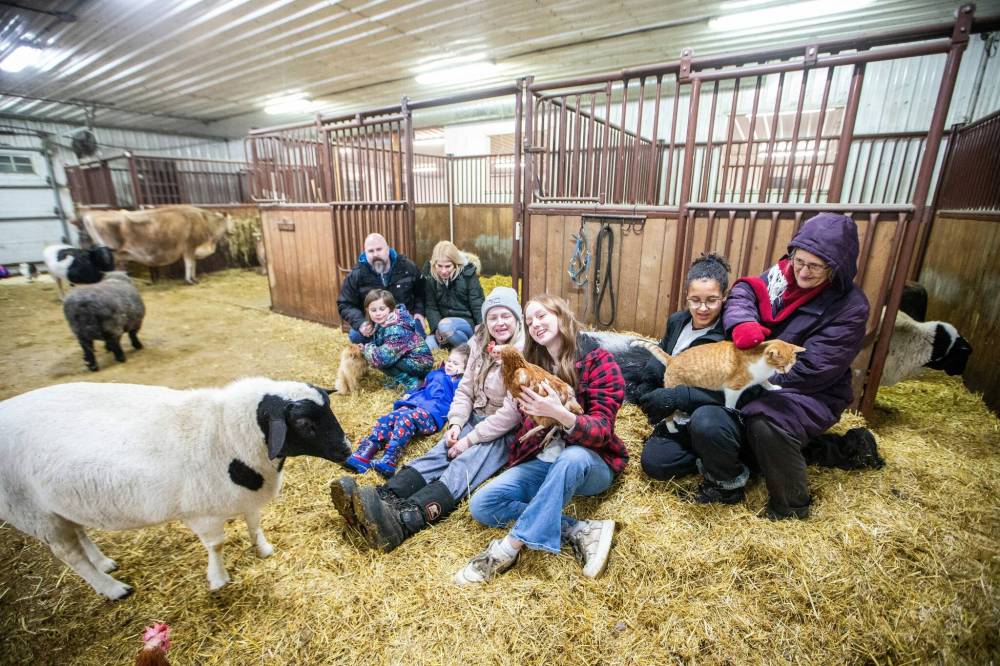
From left: Joe Tonge, Harley Tonge, 8, Danae Tonge, Hale Tonge, 5, Colleen Walker, Jessica Walker, 18, Fynn Solar, 12, and Kelly Solar hang out at the Little Red Barn Sanctuary. All of the family members are vegan.
“I asked my mom if we could stop eating things that came from animals, as they were treated very badly,” said Fynn, now 12. “Being vegan is not just about the food that you eat, it is a way of life.
“When I was younger and in elementary school, I tried to talk about the good things that vegans can do for the animals and the planet with my friends. I even had an animal club.”
But not all schools are vegan-friendly and Fynn has had to navigate her way through the stigma that still exists.
“There’s definitely a lack of healthy vegan food options. I would just bring my own food or eat before the event. I do not want to talk about being vegan with my classmates because I feel that they would make fun or tease me,” said Fynn.
Things are easier in the kitchen where Fynn enjoys trying out new plant-based recipes with her mom.
“I love homemade things like our feta cheese made from tofu and red lentil bolognese, guacamole made from scratch. We are going to make some ravioli soon. Nooch (nutritional yeast) sprinkled on popcorn is really good, too. Being vegan is best for your health, if you follow a whole-food plant diet and not a junky one,” she said.
Mother and daughter are inspired by an expanding list of vegan resources including Rainbow Plant Life, Make it Dairy Free, Plant Chompers, Million Dollar Vegan, and Animal Justice, as well as vegan farm sanctuaries worldwide (and the local Little Red Barn Sanctuary).
“It is important to open your eyes and really look and question the things around you,” added Fynn. “Cows, pigs, chickens, goats, horses and sheep are forced into factory farms. Being vegan shows me that there is a kinder way.”
Long-time vegan Danae Tonge always knew she would raise her children the same way.
“I like being vegan because I don’t hurt animals,” said her eight-year-old daughter Harley, who convinced her father to go vegan. “We are respecting animals by not eating them. It’s better for the environment to be vegan because farming animals causes harm to the environment. I wish there were more vegans in the world because then there will be more vegan products and then people will have more vegan ideas. And no animals will get hurt, and all the animals can be free and wild.”
“No animals die because we don’t eat them,” added her five-year-old brother Hale.
For Harley, birthday parties and special events can be a little tricky, as vegan treats are not always made available.
“Once, I was at soccer, and they were giving out Timbits but I couldn’t eat that, so I felt left out. But now we know to bring our own,” Harley said.
Given the misconception that there is a lack of delicious vegan food, both Harley and Hale excitedly shared a long list of their favourite snacks and meals, which includes pickled beans, Nutter Butter cookies, chocolate, seaweed, grapes, strawberries, sushi, pizza, tomato soup, chocolate zucchini cake, vegan corndog waffles, pad Thai, pickles, noodle soup, strawberry waffles, plant-based sausages, popsicles, mango and dragon fruit.
Jessica Walker, now 18, learned in Grade 7 about factory farming when she read Esther the Wonder Pig’s book, which led her to investigate how factory farming and the treatment of animals in agriculture affects climate change.
In Grade 8, she wondered if empathy and compassion for animals — and ultimately for each other and the environment — could be taught, so she did her own research.
“My project concluded empathy and compassion can be taught but have to be learned at younger ages,” Jessica said. “This led me to create the Little Red Barn Sanctuary to rescue, advocate and educate visitors that all animals are ‘someone, not something.’ With its creation, we began to rescue all kinds of animals from slaughter. We were vegetarian at that time but as we began to learn more about our food system and the suffering of dairy moms, their calves, we transitioned to becoming vegan.
“Vegan, however, is not just a diet. It is a lifestyle and belief system about minimizing suffering, including that involved in wardrobe, makeup, cleaning supplies.”
Finding cruelty-free vegan products is easy if you take a few extra few moments to look, she said.
“The best part of being vegan is knowing you are not contributing to the suffering of animals; minimizing your carbon footprint, but at the same time promoting your own health. A recent study found vegans live an average 10 years longer. Vegan food is delicious, nutritious and minimizes risk of heart disease and other diet-related medical conditions.”

While in high school, Jessica was shocked to learn her school was paying to bring in a petting zoo and handing out free hot dogs. Knowing that the World Health Organization had classified processed meat as a known carcinogen, Jessica decided to run for student president to implement some changes.
The petting zoo was replaced with activities not involving animal exploitation, and with her peers she worked with the Winnipeg Humane Society’s Farm Compassion and Education team to promote education about factory farming. She also brought in a vegan food cart.
“If people saw what we have seen in our food system, they would be vegan yesterday. We live in a time when we have access to more information than ever. There are a number of excellent documentaries available which can remove the disconnect. With rising food costs, vegan meals are also nutritious and economical,” Jessica said.
These early learners have a natural eagerness to find and share the bounty of their knowledge and wisdom. These children, who will inherit the world, as it is, are concerned about the future and would like to have a say in how to change it.
“Every day we make little choices between kindness and suffering,” added Jessica. “Every time you pick something out at the grocery store, you’re given a choice of which you want to support. In a world filled with violence and suffering towards both people and animals, why not choose kindness?”