How automation is transforming Metro’s supply chain after it hit its limit
Advertisement
Read this article for free:
or
Already have an account? Log in here »
To continue reading, please subscribe:

Digital Subscription
One year of digital access for only $205*
- Enjoy unlimited reading on winnipegfreepress.com
- Read the E-Edition, our digital replica newspaper
- Access News Break, our award-winning app
- Play interactive puzzles
*First annual payment billed as $205.00 + GST for one year. This annual subscription will automatically renew at $233.00 + GST every 52 weeks (10% off the regular annual price of $259.35). Offer available to new and qualified returning subscribers only. Cancel any time.
To continue reading, please subscribe:
Add Free Press access to your Brandon Sun subscription for only an additional
$1 for the first 4 weeks*
- Enjoy unlimited reading on winnipegfreepress.com
- Read the E-Edition, our digital replica newspaper
- Access News Break, our award-winning app
- Play interactive puzzles
*Your next Brandon Sun subscription payment will increase by $1.00 and you will be charged $17.95 plus GST for four weeks. After four weeks, your payment will increase to $24.95 plus GST every four weeks.
Read unlimited articles for free today:
or
Already have an account? Log in here »
Hey there, time traveller!
This article was published 18/12/2024 (652 days ago), so information in it may no longer be current.
TORONTO – Metro is heading into 2025 with renewed capacity to grow its business after reaching the final milestone in its seven-year, almost billion-dollar supply chain transformation, which added new automation technology across its warehouses in Quebec and Ontario.
In an increasingly competitive industry, Metro needed to scale up its supply chain in a way that could keep it adaptable and able to continue growing its business.
The company’s distribution network had hit its limit for inventory, delivery volume and assortment, leaving it “struggling to serve” its stores, Metro’s supply chain vice-president Yanick Blanchet said.
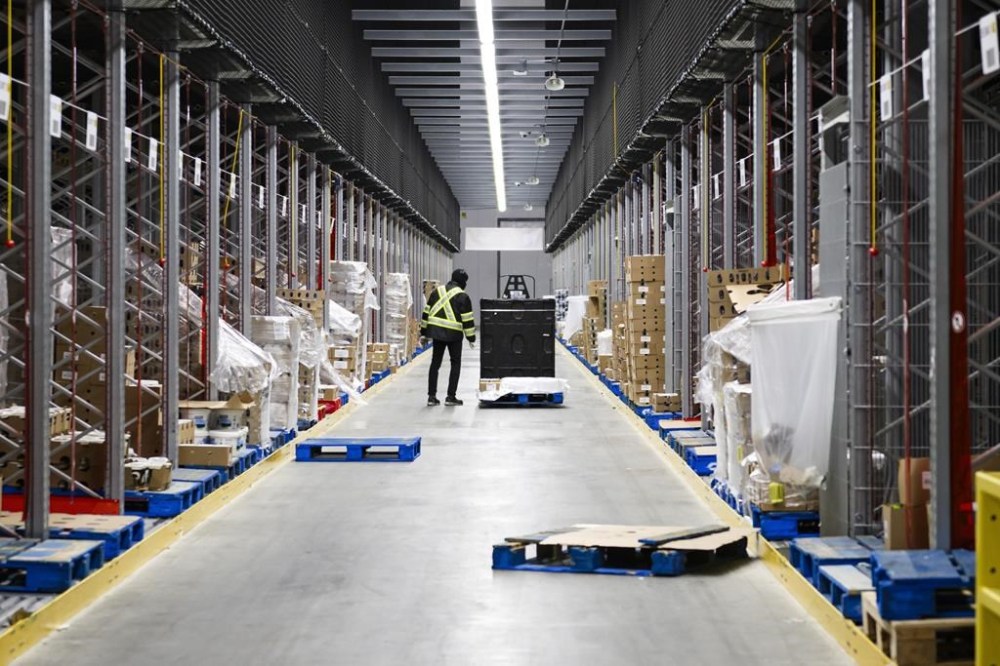
The completion of Metro’s supply chain revamp, which began in 2017, was marked this year by the opening of the final phase of its new automated fresh distribution centre in Etobicoke, Ont.It comes after Metro opened an automated warehouse for frozen products also in Etobicoke in 2022, while in Quebec, the company opened a new automated fresh and frozen centre in Terrebonne last yearand expanded its fresh produce centre in Laval.
“It’s a major investment that will allow us to support the growth over the next years,” said Blanchet in an interview at the new Etobicoke fresh distribution centre.
How it works
Thanks to automation, Metro’s distribution centres are able to hold a significantly higher volume of product within a similar square footprint, said Mario Duran, director of logistics and engineering, during a tour of the Etobicoke fresh facility.
Using automation means storage can go much higher — parts of the new fresh centre in Etobicoke are 100 feet tall, whereas the old warehouse ceilings reached just 30 feet. The total square footage of the centre is almost 567,000 square feet, shipping out 1.1 million cases per week.
The newly completed centre hosts a mix of automated, semi-automated and conventional operations working to bring products including meat, flowers and dairy to Metro’s 277 Metro and Food Basics stores in Ontario.
The first phase of the centre, constructed next to an existing warehouse, went live in January 2021. Once the transition to that building was complete, the building next door was demolished to make way for the second phase, which went live this June.
Some products, like raw meat, can’t be processed through the automated system for safety reasons, said Blanchet.Others don’t work in the fully automated section because of the packaging they come in, though Metro is working with vendors to make more products eligible for automation in the future.
“We want to leverage (our investment) as much as we can,” Blanchet said.
In the semi-automated sections, robotic cranes transfer product from high up in the shelves to the base of the shelves, where they’re picked up by workers driving electric pallet jacks.
In the fully automated section, a multi-level city of conveyor belts and machinery whirs as cases of grapes, iced tea, avocados and orange juice are shuffled from place to place. From a command centre on the ground level, workers monitor the operation.
Here, pallets from vendors are unloaded and cases of product are sorted and stacked for short-term storage.
Rows of metal racks towering 80 feet in height make up the short-term storage area.The racks are trawled by 28 automated cranes, travelling up to 30 kilometres per hour to place cases in the racks and take them back out.
The cases are loaded back onto pallets in a seemingly random order to form a stack that’s then wrapped in plastic, ready to be shipped to grocery stores.
The system, designed by German company Witron, takes in information on incoming shipments such as case dimensions, weight and fragility, plus the orders from stores, and spits out a series of pallet designs, playing a theoretical game of Tetris before building what Blanchet calls “the perfect pallet” in real life. The 14 machines that build the pallets can each handle about 500 cases per hour.
More and more retailers are investing in automation in their warehouses, said retail analyst Bruce Winder. The technology helps lower costs, speed up operations and improve accuracy, he said.
Competitors Loblaw and Empire have also added automation to their supply chain in recent years.
“It’s an interesting sort of evolution of grocery as it relates to how they’re using centralized distribution and automation,” said Winder.
Room to grow
The new centres require some different skills and training than a conventional warehouse, Blanchet said — they’re more maintenance-driven, but they also provide more pleasant jobs, with many physically demanding tasks like moving cases out of a freezer largely taken out of the equation.
“You need less labour … but you need more expertise,” Blanchet said, though he added that Metro was intent on making the shift without laying people off.
Though work on the project began before COVID-19, the pandemic and other supply chain disruptions showed how important it is to have a resilient supply chain with contingency plans built in, Blanchet said.
Over time, the new distribution centres will support further growth, reduce the impact of labour shortages, prevent product damage, improve order accuracy and boost efficiency, making deliveries fresher, said Blanchet.
The changes also allow Metro to increase its assortment by delivering more products from its distribution centres instead of relying on vendors to deliver directly to stores, he said.
Winder said this is another increasingly common feature of retail supply chains, not just in grocery.
“Instead of having the vendor ship all these disparate pallets that are inefficient, they send pallets that are … picked properly and much more efficient, transportation-wise,” he said.
This method also reduces waste as each store gets exactly what it needs, said Winder.

“There’s all kinds of benefits, and a lot of other retailers have been using this model for decades.”
The new network has a lot of room for growth, said Blanchet, and the automation opens doors for continuous improvement and opportunities.
“When you make (a) major investment like that, you want to make sure that it’s for (the) long term.”
This report by The Canadian Press was first published Dec. 18, 2024.
Companies in this story: (TSX:MRU)