‘Sobering statistic:’ One-fifth of pollinators in North America at extinction risk

Advertisement

Advertise with us

FREDERICTON - Many butterflies, bees and moths are fluttering into oblivion. A new report co-authored by a Canadian researcher warns that more than one-fifth of pollinator species it studied in North America are at risk of extinction.

Read this article for free:


or

Already have an account? Log in here »

To continue reading, please subscribe:

Subscribe and receive a limited-edition Free Press branded hat or tote.

Digital Subscription

One year of digital access for only $205*

  • Enjoy unlimited reading on winnipegfreepress.com
  • Read the E-Edition, our digital replica newspaper
  • Access News Break, our award-winning app
  • Play interactive puzzles

*First annual payment billed as $205.00 + GST for one year. This annual subscription will automatically renew at $233.00 + GST every 52 weeks (10% off the regular annual price of $259.35). Offer available to new and qualified returning subscribers only. Cancel any time.

To continue reading, please subscribe:

Add Free Press access to your Brandon Sun subscription for only an additional

$1 for the first 4 weeks*

  • Enjoy unlimited reading on winnipegfreepress.com
  • Read the E-Edition, our digital replica newspaper
  • Access News Break, our award-winning app
  • Play interactive puzzles
Start now

*Your next Brandon Sun subscription payment will increase by $1.00 and you will be charged $17.95 plus GST for four weeks. After four weeks, your payment will increase to $24.95 plus GST every four weeks.

Hey there, time traveller!
This article was published 30/03/2025 (554 days ago), so information in it may no longer be current.

FREDERICTON – Many butterflies, bees and moths are fluttering into oblivion. A new report co-authored by a Canadian researcher warns that more than one-fifth of pollinator species it studied in North America are at risk of extinction.

Out of 759 pollinators — animals critical for food production and healthy ecosystems — studied in Canada, more than 10 per cent were at some level of risk of extinction, says the study published this week in the journal Proceedings of the National Academy of Sciences, or PNAS. And of 1,579 pollinators assessed in the United States, 22.5 per cent were found to be at some level of risk.

The study is the most comprehensive look at North American pollinators and their conservation status to date, John Klymko, scientist at Atlantic Canada Conservation Data Centre in Sackville, N.B., and one of the co-authors, said in a recent interview.
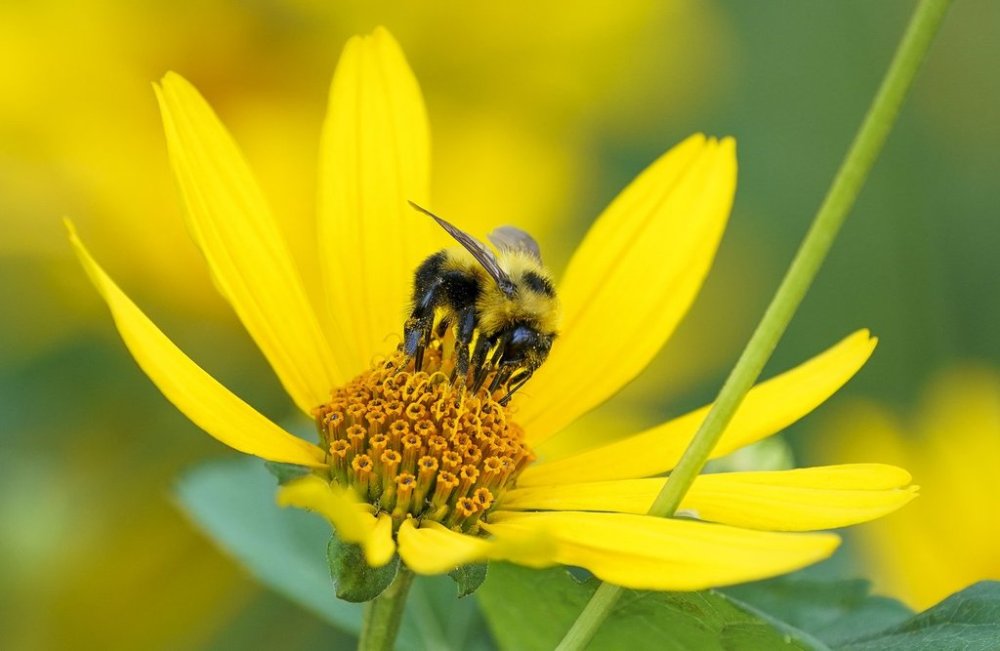
A bee collects pollen on a flower on the grounds of the Canadian Museum of Nature in Ottawa on July 28, 2021.  A new report involving a Canadian researcher warns more than one-fifth of pollinator species assessed in North America — critical for food production and ecosystem function — are at risk. THE CANADIAN PRESS/Sean Kilpatrick
A bee collects pollen on a flower on the grounds of the Canadian Museum of Nature in Ottawa on July 28, 2021. A new report involving a Canadian researcher warns more than one-fifth of pollinator species assessed in North America — critical for food production and ecosystem function — are at risk. THE CANADIAN PRESS/Sean Kilpatrick

Commonly known pollinators, which transfer pollen from one flower to another, are bees, butterflies and moths, Klymko said. But they also include vertebrates like hummingbirds and bats. “Many plants are reliant on pollinators in order to reproduce,” he said.

The study noted that pollinators provide more than $15 billion worth of food each year in North America. 

Among the insect pollinators, extinction risks were highest with bees. Out of 472 species of bees studied in Canada and the U.S., 34.7 per cent were at risk of extinction. The study said that 10 bee, 11 butterfly, and two moth species were classified as critically imperilled.

Flower flies and beetles are relatively secure from extinction, but all three pollinating bat species are at risk of extinction. The 17 hummingbird species studied have seen a population decline but their numbers are high enough that they don’t qualify for an at-risk status.

“To have a broad diversity of pollinators is important because there’s a whole broad diversity of plants that need to be pollinated, and different species of pollinators will be more efficient at pollinating some plants compared to others,” Klymko said.

“Certain species (pollinate) only a handful of plants. And so if you start to lose that diversity of pollinators, there are going to be plant species that are affected.” 

Klymko studied the extinction risk for flower flies for the paper.

“They’re an attractive group of flies. A lot of them are bee or wasp mimics,” he said, describing the insects.

“They hang out on flowers, so it benefits them to look like an insect that can sting you. They trick predators into thinking that they would be stung. So they are a lot of pretty spectacular looking flies. They’re a diverse, diverse group.”

The risk for pollinators is lower, on average, in Canada because many species are distributed over larger areas than they are in the United States. Although there are some Canadian species that are quite restricted in range, and that puts them at an elevated risk level, he added.

Some pollinator species have large ranges such as the boreal forest, which extends from Atlantic Canada all the way to the Yukon, he said.

“When you have species with that broad distribution, the risk of imperilment tends to be less. They’re just inherently more secure by being so broad and widespread.”

But he pointed out that some Canadian species are reliant on rare habitats in places such as southern Ontario, the prairies, and in British Columbia’s Okanagan Valley, where there is fairly high pollinator diversity.

“But there is also a fairly heavy human footprint (in those regions), and continued pressure on the landscape from humans,” he said, warning against complacency. 

Habitat loss, pesticide exposure, climate change, and disease can all adversely affect pollinators, the study said. Klymko said climate change can disturb the routine of pollinators, causing them to emerge from hibernation “before the flowers they rely on are blooming.”

He said pesticides, while primarily used in agricultural areas, can drift to natural ecosystems, killing insects.

Habitat loss such as urban development is a significant driver of species loss, he added. What surprised Klymko the most about the study was the overall percentage of species at risk, he said.

“More than one-fifth of the species that were assessed were at risk,” he said. “That’s a sobering statistic.” 

This report by The Canadian Press was first published March 30, 2025.

Report Error Submit a Tip

More Stories

Thank Manitoba’s teachers by investing in students

Lillian Klausen 5 minute read 2:00 AM CDT

Manitoba’s students are settling into a new school year. Whether you graduated in 1986 or 2006, today’s classrooms look very different from the ones you remember.

Students reflect the changing makeup of our communities — differences in social, emotional, physical and cognitive abilities and socioeconomic stresses are all increasingly present and adding to the complexity of our classrooms.

Meeting these differing individual needs is no easy feat. It requires manageable class sizes, school counsellors, social workers, specialized resource teachers and investment in the systems that can help students thrive. But when those supports aren’t available, students’ needs don’t disappear. Increasingly, it falls to classroom teachers to try to fill the gaps.

When I started working as a teacher more than 30 years ago, we had budgets for resources when we needed them. Today, the needs of students have diversified and increased, but the funding for our public schools is failing to meet them.

Wasteful operations should be held accountable

Barry E. Prentice 5 minute read Preview

Wasteful operations should be held accountable

Barry E. Prentice 5 minute read 2:00 AM CDT

Rising water bills are a top-of-mind issue for residents of Winnipeg going into the fall election. Management of the water and waste system is under question, with citizen’s groups, as well as the Free Press, calling for proper oversight of rates.

Read
2:00 AM CDT

Record participation, funds raised in 2026 breast cancer awareness race

Maggie Macintosh 4 minute read Preview

Record participation, funds raised in 2026 breast cancer awareness race

Maggie Macintosh 4 minute read Updated: Yesterday at 7:08 PM CDT

It’s become a tradition for the West End Legends to gather, get dressed up in hot pink and gab about their late girlfriend on the first Sunday of Breast Cancer Awareness Month.

“Mary was a beauty, a brain, an athlete and a friend,” said Linda Opalko, a 67-year-old member of the fundraising team founded in honour of Mary Stawychny.

Stawychny’s last breath was taken the same day the group — made up of friends the career teacher maintained since she grew up on Ingersoll Street more than 50 years ago — got together for the 2022 CIBC Run for the Cure.

“We were walking as she was leaving us four years ago,” Opalko said as she and fellow fundraisers strolled down Wellington Crescent on Sunday morning.

Read
Updated: Yesterday at 7:08 PM CDT

The freedom to create can be a balm for the soul

Deborah Schnitzer 5 minute read 2:01 AM CDT

My mother-in-law, Malka, came to Toronto in 1958 from postwar Poland. She came with unbearable losses authored by the Third Reich fascist fantasies that had destroyed her world.

Winnipeggers witness unveiling of Japanese Canadian monument in B.C.

Morgan Modjeski 6 minute read Preview

Winnipeggers witness unveiling of Japanese Canadian monument in B.C.

Morgan Modjeski 6 minute read Saturday, Oct. 3, 2026

As Miki Stewart gathered with her family at the Japanese Cultural Association of Manitoba on Saturday afternoon, she was thinking of her parents, Yoshimaru and Yoshi Abe.

Both Stewart, 80, and her sister Yumi Falk, 81, alongside an older brother, were born in the Tashme internment camp in British Columbia. They were among more than 2,600 Japanese Canadians who were forcefully removed and interned at the camp following the bombing of Pearl Harbour and Canada’s declaration of war on Japan in 1941.

“They didn’t talk much about how they suffered,” Stewart said of her parents. “But they did.”

She was amongst a group of more than 150 people who gathered at the association’s McPhillips headquarters on Saturday afternoon to watch the unveiling of the Japanese Canadian Monument in Victoria B.C.

Read
Saturday, Oct. 3, 2026

‘Sobering statistic:’ One-fifth of pollinators in North America at extinction risk

Hina Alam, The Canadian Press 5 minute read Preview

‘Sobering statistic:’ One-fifth of pollinators in North America at extinction risk

Hina Alam, The Canadian Press 5 minute read Sunday, Mar. 30, 2025

FREDERICTON - Many butterflies, bees and moths are fluttering into oblivion. A new report co-authored by a Canadian researcher warns that more than one-fifth of pollinator species it studied in North America are at risk of extinction.

Out of 759 pollinators — animals critical for food production and healthy ecosystems — studied in Canada, more than 10 per cent were at some level of risk of extinction, says the study published this week in the journal Proceedings of the National Academy of Sciences, or PNAS. And of 1,579 pollinators assessed in the United States, 22.5 per cent were found to be at some level of risk.

The study is the most comprehensive look at North American pollinators and their conservation status to date, John Klymko, scientist at Atlantic Canada Conservation Data Centre in Sackville, N.B., and one of the co-authors, said in a recent interview.

Commonly known pollinators, which transfer pollen from one flower to another, are bees, butterflies and moths, Klymko said. But they also include vertebrates like hummingbirds and bats. "Many plants are reliant on pollinators in order to reproduce," he said.

Read
Sunday, Mar. 30, 2025