Budding food scrap pickup services across the US want your coffee grounds and eggshells
Advertisement
Read this article for free:
or
Already have an account? Log in here »
To continue reading, please subscribe:

Digital Subscription
One year of digital access for only $205*
- Enjoy unlimited reading on winnipegfreepress.com
- Read the E-Edition, our digital replica newspaper
- Access News Break, our award-winning app
- Play interactive puzzles
*First annual payment billed as $205.00 + GST for one year. This annual subscription will automatically renew at $233.00 + GST every 52 weeks (10% off the regular annual price of $259.35). Offer available to new and qualified returning subscribers only. Cancel any time.
To continue reading, please subscribe:
Add Free Press access to your Brandon Sun subscription for only an additional
$1 for the first 4 weeks*
- Enjoy unlimited reading on winnipegfreepress.com
- Read the E-Edition, our digital replica newspaper
- Access News Break, our award-winning app
- Play interactive puzzles
*Your next Brandon Sun subscription payment will increase by $1.00 and you will be charged $17.95 plus GST for four weeks. After four weeks, your payment will increase to $24.95 plus GST every four weeks.
Read unlimited articles for free today:
or
Already have an account? Log in here »
DETROIT (AP) — Every Monday, Ricky Blanding drives his Ford Ranger pickup truck around Detroit along a carefully planned route.
Blanding hops in and out of the truck, grabbing buckets of food scraps from porches and restaurants, piling those scraps into bins in the truck bed and driving them to a composting site.
Blanding is the CEO of Scrap Soils, one of the many budding food waste collection services across the country helping to divert food from landfills and make composting more accessible. It’s especially important for those who can’t compost at home, who live in cities without municipal curbside pickup or who can’t get to a drop-off location.
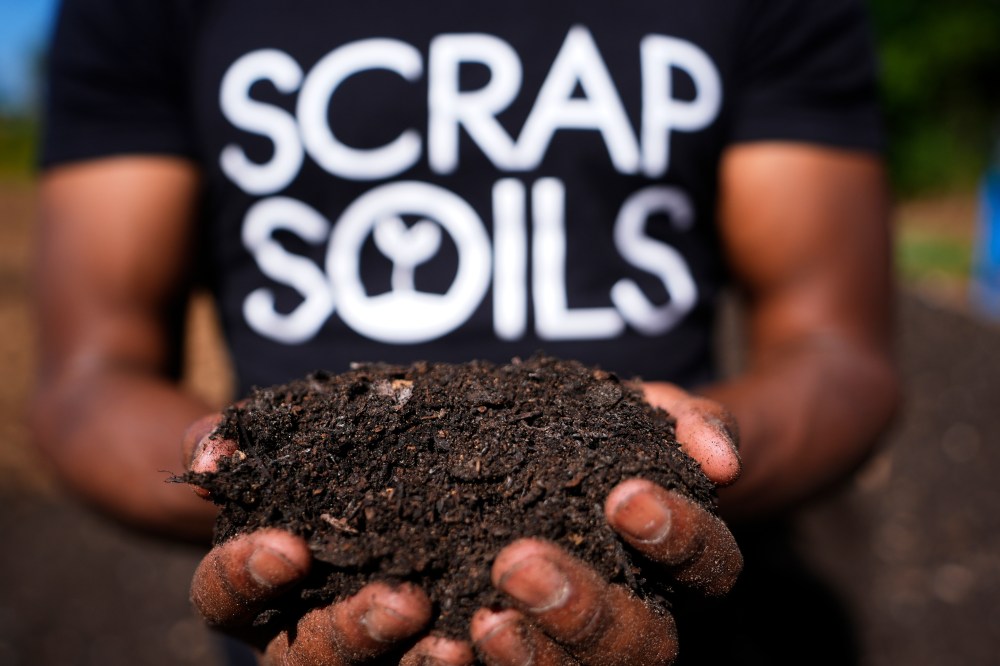
Composting leftover coffee grounds, eggshells, carrot tops and more reduces the amount of food that goes into dumps where it produces the potent greenhouse gas methane. It also ultimately helps create healthy soil for gardeners and urban farmers.
Experts say companies like Scrap Soils are an important part of cleaning up the broader food ecosystem. Emily Cassidy, research associate at climate solutions nonprofit Project Drawdown, said composting offers the dual benefits of reducing landfill methane emissions and, once the composting process is complete, returning nutrients to soil.
“Because methane has such a big impact on the climate in a short amount of time, the more we can reduce methane, it is like pulling the emergency brake on climate change,” Cassidy said.
Beyond mitigating climate change, composting can also improve local food production, she said.
“That’s a way that we can see that we’re benefiting the environment, because we’re taking food and then replenishing the ground with those nutrients,” she said.
Detroit homes and restaurants use the service
Blanding, a 34-year-old native Detroiter, co-launched Scrap Soils in 2020 to play a local part in solving a statewide food waste problem that mirrors what’s happening around the globe. Food waste is a huge source of methane in Michigan landfills, estimates say, and accounts for millions of metric tons of carbon dioxide equivalent emissions in the state.
In Detroit, more than 70 homes and businesses are signed up for Scrap Soils’ weekly pickups. It’s an easier way to compost than making space in one’s backyard or driving to a city drop-off site. Home pickups start at $15 per month, while businesses pay $60 per month or more, depending on volume.
One of those commercial customers is The Grand Porter restaurant in the Southwest neighborhood of Detroit.
“We go through a lot of eggs, so mostly egg scraps, eggshells and the cardboard. We put all of our bread scraps, stale bread scraps, in here,” said Lou Hammer, the restaurant’s executive chef, pointing to a large bin with bags of food waste inside. “Some tomato tops, some avocado skins. Probably a few other things in there, too.”
“It doesn’t take any extra effort,” she said of the pickup service. “This was going to go in a bag anyway. It’s just going to go in a green bag instead.”
Scraps get turned into a rich soil additive
After completing his nine-hour, more than 100-mile (160-kilometer) weekly route, Blanding drops off the waste at Scrap Soils’ partner, Sanctuary Farms in Detroit. There, everything from apple cores to rotted pumpkins to corn husks is composted into a rich soil additive that’s available for purchase.
“Food waste has not only become the problem,” Blanding said, “but it’s also the solution to so many issues in climate change.”
The company ultimately plans to purchase a larger truck, as well as its own property and equipment for composting. It’s fundraising to meet a matching grant through the state.
That hasn’t been without challenges. As Blanding seeks to grow, he’s come up against skepticism that a small team with limited resources can make a big impact. Companies like Scrap Soils also face challenges ranging from gaining visibility to getting people to actually sign up and commit.
At the same time, emphasizing what can and cannot be composted, and how to do it correctly — such as removing produce stickers before putting a peel in the bucket — is key to its success, too.
“The role of a hauler is very important, and education around composting is also very important,” Blanding said.
“Being able to continue to get more engagement and more partnership, those things go far in helping us to expand this tiny effort into something that actually can scale,” he added.
City initiatives are expanding with demand
Despite hurdles, other independent composting programs and companies are expanding. Examples include the Denver Compost Collective, Nashville’s Compost Co. and Compost Now, which operates in Atlanta and the North Carolina cities of Raleigh, Durham and Asheville.
Hundreds of municipal governments oversee food waste pickup or drop-off programs to allow for composting, though a much smaller number than the thousands of ordinary waste programs nationwide, indicating room to grow. A 2023 report by BioCycle, a publication on composting and recycling, identified 400 municipally supported residential food waste collection programs in the country, 230 of which offered curbside pickup.
For many U.S. cities, compost will play a key role in broader climate plans, incentivizing more of them to start investing in it.
Detroit’s climate strategy, for instance, calls for reducing its municipal greenhouse gas emissions by 100% by 2050. Along with accelerating energy efficiency in homes and buildings, and increasing cleaner mobility, one of its strategies to get there is a three-year plan to divert 15% of waste from landfills.
Detroit started its first municipal food scrap drop-off initiative this past year with a single central site. Hundreds of residents registered to participate, filled buckets at home and dropped them off at the city’s site. Scrap Soils was a partner in the city’s educational campaign.
The city plans to expand its efforts by offering drop-off bins in more locations as well as on-site municipal building composting.
“Composting, recycling, those are really easy entryways into sustainability for people, one step that you can do as an individual to support the city’s sustainability goals and goals for our planet,” said Tepfirah Rushdan, Detroit’s director of sustainability. “As we make this transition to different ways of doing all of our systems, including our waste streams, it’s exciting to see people participating.”
___

Alexa St. John is an Associated Press climate reporter. Follow her on X: @alexa_stjohn. Reach her at ast.john@ap.org.
___
Read more of AP’s climate coverage.
___
The Associated Press’ climate and environmental coverage receives financial support from multiple private foundations. AP is solely responsible for all content. Find AP’s standards for working with philanthropies, a list of supporters and funded coverage areas at AP.org.