Champagne problems: Alcohol authorities in Canada warn of holiday liquor shortages

Advertisement

Advertise with us

Canada is facing alcohol shortages ahead of the holidays due to supply chain issues, a situation prompting some provincial liquor authorities to urge customers to shop early — or be prepared to try a new libation.

Read this article for free:


or

Already have an account? Log in here »

To continue reading, please subscribe:

Subscribe and receive a limited-edition Free Press branded hat or tote.

Digital Subscription

One year of digital access for only $205*

  • Enjoy unlimited reading on winnipegfreepress.com
  • Read the E-Edition, our digital replica newspaper
  • Access News Break, our award-winning app
  • Play interactive puzzles

*First annual payment billed as $205.00 + GST for one year. This annual subscription will automatically renew at $233.00 + GST every 52 weeks (10% off the regular annual price of $259.35). Offer available to new and qualified returning subscribers only. Cancel any time.

To continue reading, please subscribe:

Add Free Press access to your Brandon Sun subscription for only an additional

$1 for the first 4 weeks*

  • Enjoy unlimited reading on winnipegfreepress.com
  • Read the E-Edition, our digital replica newspaper
  • Access News Break, our award-winning app
  • Play interactive puzzles
Start now

*Your next Brandon Sun subscription payment will increase by $1.00 and you will be charged $17.95 plus GST for four weeks. After four weeks, your payment will increase to $24.95 plus GST every four weeks.

Hey there, time traveller!
This article was published 11/12/2021 (1716 days ago), so information in it may no longer be current.

Canada is facing alcohol shortages ahead of the holidays due to supply chain issues, a situation prompting some provincial liquor authorities to urge customers to shop early — or be prepared to try a new libation.

Supply chain experts say the inventory crunch stems from issues with production, transportation and demand.

Yet with much of the backlog impacting imported booze, Canadian wineries, distilleries and breweries are encouraging people to buy local.
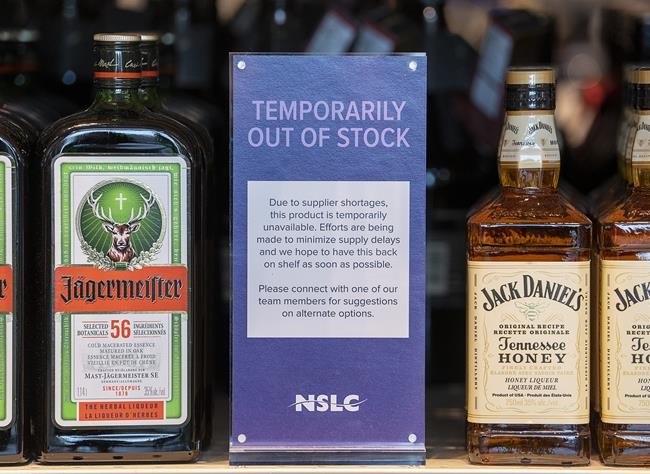
Signage reflecting a product shortage is displayed at the Nova Scotia Liquor Corp. in Halifax on Friday, Dec. 10, 2021. The country is facing alcohol shortages ahead of the holidays due to supply chain issues related to transportation problems, production issues and pandemic-related labour shortages. THE CANADIAN PRESS/Andrew Vaughan

“Our larders are full,” said Carolyn Hurst, chair of the Ontario Craft Wineries and co-owner of Westcott Vineyards. “Every winery in Ontario has lots of product and we’re shipping every day. We have no problem getting our product to store shelves.”

It’s a different story for imported alcohol.

While some types of booze are fully stocked, others varieties are running low or out of stock altogether.

Part of the problem is production. Adverse weather events like fires and droughts have impacted crops in some wine-producing regions.

Labour shortages have also curtailed production of alcohol, especially varieties that are more reliant on manual work.

Production has also been hamstrung by shortages of packaging materials like bottles, screw caps and cans.

“Evolving consumer demand, the availability of raw materials such as glass and aluminum and challenging growing conditions in some areas of the world such as France and New Zealand have impacted some vendors’ production schedules,” Nick Nanos, chief supply chain officer for the Liquor Control Board of Ontario, said in a recent statement.

“We encourage customers to shop early this year for the best selection of gifts and holiday favourites, be flexible about choice, and take the opportunity to try something new.”

Meanwhile, transportation problems are also impacting booze availability.

A global container shortage, congestion in ports and blank sailings — when a cargo vessel skips or cancels a port of call — have all contributed to inventory backlogs.

“Supply dropped off because of production issues and then there was a huge scarcity of transportation infrastructure,” said Saibal Ray, a supply chain management expert and professor in the Bensadoun School of Retail Management at McGill University.

“Wine shipments are even more problematic because they require temperature-controlled containers.”

Even once imported liquor arrives in Canada, flooding in British Columbia has curbed road shipping along major trade routes, with Australian and New Zealand wines particularly impacted.

Meanwhile, a pandemic-fuelled rise in demand has only worsened the industry’s transportation and production challenges.

Research published last month in the medical journal JAMA Network Open said sales of alcohol soared during the pandemic.

The study found alcohol sales in Canada surpassed pre-pandemic estimates over a 16-month period of the pandemic by 5.5 per cent or $1.86 billion.

One example of an unexpected rise in demand was champagne sales in New Brunswick.

The province recorded an unexpected boom in champagne and sparkling wine sales during the latter half of the pandemic, New Brunswick Liquor Corp. spokeswoman Marie-Andrée Bolduc said.

“This unprecedented increase in demand has unfortunately left us in a situation where we will likely be out of some of our most popular champagnes in the lead up to Christmas,” she said in an email.

French brands Veuve Clicquot and Moet & Chandon will be hard to come by in the province, Bolduc said.

The increase in pandemic-era alcohol sales coupled with the usual holiday bump in sales could leave store shelves bereft of some products.

In Nova Scotia, liquor store shelves are already running low on champagnes, scotches, U.S.-produced whisky and some wines from New Zealand, Chile and Argentina.

“We do have … signs on shelves where we are experiencing shortages that tell customers that the product is temporarily out of stock due to supply shortages,” said Beverley Ware, a spokeswoman for the Nova Scotia Liquor Corp. “We recommend alternatives that they can purchase.”

While some products aren’t available at all, she said in other cases it may be as simple as recommending a different package size — a can as opposed to a bottle or a 12-pack rather than a six-pack.

Saskatchewan is also experiencing alcohol supply chain issues, but continues to have a high availability rate of 96 per cent for the top 500 products sold in the province, said David Morris, a spokesman with the Saskatchewan Liquor & Gaming Authority.

“The main impact has been on products imported through the ports in Vancouver,” he said in an email, noting that wine from Australia, New Zealand and South American countries have been most affected.

“Although there are some products currently impacted, customers shopping in both private and public retail stores across the province will continue to have access to a wide variety of beverage alcohol products throughout the busy holiday season.”

– With files from Keith Doucette.

This report by The Canadian Press was first published Dec. 11, 2021.
Report Error Submit a Tip

More Stories

City inundated with thousands of complaints after launch of new transit system

Morgan Modjeski 11 minute read Preview

City inundated with thousands of complaints after launch of new transit system

Morgan Modjeski 11 minute read Friday, Aug. 21, 2026

Despite complaints from thousands of dissatisfied users, Winnipeg hasn't hit the brakes on the rollout of its new primary transit network. And it appears that ignoring the public response cost Winnipeg Transit millions of dollars in lost revenue and ridership.

Read
Friday, Aug. 21, 2026

‘Strong sense of unity’

By Melissa Martin 6 minute read Preview

‘Strong sense of unity’

By Melissa Martin 6 minute read Yesterday at 5:14 PM CDT

Manitoba government and business leaders are rallying behind Prime Minister Mark Carney’s plan to fight back, after a sudden collapse of trade talks between the U.S. and Canada sparked a new salvo of U.S. tariffs on some Canadian goods.

On Saturday, after Carney vowed to respond with retaliatory tariffs, Manitoba premier Wab Kinew said his government stood “100 per cent” behind the prime minister’s plan to respond to what Kinew called U.S. president Donald Trump’s “unjustified and immoral” tariffs.

“History will not be kind to Donald Trump, so we should never appease him,” Kinew said. “We should fight back, which is what Canada is doing today.”

Kinew met reporters for a brief news conference at the legislature on Saturday afternoon, about an hour after finishing a call with Carney and the other premiers. There was a “really strong sense of unity” on that call, Kinew said, and emphasized that he backs the federal decision to “walk away from what would have been a bad deal.”

Read
Yesterday at 5:14 PM CDT

Frustration mounts as drug raids sweep problems out of downtown, into West End

Scott Billeck 7 minute read Preview

Frustration mounts as drug raids sweep problems out of downtown, into West End

Scott Billeck 7 minute read Friday, Aug. 21, 2026

West End business owners say their neighbourhood has been under siege for months, and some believe downtown police drug sweeps have made things worse by pushing more street disorder in their direction — and pushing customers away.

Read
Friday, Aug. 21, 2026

Quick quotes: Here’s what people are saying about the Canada-U.S. trade negotiations

Catherine Morrison and David Baxter, The Canadian Press 10 minute read Preview

Quick quotes: Here’s what people are saying about the Canada-U.S. trade negotiations

Catherine Morrison and David Baxter, The Canadian Press 10 minute read Updated: Yesterday at 8:04 PM CDT

OTTAWA - The United States imposed 50 per cent tariffs on billions of dollars worth of Canadian exports Saturday, after the two countries failed to reach a new trade deal before an extended deadline imposed by President Donald Trump earlier in the week.

In response, Prime Minister Mark Carney announced Canada will retaliate with matching dollar-for-dollar tariffs. Carney also suspended talks with the United States and summoned his negotiators back to Ottawa.

Here's what people are saying in response: 

——— 

Read
Updated: Yesterday at 8:04 PM CDT

Canada vows dollar-for-dollar tariff retaliation, suspends trade talks with U.S.

Catherine Morrison, The Canadian Press 7 minute read Preview

Canada vows dollar-for-dollar tariff retaliation, suspends trade talks with U.S.

Catherine Morrison, The Canadian Press 7 minute read Updated: Yesterday at 8:27 AM CDT

OTTAWA - A last-ditch effort to reach a new trade deal before a midnight tariff deadline failed Friday, as Prime Minister Mark Carney suspended talks with the United States and summoned his negotiators back to Ottawa.

The decision meant new 50 per cent tariffs on billions of dollars in Canadian exports to the U.S. took effect at 12:01 a.m., and Carney vowed Canada would retaliate with equal measures of its own.

"In recent weeks, we made important progress toward improving Canada's position as having the best deal in the world with the U.S.," Carney said in a statement just before Trump's tariff deadline.

"However, that progress has not been enough to meet our objectives for Canadians."

Read
Updated: Yesterday at 8:27 AM CDT

Plenty of alternatives to U.S. wines on the shelves

Ben Sigurdson 5 minute read Preview

Plenty of alternatives to U.S. wines on the shelves

Ben Sigurdson 5 minute read Yesterday at 6:00 AM CDT

In February 2025, Manitoba (and most other provinces) pulled American liquor from store shelves as part of the ongoing trade dispute with the United States.

Then in December, the province followed a similar course to others and put American booze that was already on hand back on shelves, selling off inventory that had been wasting away in warehouses for months, and directing proceeds from those sales to charities.

Lineups sprung up at numerous stores as consumers snapped up bestselling American products — think Maker’s Mark, Jack Daniel’s, Apothic Red and the like. After that initial rush, what was left has been languishing on shelves ever since, with many products eventually being drastically discounted for a quick sale, lest they become too long in the tooth.

I decided early on not to write about/review U.S. products in this space until things were well and truly sorted. But a few months back, I found myself in the mood for a big, oaky red wine and — in a moment of weakness, or nostalgia, or maybe just curiosity — I picked up a $30-ish California Cabernet Sauvignon.

Read
Yesterday at 6:00 AM CDT