Cooking with conscience
Winnipeg chef a big proponent of ethics, social responsibility in the kitchen

Advertisement
Read this article for free:
or
Already have an account? Log in here »
To continue reading, please subscribe:

Digital Subscription
One year of digital access for only $205*
- Enjoy unlimited reading on winnipegfreepress.com
- Read the E-Edition, our digital replica newspaper
- Access News Break, our award-winning app
- Play interactive puzzles
*First annual payment billed as $205.00 + GST for one year. This annual subscription will automatically renew at $233.00 + GST every 52 weeks (10% off the regular annual price of $259.35). Offer available to new and qualified returning subscribers only. Cancel any time.
To continue reading, please subscribe:
Add Free Press access to your Brandon Sun subscription for only an additional
$1 for the first 4 weeks*
- Enjoy unlimited reading on winnipegfreepress.com
- Read the E-Edition, our digital replica newspaper
- Access News Break, our award-winning app
- Play interactive puzzles
*Your next Brandon Sun subscription payment will increase by $1.00 and you will be charged $17.95 plus GST for four weeks. After four weeks, your payment will increase to $24.95 plus GST every four weeks.
Read unlimited articles for free today:
or
Already have an account? Log in here »
Hey there, time traveller!
This article was published 05/10/2017 (3273 days ago), so information in it may no longer be current.
Some people call Ben Kramer a pioneer. Others probably refer to him as a pain in the butt.
The Regina-born chef is happy with either designation. Kramer, who moved to Vancouver when he was 11 and went to culinary school at Vancouver Community College after high school, came to Winnipeg in 2000 (”I was chasing a girl,” he says) and quickly developed a reputation as a chef with a social conscience and a single-minded dedication to cooking outside the factory-farm system.
Dandelion Eatery, his first local venture, focused on organic fare and offered vegetarian and vegan options. He went on to gut the University of Winnipeg’s food system, creating Diversity Food Services, which aimed to provide students with tasty, nutritious cafeteria meals that relied on fresh, local ingredients.
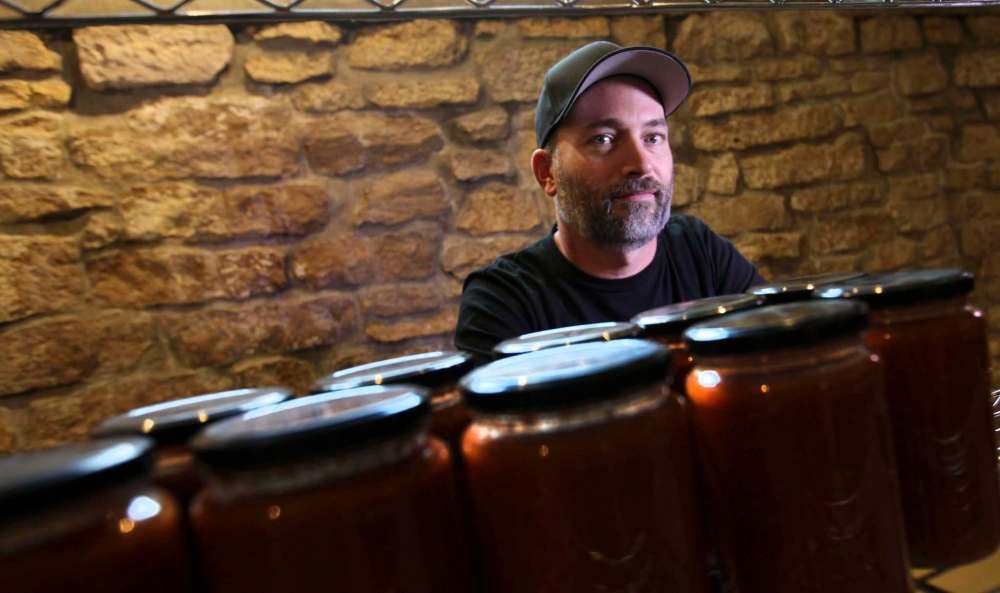
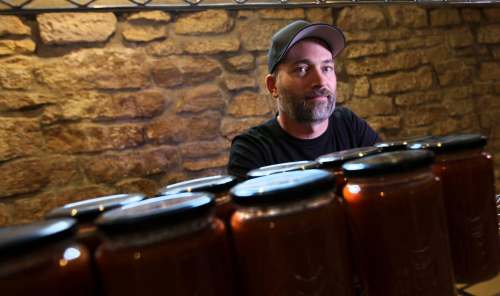
The chef then took his food-from-scratch approach to Elements in the university’s Richardson School for Environment and Science, the first public fine-dining restaurant operated by a post-secondary institution in Canada.
“I’ve always had a social bent to my food, from an early age, especially moving here from Vancouver,” Kramer says of his passion for sustainable practices and farm-to-table food. “There wasn’t a lot going on locally that kind of fit the way I grew up cooking. So I spent a lot of years cultivating that here and making those connections… when you’re dealing directly with farmers and with producers, there’s a social aspect that just comes out. When you’re talking about animal husbandry or organic producing or trying to fight ridiculous regulations that the government imposes on (farmers), the social aspect, you can’t ignore it the same way you can when you’re not involved in the food system.”
A 2011 Globe and Mail article credited Kramer’s work at U of W with revolutionizing Winnipeg’s food scene, saying, “The school’s buying power has persuaded suppliers to finally provide sustainable, organic products to the city, once deemed too small a market to justify such deliveries.”
Though the idea of locally sourced food is far more widespread now, Kramer — who left U of W two years ago to focus on his custom catering business — says there are still battles to be fought.
“My role has become a lot more political. Whereas 10 years ago I was trying to find ethical seafood — Ocean Wise wasn’t here — now I find I’m spending more time dealing with things on a Minister of Agriculture level than trying to carve a trail. But lot of that trailblazing really came from, ‘This is the only way I want to cook. I’m living here, there aren’t those opportunities, so let’s make our own.’”
Jill Wilson: Do you come from a foodie family?
Ben Kramer: Oh, yeah, my parents liked to cook at home, cooked from scratch. We had a garden growing up, although that changed when we moved to Vancouver because you can’t afford land, you can only afford buildings. When they went to eat out and dragged me along; it was often to places they wanted to eat, not places I wanted to eat… When my friends were going to Disneyland, we went to France and did wine-tasting tours, when I was too young to appreciate it. But I developed a palate and appreciation for food.
Jill: What would you say is your signature dish?
Ben: I definitely don’t have one. I’m ingredient-driven, so it’s what’s fresh and what’s local. I’m not trying to impose my style of cooking on the food; it’s very much the other way around.
Jill Wilson: Is there a food you’re not really fond of?
Ben: I don’t eat a ton of organ meat, which most chefs do. I don’t eat a ton of shellfish. I grew up vegetarian; I didn’t eat meat until I went to cooking school. I’ll try ‘em, but having brain or liver or kidney on the menu is not my go-to.
Jill: Is there an ingredient that you’d like to make more popular?
Ben Kramer: I’m a big fan of game meat. And being in Manitoba as long as I have, I love beets. People are scared of them — they don’t know what to do with them and they’re really messy.
Jill: What do you cook for your kids (Kramer has a son and a daughter) that they really enjoy?
Ben: We eat a lot of tacos at home; we do a build-your-own thing where we do as many toppings as we feel like and we have at ‘er.
Jill Wilson: Is there something that’s always in your fridge or pantry?
Ben: There’s always Frank’s Red Hot sauce in my fridge because of my daughter. She’s obsessed with it. In my pantry, I’ve always got apple cider vinegar. My fridge is pretty empty, though; it’s mostly fresh produce. Well, and beer (laughs).
Jill: What’s your favourite beer?
Ben: There’s very little beer that I don’t like. There’s a beer out of Victoria called Fat Tug (an IPA from Driftwood Brewery) that I’m into right now and I’m a big fan of Estrella in the bottle (Damm Inedit, a witbier from Spain).
Jill: What meal would you make to impress a date?
Ben Kramer: Probably gnocchi. It’s one of the first things I learned how to make as a professional. I made a ton of it at a young age and I can make it in my sleep now. If I was nervous and trying to impress, I would pull that one out.
Jill: You seem like a someone who doesn’t really have a fast-food guilty pleasure.
Ben: I come across as a really healthy eater, but I’ll hit McDonald’s now and again. I like really crappy tacos, like Taco Bell, Taco Time. Lots of pizza. It’s all about balance!

Jill: What’s your proudest moment as a chef?
Ben Kramer: We had a conflict with a marketing board a number of years ago. They were doing some unfair things to farmers and we came together as a group and started a coalition (growers and independent food retailers) and tried to reason with them. Then we had a campaign to change legislation. They made it so farmers couldn’t sell potatoes directly (to restaurants and stores). I couldn’t get organic potatoes because this board had no interest, so to get them, I had to go to B.C., and get Manitoba potatoes that were shipped to B.C and then shipped back. We took them to task and won, so the potato battle was a big one for me.
jill.wilson@freepress.mb.ca
Twitter: @dedaumier
Jill Wilson is the editor of the Arts & Life section. A born and bred Winnipegger, she graduated from the University of Winnipeg and worked at Stylus magazine, the Winnipeg Sun and Uptown before joining the Free Press in 2003. Read more about Jill.
Jill oversees the team that publishes news and analysis about art, entertainment and culture in Manitoba. It’s part of the Free Press‘s tradition, since 1872, of producing reliable independent journalism. Read more about Free Press’s history and mandate, and learn how our newsroom operates.
Our newsroom depends on a growing audience of readers to power our journalism. If you are not a paid reader, please consider becoming a subscriber.
Our newsroom depends on its audience of readers to power our journalism. Thank you for your support.
Chef’s Table

Change tastes good
When Restaurants for Change, which raises money for healthy food systems and programs across Canada, launched in 2014, Ben Kramer was the first Winnipeg chef on board.
The annual fundraiser is a one-night affair where all the proceeds from a restaurant’s dinner service go to a local community food centre.
Nick Saul, the president of Community Food Centres Canada, which organizes the fundraiser, had heard of Kramer’s dedication to sustainable, local ingredients. He asked him to join the campaign and recommend other Winnipeg restaurants with a similar commitment.
“Rather than sending out blanket emails to a bunch of restaurants, he asked, ‘Who’s doing the right thing, because we want quality, not quantity?’” Kramer recalls.
“Which to me was revolutionary, because most people, if you’re doing a fundraiser, you don’t care. ‘Give me all the restaurants, let’s make all the money.’”
“He was more like, let’s find some restaurants whose values align. In the first year, there was just two of us, Mandel (Hitzer) from deer + almond and myself.”
This year, Winnipeg has six participating restaurants: Kramer’s pop-up at Kitchen Sync, Chew, Forth, Promenade Wine Cafe, King + Bannatyne and Deer + Almond. Locally, the proceeds of the Restaurants for Change evening will go to NorWest Co-op Community Food Centre. The centre provides access to healthy food, information about cooking and gardening, and community workshops, such as an After-School Smoothie Drop-In for kids, free community lunch program, a Filipino family cooking group, Living Well with Diabetes cooking group and a Healthy Baby group.
NorWest Co-op is the local branch of Community Food Centres Canada, which helps provide resources to communities to access healthy meals in a way that goes beyond food banks.
“(Community Food Centres) took a model that I don’t want to say is broken, because there’s always a need for handouts, too, but a model that was maybe flawed,” Kramer says.
“Nick Saul was working at food-bank-style (place), getting frustrated with not having what he needed: ‘Here’s a bunch of licorice for breakfast because that’s all we have.’
“They started this idea that just because you need lunch or need some training or something to get out of the cycle of poverty, that doesn’t mean you can’t do it with dignity.
“The model they did in Toronto is unbelievable, serving the same quality of food that you’d get at fancy restaurant, and they’re doing local, they’re doing organic and it works. (Saul is) trying to spread that across Canada and that’s where NorWest comes in. It’s not just feeding people, it’s not just teaching them. They’re not lined up like at a cafeteria. It’s a holistic look at how we can help as opposed to a Band-Aid on a wound.”
Restaurants for Change takes place Wednesday, Oct. 18, with more than 90 restaurants in 19 Canadian cities participating. See www.restaurantsforchange.ca for reservations and more information. To find out more about NorWest Co-op, go to norwestcoop.ca.

A four-course brunch and tunes
Chef Ben Kramer is also participating in the Winnipeg Free Press Sunday Brunch Collective series, for which he will be creating a special four-course brunch menu with fresh local ingredients. As the courses roll out, you’ll be treated to an opening set by Winnipeg Folk Festival Young Performer Mika-Dawn. During dessert, you’ll get a headlining set from Justin Lacroix.
The next Sunday Brunch Collective takes place on Sunday, Oct. 15 at Kitchen Sync (370 Donald St.). Tickets are $49, available at winnipegfreepress.com/sbc
Wait, there’s more: Mark your calendar for the rest of the series, too, which also feature a four-course brunch by Kramer:
Sunday, Nov. 19: Don Amero (opening set by Katie MacDonald)
Sunday, Dec. 17: Nation of Two opening set by Nic Dyson)
Jill Wilson is the editor of the Arts & Life section. A born and bred Winnipegger, she graduated from the University of Winnipeg and worked at Stylus magazine, the Winnipeg Sun and Uptown before joining the Free Press in 2003. Read more about Jill.
Jill oversees the team that publishes news and analysis about art, entertainment and culture in Manitoba. It’s part of the Free Press‘s tradition, since 1872, of producing reliable independent journalism. Read more about Free Press’s history and mandate, and learn how our newsroom operates.
Our newsroom depends on a growing audience of readers to power our journalism. If you are not a paid reader, please consider becoming a subscriber.
Our newsroom depends on its audience of readers to power our journalism. Thank you for your support.
Advertisement Advertise With Us
Advertisement Advertise With Us