Hero priest of Majdanek
Fearless man of God has multiple Manitoba connections
Advertisement
Read this article for free:
or
Already have an account? Log in here »
To continue reading, please subscribe:

Digital Subscription
One year of digital access for only $205*
- Enjoy unlimited reading on winnipegfreepress.com
- Read the E-Edition, our digital replica newspaper
- Access News Break, our award-winning app
- Play interactive puzzles
*First annual payment billed as $205.00 + GST for one year. This annual subscription will automatically renew at $233.00 + GST every 52 weeks (10% off the regular annual price of $259.35). Offer available to new and qualified returning subscribers only. Cancel any time.
To continue reading, please subscribe:
Add Free Press access to your Brandon Sun subscription for only an additional
$1 for the first 4 weeks*
- Enjoy unlimited reading on winnipegfreepress.com
- Read the E-Edition, our digital replica newspaper
- Access News Break, our award-winning app
- Play interactive puzzles
*Your next Brandon Sun subscription payment will increase by $1.00 and you will be charged $17.95 plus GST for four weeks. After four weeks, your payment will increase to $24.95 plus GST every four weeks.
Read unlimited articles for free today:
or
Already have an account? Log in here »
Hey there, time traveller!
This article was published 20/09/2009 (6229 days ago), so information in it may no longer be current.
COOK’S CREEK — Stop helping the Jews! a Nazi commander in German-occupied Western Ukraine warned Father Emilian Kowcz.
Kowcz, a Ukrainian Catholic priest, was a tall man, a strong man, a leader among both religious and secular people, whose reputation for championing the rights of the poor and persecuted had spread far beyond his parish.
No, replied Kowcz, who has several connections to Manitoba. He would not stop helping. That help had included hiding Jews in his home.
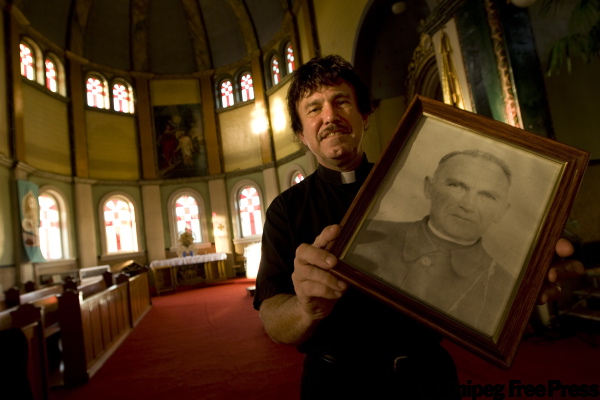
"At the front, you have to shoot; otherwise you are a deserter," Kowcz (pronounced coach) told German authorities, according to family members. "I’m a priest, and I have to fight for survival of my people, and this is my front."
His daughter, in a recent Polish documentary directed by Grzegorz Linkowski, recalled the last time she saw her father. It was 1942. Gestapo officers came to their house. "Dad dressed and said he was going out. I shouted, ‘Wait. Dinner is ready.’"
"We are going for a moment to explain something in the office," one of the Gestapo men said. That office turned out to be the concentration camp Majdanek in Poland. Majdanek was smaller than Auschwitz, the more famous German concentration camp inside Poland, but just as inhumane and horrific with Nazi instruments of death like gas chambers and ovens.
Kowcz’s crime? He baptized thousands of Jews in the Ukrainian city of Przemyslany. The city is in Ukraine’s Galicia province, where many Manitoba Ukrainians trace their ancestry. Those Jews were then able to use their baptismal certificates to deny they were Jewish in attempts to escape the Nazis.
Kowcz initially baptized one Jew at a time. But the need became so great that reports say he staged a mass baptism for up to 1,000 at once.
Details about Father Emilian Kowcz’s works during the Second World War are still surfacing. Because the Soviet Union re-took Ukraine after the war, the story was suppressed and much of the evidence destroyed as the Soviets closed Ukraine’s churches.
Darcia Senft, with the Law Society of Manitoba, wants more done to publicize the story. "In the Ukrainian church, I don’t know if we do enough to recognize our own wonderful clergy. This man’s story goes above and beyond almost anything else," she said.
Senft began her own research to have Israel recognize Kowcz as one of its "righteous among the nations," an honour recognizing non-Jews who risk their lives to save Jews, and to have him memorialized at Yad Vashem, the Holocaust memorial in Jerusalem. She and husband Gary Senft, also a lawyer, have suggested to Gail Asper informally that Kowcz be considered in the future Canadian Museum of Human Rights.
The Jewish Federation of Winnipeg is involved, too. In the summer of 2008, the federation’s community relations director, Shelley Faintuch, carried documents from Senft to Israel to Yad Vashem, which investigates candidates for "the righteous among the nations" — non-Jews like the celebrated Oskar Schindler who risked their lives to save Jews from the Nazis.
Obtaining the honour will be difficult because living testimonies are required, and Holocaust survivors are growing scarce with time. "This is very late in the day. Nevertheless, there are those of us who insist that recognition is needed where recognition is deserved," Faintuch said.
Manitoba has several other connections to the Kowcz story. His grandson is Father Taras Kowch, or Father Taras, as parishioners like Darcia Senft call him, the parish priest of the Ukrainian Immaculate Conception Church at Cook’s Creek, 35 kilometres east of Winnipeg.
(Ukrainian Catholic priests can marry, which explains how Emilian Kowcz has grandchildren. Meanwhile, Father Taras changed his name to Kowch because people in Detroit, where he grew up after his parents escaped Soviet-controlled Ukraine, kept pronouncing his last name as ‘cowz.’)
Ironically, Father Taras’s father, Myron, also a priest, almost took over the same Cook’s Creek parish in the 1960s. Myron Kowcz, a pharmacist before he fled Ukraine, also became the first married man to be ordained a Ukrainian Catholic priest in Canada. There was great resistance to ordaining married men out of respect for the Roman Catholic church, which upholds celibacy among its priests and which helped Ukrainian Catholics become established in Canada.
The ordaining of the first married priest was very hush-hush. It took place at the Ukrainian Catholic Blessed Virgin Mary Church on Boyd Avenue in Winnipeg’s North End in 1964.
Which is another Winnipeg connection. Father Roman Dobrianski, who later presided at the Boyd Avenue church, was Father Emilian Kowcz’s brother-in-law from Ukraine. That’s how Father Taras first came to Winnipeg. He came to visit his great uncle in 1984. At the time, Taras was planning on becoming a celibate priest. Then he went to a Ukrainian New Year’s dance with cousins and met Marika Tracz. Any ideas of celibacy flew out the window. The couple were married six months later.
In 1997, Taras became the second Ukrainian Catholic priest ordained in Canada — 33 years after his father — and was ordained at the same Boyd Avenue church. "I had to fight for it," he said. In the past dozen years, ordaining married men as priests has become more common among Ukrainian Catholics in Canada.
In 1998, Father Taras became priest of Cook’s Creek church. He is also a chaplain at the Health Sciences Centre in Winnipeg.
The sacrifice to save Jews by his grandfather, Father Kowcz, born in Ukraine in 1894, was consistent with Father Kowcz’s character his entire life. When Poland controlled western Ukraine, his house was searched 40 times and he was fined and imprisoned for his outspoken defence of the rights of fellow Ukrainians.
When Stalin-led Russia took control of the region and shipped tens of thousands of Poles to Siberian gulags, Kowcz defended the Poles and supported their widows and their children. That also landed him in prison.
As a narrator says in The Parish Priest of Majdanek, the Polish documentary: "When the Poles ruled, he stood up for Ukrainians. When the Soviets ruled, he stood up for the Poles. When the Germans arrived, he stood up for Jews." Kowcz also sent his children into the Jewish ghetto to hand out food.
He was never concerned with whether the Jews he baptized really wanted to become Catholics, said grandson Father Taras. "He said, ‘Am I the judge of the human soul? Only God is the judge of the human soul.’"
Holocaust survivor Rubin Pezim, in a telephone interview from West Orange, N.J., where he lives, remembered being about nine or 10 years old and visiting Father Kowcz with his mother and sister in the city of Przemyslany.
"We went at night. There was an agreement. He spoke a few words and gave us the documents (baptismal certificates)," said Pezim. "He was a super human being."
The baptismal papers wouldn’t get a Jew past a German border guard, he said. But they could help where people or officials were willing to look the other way.
In the case of Pezim’s family, they used the papers to provide cover for gentile families who hid them. The families could then say they didn’t realize they were protecting Jews.
This was important because gentiles caught sheltering Jews in Poland and Ukraine were put to death, Pezim said. "Don’t make it out that hiding Jews was a simple thing. It was a very dangerous thing to do," he said.
Several gentile families hid the Pezim family members, one for as long as two months, others for weeks. Pezim, his mother and sister Ida eventually lived in the woods 25 kilometres from Przemyslany for a year before the liberation, when the Soviet Union re-took control of Ukraine.
They were the only ones in his family who made it out alive. His father, other siblings, aunts, uncles and grandparents, all perished.
Kowcz is estimated to have baptized from 5,000 to 10,000 people. Pezim doesn’t know how many may have survived, and there is no record. "I know he helped a lot of other people," he said. "Some of them survived. The majority of them were killed. The paper was not a guarantee of life."
Pezim has written a letter to Yad Vashem detailing Kowcz’s sacrifice, after Darcia Senft tracked him down.
One final note. After three or four months in the concentration camp, the Nazis gave Kowcz a choice.
"He was taken into a room and they were going to release him. They said, ‘We’re going to release you — on one condition,’" said grandson Father Taras. That condition was that Kowcz stop performing baptisms, particularly of Jews. He refused.
The camp was comprised of large numbers of Jews but also Ukrainians, Poles, Lithuanians, Estonians and others. Kowcz spent his time giving comfort to people and performing last rites before prisoners were put to death. "Yesterday, 50 people were shot. If I weren’t here, who’d help them to cross the threshold?" he wrote in a letter smuggled out of the camp.
Kowcz was already 60 by that time and his health gave out. He became sick with an untreated stomach ailment and after a period could no longer walk.
He died in March 1944. He was burned in a gas oven. "Some say he was still alive. The dead and nearly dead were thrown in the gas ovens," said Father Taras.
In 2001, Pope John Paul II’s announced beatification for Fr. Kowcz. He is one miracle short of being proclaimed a saint.
At the Majdanek Museum in Lublin, Poland, where he died, a ceremony was held earlier this year to mark the 65th anniversary of his death. A large crowd of Poles and Ukrainians attended.
At the ceremony, a memorial tablet to Father Emilian Kowcz was unveiled, inscribed with his words found in a letter written from the extermination camp: "… Here I see God, God who is the same for us all, independent of our religious differences."
bill.redekop@freepress.mb.ca