Sea slug sustains self with photosynthesis

Advertisement

Advertise with us

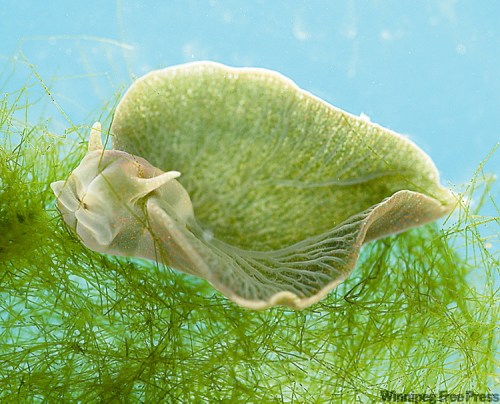
A green sea slug that inhabits the saltwater marshes of Eastern Canada is being hailed as the first animal to feed itself using photosynthesis, the sunlight-derived energy source that sustains plants.

Read this article for free:


or

Already have an account? Log in here »

To continue reading, please subscribe:

Subscribe and receive a limited-edition Free Press branded hat or tote.

Digital Subscription

One year of digital access for only $205*

  • Enjoy unlimited reading on winnipegfreepress.com
  • Read the E-Edition, our digital replica newspaper
  • Access News Break, our award-winning app
  • Play interactive puzzles

*First annual payment billed as $205.00 + GST for one year. This annual subscription will automatically renew at $233.00 + GST every 52 weeks (10% off the regular annual price of $259.35). Offer available to new and qualified returning subscribers only. Cancel any time.

To continue reading, please subscribe:

Add Free Press access to your Brandon Sun subscription for only an additional

$1 for the first 4 weeks*

  • Enjoy unlimited reading on winnipegfreepress.com
  • Read the E-Edition, our digital replica newspaper
  • Access News Break, our award-winning app
  • Play interactive puzzles
Start now

*Your next Brandon Sun subscription payment will increase by $1.00 and you will be charged $17.95 plus GST for four weeks. After four weeks, your payment will increase to $24.95 plus GST every four weeks.

Hey there, time traveller!
This article was published 26/01/2010 (6046 days ago), so information in it may no longer be current.

A green sea slug that inhabits the saltwater marshes of Eastern Canada is being hailed as the first animal to feed itself using photosynthesis, the sunlight-derived energy source that sustains plants.

Research led by University of Florida biologist Sidney Pierce shows the emerald marine creature Elysia chlorotica — which shares North Atlantic coastal habitats with a species of algae called Vaucheria litorea — has evolved, over countless millennia, to absorb some of the plant’s photosynthesis-enabling genes into its own DNA.

The solar-powered mollusk, about three centimetres long, even looks like a small leaf. Early in life, each slug ingests key chlorophyll-producing cells from the algae in its environment. But the slug’s own built-in photosynthesis functions kick in after that, sustaining it for the rest of its life cycle of about one year.

CANWEST NEWS SERVICE
A green sea slug has evolved to absorb a plant’s genes into its DNA.
CANWEST NEWS SERVICE A green sea slug has evolved to absorb a plant’s genes into its DNA.

"Those genes are already there, in the slug, and transferred from generation to generation," Pierce told Canwest News Service on Monday. While survival by photosynthesis is a defining trait in the plant kingdom, "that’s exactly what this slug does."

Noting that gene transfer between microscopic, unicellular organisms is known to occur, Pierce points out that "the most significant part of this is that genes have been transferred between two multicellular species. This is the first discovery of that happening."

Pierce outlined his research at a scientific conference earlier this month, and the detailed findings are to be published in an upcoming issue of the biology journal Symbiosis.

In 2007, the journal published a Pierce-led study that first indicated the possibility these sea slugs were surviving by photosynthesis. A study by another group of U.S. researchers, published in 2008 in the Proceedings of the National Academy of Sciences, bolstered the theory.

Now, said Pierce, his findings indicate the slug acquired "many, many" algae genes, so that the plant’s photosynthesizing structures have essentially been replicated within the animal’s own genetic code.


— Canwest News Service

 

Report Error Submit a Tip

More Stories

Corroded Arlington overpass yields way for new hope of spanning urban chasm

Melissa Martin 6 minute read Preview

Corroded Arlington overpass yields way for new hope of spanning urban chasm

Melissa Martin 6 minute read Yesterday at 2:00 AM CDT

It’s an interesting quirk of timing, perhaps, that the end of two of Winnipeg’s most unlovely features are coming into view in the same few weeks. The rail lines that split the city in half, and the bridge that was built to tie it back together. The original problem, and the solution.

And in the confluence of those two ends, we have an opportunity to dream of what a better Winnipeg can be.

At a news conference on Wednesday, former federal transport minister Lloyd Axworthy laid out a vision for a rail line bypass that would remove more than 120 railway crossings from Winnipeg, route them through Crown and Manitoba Hydro corridor land south of the city, and reclaim 250 acres in the urban core for greenspace and development.

The next step is to focus on how to make it happen. Nothing of this scope comes easy. This new bypass plan emerged from a two-year feasibility study that Premier Wab Kinew had tasked Axworthy with back in 2024. Now, Axworthy will helm a new 90-day feasibility study zooming in on that route specifically.

Read
Yesterday at 2:00 AM CDT

Ratcheting up heat can lead to cold feet

Maureen Scurfield 5 minute read Yesterday at 2:00 AM CDT

DEAR MISS LONELYHEARTS: I came home early from my family’s beautiful lake cottage with my heart broken in pieces. I’d taken my new love out there and he seemed so happy to go with me. Friends of mine at the lake helped by offering me their romantic cabin while they were away on a road trip.

After two days of bliss on the beach, walking the sandy shores at twilight, plus some great lovemaking, our trip felt absolutely magical to me. It was like the honeymoon I hope to have with him someday. I happily told my guy that over breakfast in the morning. His face fell.

He went out right away for a “long run,” and then he went again for a second one right after lunch. He didn’t come back for many hours, so I finally went down to the kiosks at the beach at 5 p.m. looking for him, asking if anyone had seen my guy.

One guy said, “Yeah, he was with your other visitor today — the red-headed girl.” I’d had no other visitor. I suddenly realized he must have met another woman at the beach, and passed her off as my friend. I just lost it!

RCMP searching for missing 34-year-old woman

1 minute read Yesterday at 6:29 PM CDT

Police are asking for the public’s help locating a 34-year-old woman last heard from almost a week ago.

Tamara Stevens, who also goes by Tammy, was last heard from on Sunday last weekend and was reported missing Tuesday morning, said a Thompson RCMP news release Saturday.

RCMP and family are worried for her well-being.

Stevens is believed to be in Thompson and is described as 5'7, with a slender build and long red hair, said RCMP. She also has a piercing on her lip and was last seen wearing black T-Shirt featuring the Twilight character Jacob, pants and work boots.

Manitoba family finalist for cattle producers environmental award

Aaron Epp 4 minute read Preview

Manitoba family finalist for cattle producers environmental award

Aaron Epp 4 minute read Yesterday at 2:00 AM CDT

A family in western Manitoba is one of seven finalists for a national environmental award honouring beef cattle producers.

Connor and Kyla English, alongside Connor’s parents, Brian and Leanne English, are nominated for the Canadian Cattle Association’s Environmental Stewardship Award. The 30-year-old award is presented to beef farmers and ranchers who explore innovative ways to protect, preserve and enhance their operations and the environment simultaneously.

This year’s recipient will be announced on Wednesday during a banquet at the Canadian Beef Industry Conference in Winnipeg.

The English family’s roots near Bradwardine — about 265 kilometres west of Winnipeg — date back to 1898. Today, Connor, Kyla, Brian and Leanne manage a herd of about 320 breeding cows on nearly 445 hectares (1,100 acres) of owned and rented pasture and forage land.

Read
Yesterday at 2:00 AM CDT

Don’t be a big loser — check out Real Love Summer Fest ReunionBig Loser takes the stage at 8:20 p.m. tonight as part of the Real Love Summer Fest Reunion, a one-day event put on by the indie promotion company, which ran the festival in the Interlake area for a decade until last summer’s final edition near Teulon.

Bookers Gil Carroll and Adam Soloway have programmed a full day of music at Blue Note Park (220 Main St.), the outdoor venue adjacent to Times Change(d) High and Lonesome Club.

First up at 4 p.m. is folk-rock songwriter tofusmell, followed at 5 p.m. with a rare performance by indie-songwriting darlings Animal Teeth, a group with several summer fest bills under its belt. Up-and-coming pop-rockers Synthetic Friend take the stage at 6, followed at 7 by the fun electronic dance pop of French Class.

After playing with his full band at last month’s Winnipeg Folk Festival, Amos the Kid will perform a solo set at 8 p.m. Sans band, the performer shows off his affable roots as a Gord Downie acolyte with catchy earworms to match.

WRHA directs three care homes to accommodate surge of hospital patients

Malak Abas 5 minute read Preview

WRHA directs three care homes to accommodate surge of hospital patients

Malak Abas 5 minute read Friday, Aug. 14, 2026

The Winnipeg Regional Health Authority has directed three long-term care centres to make space for hospital patients, citing “exceptionally high demand for care across the health-care system.”

Read
Friday, Aug. 14, 2026