Kids under 3 will get first visit to dentist free
Attack decay early, profession urges
Advertisement
Read this article for free:
or
Already have an account? Log in here »
To continue reading, please subscribe:

Digital Subscription
One year of digital access for only $205*
- Enjoy unlimited reading on winnipegfreepress.com
- Read the E-Edition, our digital replica newspaper
- Access News Break, our award-winning app
- Play interactive puzzles
*First annual payment billed as $205.00 + GST for one year. This annual subscription will automatically renew at $233.00 + GST every 52 weeks (10% off the regular annual price of $259.35). Offer available to new and qualified returning subscribers only. Cancel any time.
To continue reading, please subscribe:
Add Free Press access to your Brandon Sun subscription for only an additional
$1 for the first 4 weeks*
- Enjoy unlimited reading on winnipegfreepress.com
- Read the E-Edition, our digital replica newspaper
- Access News Break, our award-winning app
- Play interactive puzzles
*Your next Brandon Sun subscription payment will increase by $1.00 and you will be charged $17.95 plus GST for four weeks. After four weeks, your payment will increase to $24.95 plus GST every four weeks.
Read unlimited articles for free today:
or
Already have an account? Log in here »
Hey there, time traveller!
This article was published 30/01/2010 (6089 days ago), so information in it may no longer be current.
Manitoba’s dentists want every toddler to have a clean mouth.
And that goes for their moms, too.
To help make that happen, the Manitoba Dental Association will give children under three their first dental visit for free, starting April 1.
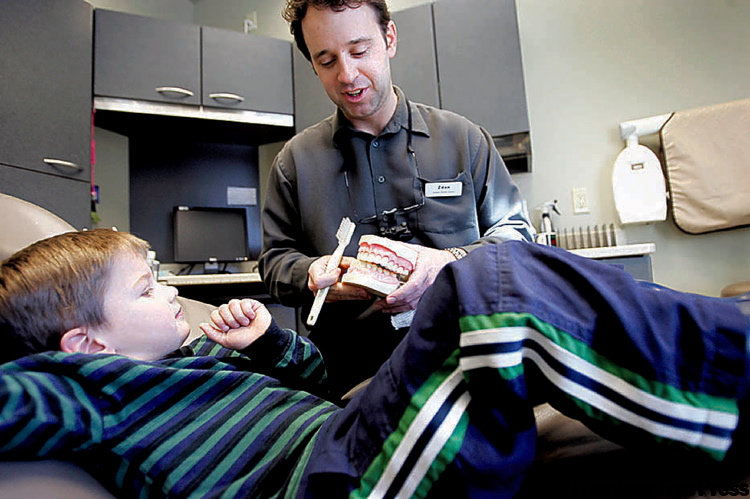
The goal is to root out early tooth decay before it becomes a lifelong problem.
"Early detection is what it’s all about," Dr. Leon Stein said Friday of the new program. "We like to get them in at one year of age when the first teeth are coming in."
The MDA said early childhood tooth decay affects 40 per cent of children in North America by the time they reach kindergarten. Between 1997 and 2007, close to 19,000 children under the age of six were treated under general anesthesia for rotting baby teeth. Of those, nearly one quarter were under the age of three.
During the free checkup, the dentist will try to intercept the onset of tooth disease and teach parents how to help their kids take care of their teeth.
One of the culprits responsible for bad teeth in young kids is usually mom, Dr. Lanny Jacob said.
Specifically, if mom has bad teeth, she can pass on a bacteria (strep mutans) to her child that attacks the child’s teeth.
"Children are not born with teeth and they’re not born with this bacteria," Jacob said. "The bacteria tends to favour teeth. So once a child’s teeth start coming in, on average about six months of age, and mom’s kissing the kid or sharing utensils, that’s where the kids get these strep mutans.
"So if mom has a clean, healthy mouth, doesn’t have cavities and doesn’t have a lot of this bacteria, then there’s less chance of her transmitting this disease to her child."
Jacob said kids who get cavities at an early age are more likely to have dental problems throughout life.
"Parents don’t understand sometimes if the child is acting up, they may have a tooth problem," Jacob said. "A lot of parents don’t look in their kids’ mouths. They don’t know that’s something’s going on in there."
bruce.owen@freepress.mb.ca
Toothpaste for kids
How much toothpaste is enough for a little kid?
A pea-size amount on a brush is plenty for a child under eight whose teeth are forming, dentists say.
Why? Most toothpaste has fluoride in it. So does Winnipeg’s drinking water.
"Too much fluoride, if it’s ingested, will end up causing fluorosis for the teeth," Dr. Leon Stein said. "You don’t want to overdo it."
Too much fluoride causes dental fluorosis by damaging the enamel-forming cells. The damage to these cells results in a mineralization disorder of the teeth. In its most common form, fluorosis appears as tiny white streaks or specks that are often unnoticeable. In its severe form, it is characterized by black and brown stains, and cracking and pitting of the teeth.
Fluoride is added to Winnipeg’s drinking water, according to the province’s fluoridation program. Fluoride helps prevent tooth decay in older children and adults.