

Kid from Rivers a legend in Oz
Manitoba-born professor honoured in Australia
Advertisement
Read this article for free:
or
Already have an account? Log in here »
To continue reading, please subscribe:
Monthly Digital Subscription
$1 per week for 24 weeks*
- Enjoy unlimited reading on winnipegfreepress.com
- Read the E-Edition, our digital replica newspaper
- Access News Break, our award-winning app
- Play interactive puzzles
*Billed as $4.00 plus GST every four weeks. After 24 weeks, price increases to the regular rate of $19.95 plus GST every four weeks. Offer available to new and qualified returning subscribers only. Cancel any time.
Monthly Digital Subscription
$4.99/week*
- Enjoy unlimited reading on winnipegfreepress.com
- Read the E-Edition, our digital replica newspaper
- Access News Break, our award-winning app
- Play interactive puzzles
*Billed as $19.95 plus GST every four weeks. Cancel any time.
To continue reading, please subscribe:
Add Free Press access to your Brandon Sun subscription for only an additional
$1 for the first 4 weeks*
*Your next subscription payment will increase by $1.00 and you will be charged $16.99 plus GST for four weeks. After four weeks, your payment will increase to $23.99 plus GST every four weeks.
Read unlimited articles for free today:
or
Already have an account? Log in here »
Hey there, time traveller!
This article was published 29/05/2010 (5790 days ago), so information in it may no longer be current.
In Depression-era Manitoba, a boundlessly energetic son of Ukrainian immigrants spent his time hunting, fishing and reading every book (twice) in the tiny public library in Rivers, a railway town about 250 kilometres west of Winnipeg.
Flash forward eight decades or so, to a packed auditorium last week at the University of Sydney, where 88-year-old Harry Messel — half a world and "three lifetimes" away from his Canadian roots — was the star of a special gala honouring his remarkable contributions to science and education in Australia.
The Canadian-born physicist is an academic titan Down Under, where he almost single-handedly reshaped the country’s high school science curriculum while becoming his adopted nation’s leading expert on crocodiles — one of the few creatures he didn’t encounter during his outdoorsy upbringing in small-town Manitoba.
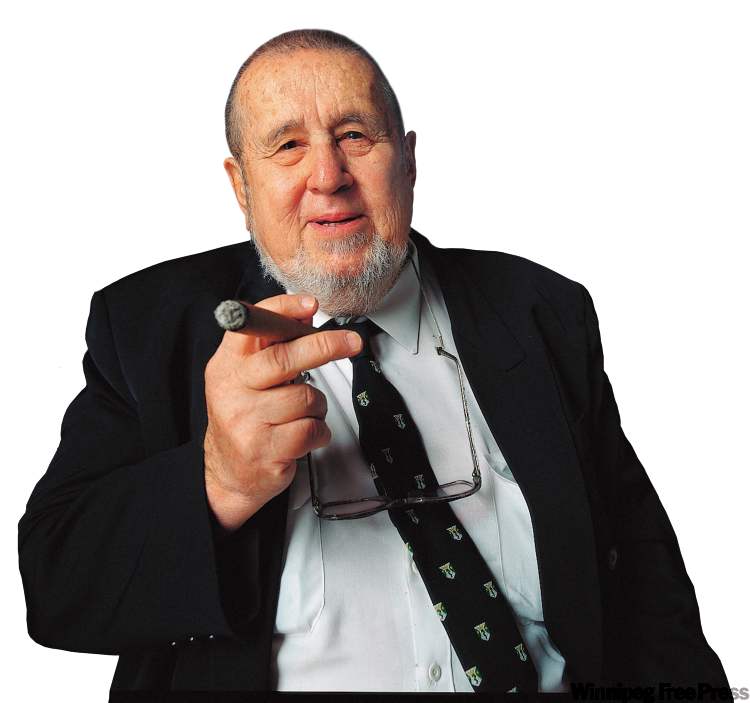
But as much as he loved trapping and fishing — skills he says he learned largely from Sioux natives he befriended as a youth — his main quarry was always knowledge.
"I loved school," recalls Messel, who’s now properly titled Emeritus Professor at the University of Sydney, AC (Companion of the Order of Australia) and CBE (Commander of the Order of the British Empire).
"And I hated holidays, because it meant I was stopping learning. There was nothing that used to annoy me more than school holidays — I was just such an eager beaver for knowledge."
So weekends or holidays were often spent devouring the library’s modest holdings, a humble but effective apprenticeship in erudition for a man destined to become an academic juggernaut in Australia.
Messel left Canada in the late 1940s and landed a job in Adelaide as a physics professor specializing in cosmic rays. By age 29, he was head of the physics department at the University of Sydney, a post he would hold for the next 35 years as the institution emerged as a world leader in the field.
But that was just one of those "three lifetimes" the Canadian claims to have lived — "And I’ve loved every one of them" — during his epic career spanning 60 years in Australia. It saw him rewrite the textbook (literally) on teaching high school science, spearhead an Australian government initiative to draw girls into the traditionally male domain, help build the country’s first computer, lead the development of its first solar-power system, pioneer the use of satellite technology to track wildlife — including Australia’s iconic croc — and play a leading role in both the creation of Bond University and the growth of the University of Sydney, where an international science school bears his name today.
Along the way, Messel became one of the first Canadians of Ukrainian descent admitted to the Royal Military College in Kingston, Ont., served as a Canadian paratrooper during the Second World War and became the first undergraduate student in the history of Queen’s University to take two degrees simultaneously — physics and engineering during the day, math and arts at night.
"I was the only person up until that time to be allowed to do that — and they had to pass a special bylaw to allow me to do it," he told Canwest News Service. "I wasn’t sure what I wanted to be — a doctor, a mineralogist, a geologist, a physicist, a mathematician. I wanted to do all those things."
While physics became his official calling, Messel built as big a reputation in conservation circles as a specialist in Australian crocodile habitats ("I wrote 20 books on that") and as the driving force behind the Blue Book — a revolutionary rewriting of Australia’s main high school science textbook that integrated all major fields of study and became a model for the educators around world.
Messel’s exploits are little known in Canada, where he still holds citizenship and returned often over the years — especially when his parents were still alive in Manitoba.
One of the last times he visited was when he received an honourary degree a few years ago at Queen’s, 65 years to the day after he’d received a Governor General’s medal on the same stage for outstanding academic results — in both of his undergrad degrees.
And if you think the "retired" Messel is taking a well-earned break from working and learning, forget it.
The kid from Rivers remains an avid reader, writer, storyteller and educator — one who has never forgotten the Manitoba schoolmasters who set him on the road to academic stardom.

"I went to the Rivers Public School, which I thoroughly enjoyed," he said. "It was a marvellous place with some wonderful teachers."
— Canwest News Service