Slow down, stat!
In our 24/7 go-go-go world, the real rush might come from taking our time
Advertisement
Read this article for free:
or
Already have an account? Log in here »
To continue reading, please subscribe:

Digital Subscription
One year of digital access for only $205*
- Enjoy unlimited reading on winnipegfreepress.com
- Read the E-Edition, our digital replica newspaper
- Access News Break, our award-winning app
- Play interactive puzzles
*First annual payment billed as $205.00 + GST for one year. This annual subscription will automatically renew at $233.00 + GST every 52 weeks (10% off the regular annual price of $259.35). Offer available to new and qualified returning subscribers only. Cancel any time.
To continue reading, please subscribe:
Add Free Press access to your Brandon Sun subscription for only an additional
$1 for the first 4 weeks*
- Enjoy unlimited reading on winnipegfreepress.com
- Read the E-Edition, our digital replica newspaper
- Access News Break, our award-winning app
- Play interactive puzzles
*Your next Brandon Sun subscription payment will increase by $1.00 and you will be charged $17.95 plus GST for four weeks. After four weeks, your payment will increase to $24.95 plus GST every four weeks.
Read unlimited articles for free today:
or
Already have an account? Log in here »
Hey there, time traveller!
This article was published 08/02/2011 (5699 days ago), so information in it may no longer be current.
“In this media-drenched, data-rich, channel-surfing, computer-gaming age, we have lost the art of doing nothing, of shutting out the background noise and distractions, of slowing down and simply being alone with our thoughts.”
— Carl Honoré, In Praise of Slowness (2005)
TWO centuries ago, Benjamin Franklin predicted that technology would be our liberator.
If every person worked “four hours each day on something useful, that labour would produce sufficient to procure all the necessities and comforts of life… and the rest of the 24 hours might be leisure and pleasure,” he wrote in a 1784 essay.
We all know how that’s working out.
Despite our many labour-saving devices, we’re toiling longer and harder than ever before, in a 24/7 economy where even an eight-hour work day is starting to seem like a quaint fantasy.
Somewhere along the way, the world got stuck in overdrive and now the only way to avoid getting left in the dust is to cram more and more into every minute. And better make it snappy.
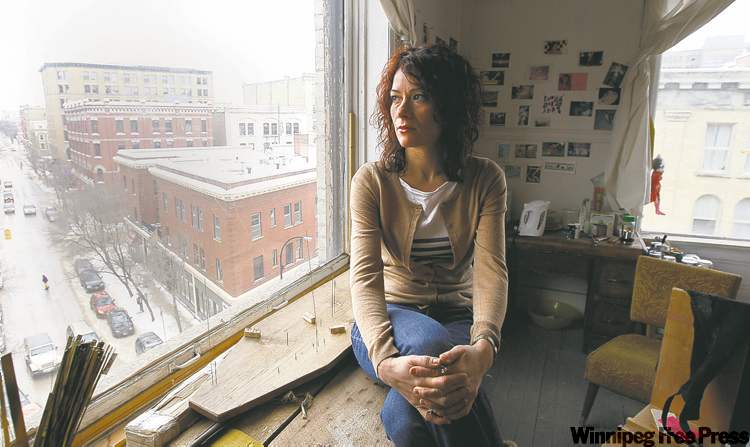
Not so fast, says a Winnipeg artist whose latest project invites us to discover the pleasures of life in the slow lane.
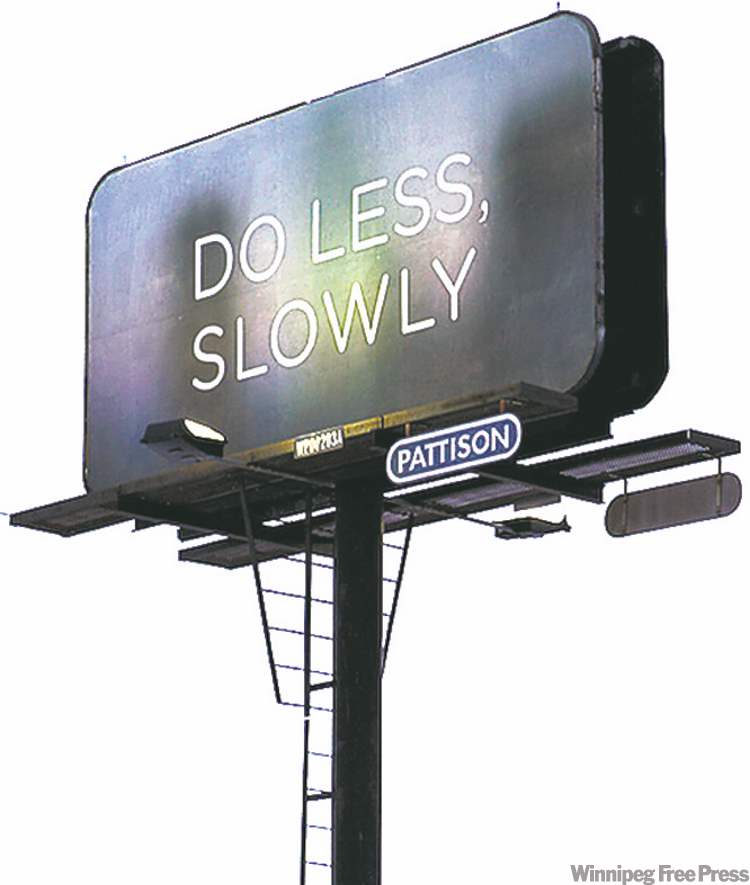
It’s called Do Less, Slowly and its counterintuitive message is currently being conveyed on a handful of billboards around the city. You may have recently driven past one and assumed it was part of the Winnipeg Police Service’s Just Slow Down campaign.
Like the police with their speed-reduction initiative, Dominique Rey aims to educate, enlighten and change attitudes. But she’s urging folks to apply the brakes in virtually every aspect of their daily lives, from work to food to parenting. Even sex.
“You can rush around in life, but eventually it’ll catch up with you,” says the 35-year-old Franco-Manitoban. “People are getting burnout at a younger and younger age.”
Do Less, Slowly is the legacy project of Rey, who was named Winnipeg’s arts ambassador for visual arts under the 2010 Cultural Capital of Canada program.
Yes, it’s an art project that encourages people to stop and smell the roses. (The website, dolessslowly.ca, is filled with advice on how to slow down in the city and in your life.)
But it only came about because Rey decided to wake up and smell the coffee. “After nearly 15 years of professional life conditioned by speed, sick with hurry, and ruled by ideologies of productivity and success, my life was void of true happiness or satisfaction,” she writes on the website.
No longer able to quell or deny the nagging inner voice, Rey decided to listen to it instead and in 2005, signed up for her first Vipassana meditation course — 10 days of silence, 110 hours of stillness.
“When I got to the end of it, an authentic joy and peace was flowing out of me, and I’m usually a pretty high-strung person,” she recalls.
That first experience of “sustained slowness” opened the door to a different way of living, says Rey, who would spend the next five years researching a worldwide phenomenon known as the Slow Movement.
More than a clarion call to kick our addiction to speed, it’s a reaction to the “roadrunner culture” that is taking a toll on everything from our health, diet and work to our communities, relationships and the environment.
“For at least 150 years, everything has been getting faster and for the most part, speed was doing us more good than harm in that time. But in recent years we’ve entered the phase of diminishing returns,” said Carl Honoré, a London-based Canadian journalist and author of In Praise of Slowness, a 2005 bestseller that has been translated into 30 languages.
By most accounts, slowness as a concept started in 1989 in Italy with the advent of the Slow Food Movement. What began as a local revolt against fast food chains has grown into a global network that keeps branching out into other arenas: slow cities, slow travel, slow money, slow design and slow sex all have their own movements.
Oh, yes, there’s also slow art.
“I wanted to bring slowness to people as an experience and not just as a message,” says Rey, who admits she is “very slow at becoming a slow person.”
She emphasizes that Do Less, Slowly is not meant to be a crash diet, but rather a catalyst for starting your own slow practice.
How about it? Think you can find the time in your harried and hurried life to commit a random act of slowness?
Apparently, you just did.
“Just thinking about slowness is an act of slowness,” says Rey.
To learn more, go to www.dolessslowly.ca.
carolin.vesely@freepress.mb.ca