Cacti collection a fantastic tale
Curator oversees tire salesman's donation
Advertisement
Read this article for free:
or
Already have an account? Log in here »
To continue reading, please subscribe:

Digital Subscription
One year of digital access for only $205*
- Enjoy unlimited reading on winnipegfreepress.com
- Read the E-Edition, our digital replica newspaper
- Access News Break, our award-winning app
- Play interactive puzzles
*First annual payment billed as $205.00 + GST for one year. This annual subscription will automatically renew at $233.00 + GST every 52 weeks (10% off the regular annual price of $259.35). Offer available to new and qualified returning subscribers only. Cancel any time.
To continue reading, please subscribe:
Add Free Press access to your Brandon Sun subscription for only an additional
$1 for the first 4 weeks*
- Enjoy unlimited reading on winnipegfreepress.com
- Read the E-Edition, our digital replica newspaper
- Access News Break, our award-winning app
- Play interactive puzzles
*Your next Brandon Sun subscription payment will increase by $1.00 and you will be charged $17.95 plus GST for four weeks. After four weeks, your payment will increase to $24.95 plus GST every four weeks.
Read unlimited articles for free today:
or
Already have an account? Log in here »
Hey there, time traveller!
This article was published 30/07/2011 (5469 days ago), so information in it may no longer be current.
INTERNATIONAL PEACE GARDEN — The funny thing about the cactus — one of the largest collections in North America was recently donated to this bit of border greenery — is that all those thorns, called spines, used to be leaves.
With geological change, like continental drift, the plant moved from moist climates to dry. So it ditched its leaves for spines and began photosynthesizing through the stem.
It’s a fantastic tale. The problem with leaves is they increase surface area from which moisture can be lost. The thorns are also its Darwinian survival kit. Back off, Jack! When you’re the only thing green in a desert, everyone wants a piece of you.
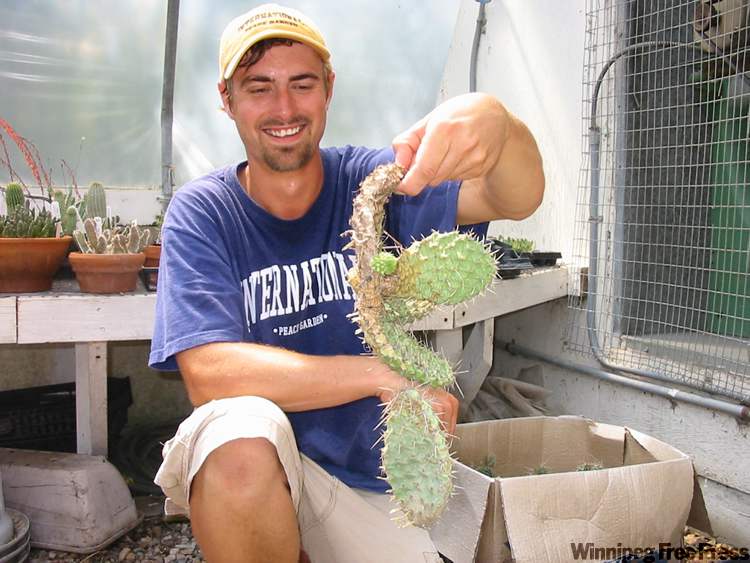
Cacti in Manitoba? It used to be the only cactus near here was a beloved, scratchy-voiced sportscaster and Happy Honker award disseminator, named Cactus Jack Wells.
Johannes Olwage, who is the cactus exhibit curator here, thought the same thing. He is from Namibia, which is overrun with cacti. He expected to have to pretend to be impressed when shown the cactus collection in this northern clime that was installed at the Peace Garden last October.
It turned out he didn’t have to pretend.
“The crazy part is they all came from Minot, North Dakota, from a guy whose a tire salesman by day,” said Olwage. That would be Don Vitko.
The second “crazy part,” he says, is this is less than 20 per cent of Vitko’s collection. The rest arrives next year. The cactus collection is in the recently completed $5.1-million Interpretive Centre and Conservatory, part of an effort to bring tourists back to the Peace Garden. A $2-million sunken garden, fenced off from flower-munching deer, is also new.
International Peace Garden literature calls Olwage its “perfect curator” because of his botany degree and African background with cacti. His father’s missionary work moved the family from Holland to Africa. He met his wife, who is from Minot, while she was an international exchange student in Africa.
All types of cactus are from “the New World,” as Olwage calls North and South America. The plant is extremely invasive in Africa but it was imported there by Europeans, after stopovers in the new world, to grow for food and fodder.
“(Cacti) like poor, sandy soils in harsh conditions where other things don’t like to grow,” he said. They typically have vertical columns up their sides, called ribs, which house its spines. The ribs fold and unfold like an accordion, depending on how much water is stored.
Their shapes are fairly uniform: straight up, like a Louisville Slugger (columnar); pin-cushioned, like a porcupine (globose); or with garbo mitt-shaped pads, like the prickly pear.
If the cactus shapes seem repetitive after awhile, Vitko’s collection includes succulents — any plant that stores water in its fleshy tissue. They are weird, bonsai-like twisting plants.
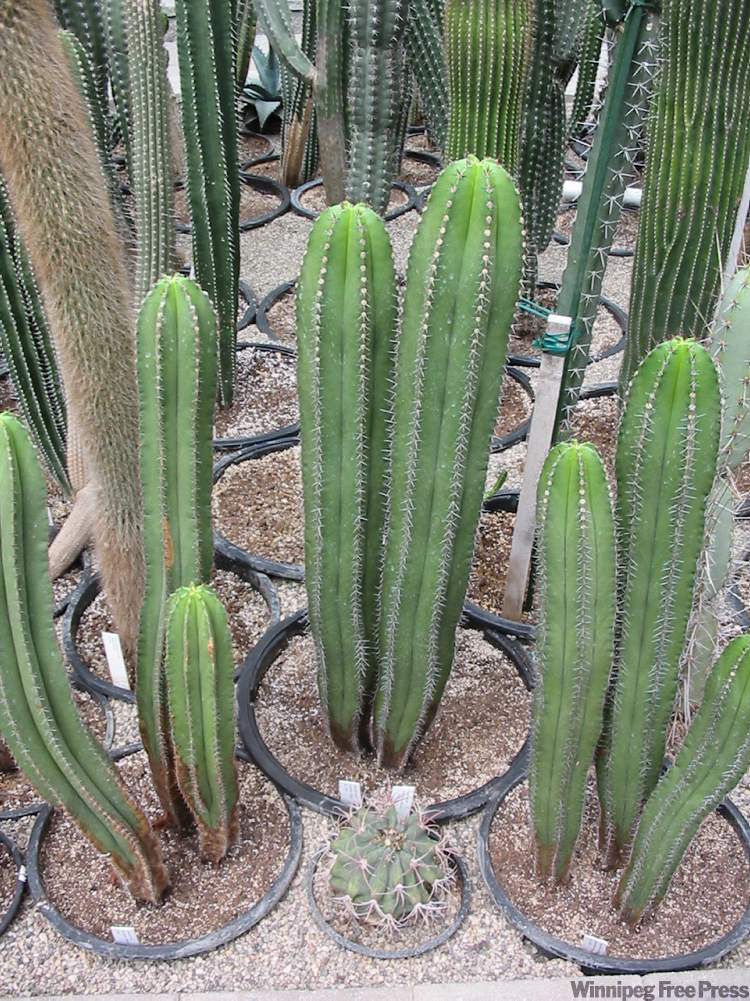
“What I love about succulents is their architecture, their shape. They are other-worldly,” Olwage said.
The Prairies actually have four native cactus species, but the main one is a genus of the prickly pear, or opuntia fragilis. The prickly pear has little pads that look like Mickey Mouse ears but with nasty pins for ear hairs. Another northern prairie cactus is the Coryphantha, a small pin-cushion type. The other two varieties are quite rare. The native cactus will be at the Peace Garden next year.

Vitko, 57, started the collection at age eight on his grandparents’ farm. He was keen about gardening but couldn’t be at his grandparents house every day to water plants. So he chose cacti because he could visit his grandparents on weekends and water his plants. He still has the first cactus he planted.
A few years later, he begged for and got a tiny greenhouse. He kept collecting until he had 5,200 different plants.
“You walked into his house and every square inch was packed with cactus,” said Olwage.
The Peace Garden straddles the Manitoba-North Dakota border on Highway 10, directly south of Brandon.
bill.redekop@freepress.mb.ca