Conflict resolution, aboriginal-style
Idle No More movement divisive on several different levels
Advertisement
Read this article for free:
or
Already have an account? Log in here »
To continue reading, please subscribe:

Digital Subscription
One year of digital access for only $205*
- Enjoy unlimited reading on winnipegfreepress.com
- Read the E-Edition, our digital replica newspaper
- Access News Break, our award-winning app
- Play interactive puzzles
*First annual payment billed as $205.00 + GST for one year. This annual subscription will automatically renew at $233.00 + GST every 52 weeks (10% off the regular annual price of $259.35). Offer available to new and qualified returning subscribers only. Cancel any time.
To continue reading, please subscribe:
Add Free Press access to your Brandon Sun subscription for only an additional
$1 for the first 4 weeks*
- Enjoy unlimited reading on winnipegfreepress.com
- Read the E-Edition, our digital replica newspaper
- Access News Break, our award-winning app
- Play interactive puzzles
*Your next Brandon Sun subscription payment will increase by $1.00 and you will be charged $17.95 plus GST for four weeks. After four weeks, your payment will increase to $24.95 plus GST every four weeks.
Read unlimited articles for free today:
or
Already have an account? Log in here »
Hey there, time traveller!
This article was published 24/01/2013 (4983 days ago), so information in it may no longer be current.
If you are to believe the mainstream media, the Idle No More movement has been divisive. It has pitted the racists versus the activists, the chiefs versus the prime minister and well, these chiefs versus those chiefs. This is really too bad because the goals of the movement itself, social and environmental justice, are ones that many Canadians can identify with. Beyond that, indigenous cultures have always been inclusive. From our ancestors inviting the early European settlers to share the land right to the modern era.
With that in mind, I decided to reach back in to our traditions for some ideas on how to smooth over some of the tensions that have arisen lately. Call it conflict resolution, aboriginal-style.
1. Adoption: Adoptions were done in traditional times as peace-making exercises. They are also known as “making relations ceremonies,” though the ceremony is way less fun than that name implies. The idea is simple: have two people in conflict embrace each other as kin. Once they are family, they are forced to work it out. It works better than marriage because with family, there is no divorce.
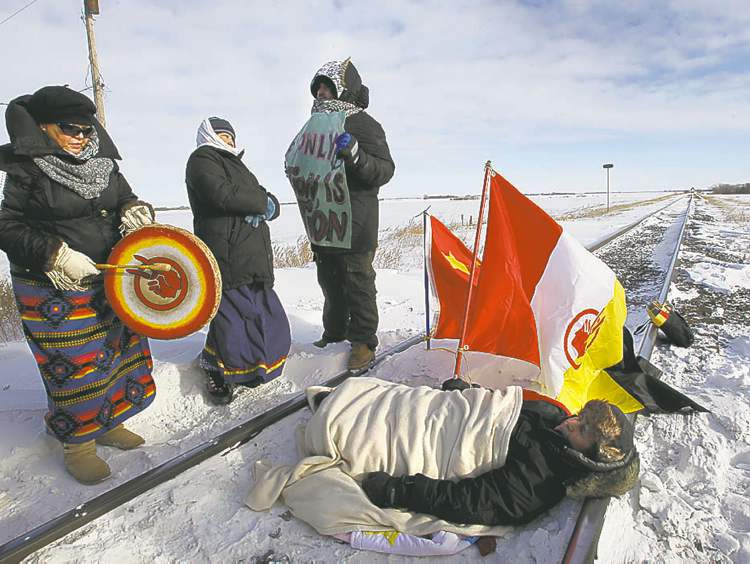
What I propose is to have every person who makes a racist comment adopt an old-school indigenous-rights activist. “Small-town Manitoba newspaper editor, meet your new brother, Luke Warmwater.” He enjoys blockades, red berets and chants that start with “Two, four, six, eight…”
Let’s make it a two-way street. When an indigenous person says something ridiculous on Twitter, have them adopt an equally outlandishly opinionated voice from the anti-Idle No More camp. “Armchair activist, meet Ezra.”
Just imagine the fun that will be had. Seriously though, seeing each other as family might help us to respect the differences in opinion and realize that we are all in this together.
2. Lacrosse: In traditional times, lacrosse was often used as a way of settling disputes. My lacrosse-playing friends — Cam Bomberry and Kevin Sandy — often talk about the example of two neighbouring tribes battling over the same fishing spot. Rather than wage war, they would hold a lacrosse game. Winner gets to fish, loser gets to live.
My Twitter follower Jeremy Sanford suggested we could hold just such a showdown to settle the implementation of treaty rights. Imagine a winner-take-all lacrosse game between the treaty chiefs and Prime Minister Stephen Harper’s cabinet. At stake: the resource riches of this country.
It is difficult to predict who would emerge victorious. On the one hand, the cabinet team would have excellent strategy, their front bench would be well-versed in trash talk and their post-game interviews would likely fit in very well on TSN. “You know we just went out there… and gave 110 per cent… and hoped to make investments in Canadian families.”
On the flip side, the treaty team would have Chief Isadore Day, Grand Chief Derek Nepinak and Grand Chief Patrick Madahbee as their power forwards. Come to think of it, those three actually were the power forwards back on Dec. 4, when the chiefs decided to march to Parliament. They ended up facing off against some Mounties instead on that occasion.

A lacrosse game may seem like an arbitrary way to decide how Canada’s $650 billion in natural resources gets developed. But consider the recent string of legal victories racked up by First Nations as outlined in Bill Gallagher’s new book Resource Rulers. The cabinet team may have better odds winning on the lacrosse field than in the courtroom.
3. Smoking the pipe: “The peace pipe” is a Hollywood term, but the name has some basis in reality. Our sacred pipes have been used to forge peace. We are taught never to pick up a pipe in anger. When we sit down to smoke one, cooler heads prevail and we talk through our differences.
Seems like a great way to heal the increasingly publicized rift between the chiefs, who boycotted the meeting with the prime minister, and those who attended.
Thing is, the chiefs who boycotted did hold pipe ceremonies. This is where they forged the consensus among their ranks. So why has the pipe not bridged the gap between their position and that of the Assembly of First Nations executive?
The pipe was not used in traditional times in all parts of what is now Canada. In other regions the Indian Act and residential schools rendered the pipe invisible. This is where one of the fundamental teachings of indigenous culture plays a role: we must respect the decision of other indigenous peoples to have their own traditions. If they do not want to use the pipe, we must respect that choice. Yes, even aboriginal people must respect diversity. Hopefully that teaching will be strong enough to bring those two sides together.

Advertisement Advertise With Us
Advertisement Advertise With Us