A few determined U.S. families still pursuing adoptions from Kyrgyzstan
Advertisement
Read this article for free:
or
Already have an account? Log in here »
To continue reading, please subscribe:

Digital Subscription
One year of digital access for only $205*
- Enjoy unlimited reading on winnipegfreepress.com
- Read the E-Edition, our digital replica newspaper
- Access News Break, our award-winning app
- Play interactive puzzles
*First annual payment billed as $205.00 + GST for one year. This annual subscription will automatically renew at $233.00 + GST every 52 weeks (10% off the regular annual price of $259.35). Offer available to new and qualified returning subscribers only. Cancel any time.
To continue reading, please subscribe:
Add Free Press access to your Brandon Sun subscription for only an additional
$1 for the first 4 weeks*
- Enjoy unlimited reading on winnipegfreepress.com
- Read the E-Edition, our digital replica newspaper
- Access News Break, our award-winning app
- Play interactive puzzles
*Your next Brandon Sun subscription payment will increase by $1.00 and you will be charged $17.95 plus GST for four weeks. After four weeks, your payment will increase to $24.95 plus GST every four weeks.
Read unlimited articles for free today:
or
Already have an account? Log in here »
Hey there, time traveller!
This article was published 01/02/2013 (4981 days ago), so information in it may no longer be current.
NEW YORK, N.Y. – The boy, named Vladimir, is 5 1/2 years old, struggles at learning to count and draw, and lives in an orphanage in Kyrgyzstan. His would-be parents in New York have had just five brief visits since they signed on to adopt him in 2008, yet they refuse to abandon the quest.
“We have already bonded with this child,” said Frances Pardus-Abbadessa. “Probably a day doesn’t go by that we don’t think of him. In our mind, he’s our child. If we don’t wait for him, what’s his fate going to be?”
Frances and her husband, Drew, were among a group initially known as the “Kyrgyz 65” — Americans who were in the process of adopting 65 orphans from the Central Asian republic when it suspended international adoptions in 2008 due to allegations of fraud.
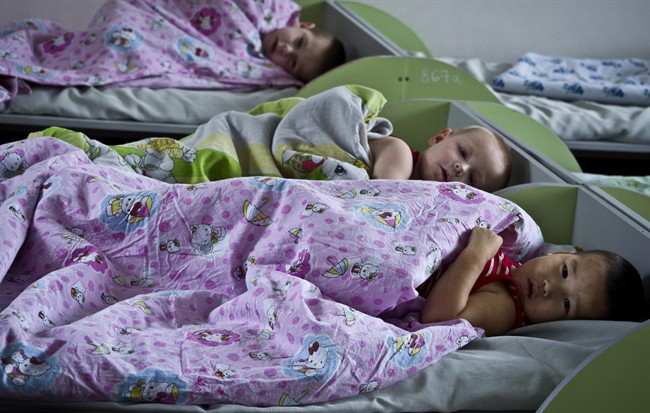
The group’s ranks have dwindled over the ensuing years while Kyrgyzstan’s adoption system has been disrupted by political turmoil and persisting corruption problems.
Some of the Americans gave up, some of the children were placed in domestic adoptions, and last summer nine of the remaining children finally were allowed to go to America. The Pardus-Abbadessas are now among 16 U.S. families still waiting, five years later.
Drew describes their predicament as “an emotional roller-coaster.” But he and others in the waiting group are cautiously encouraged by the efforts of Kyrgyzstan’s new social development minister, Edil Baisalov.
A 35-year-old English-speaker and avid Twitter user, Baisalov has brought an uncharacteristic level of openness to government business in his post-Soviet nation during six months on the job. He is working on new anti-corruption regulations and hopes for swift government approval that might help clear the way for the remaining U.S. adoption cases to be completed.
It’s not a sure thing. Various anti-corruption and children’s rights activists in the Kyrgyz capital, Bishkek, have criticized the proposed rules as inadequate and vowed to oppose them. But one of the waiting Americans, Shannon Fenske of Reeseville, Wisconsin, said Baisalov nonetheless had raised hopes after so many disappointments.
“We are so incredibly impressed and grateful for what he has done since taking over,” Fenske said. “He’s been the most vocal in favour of moving our cases forward.”
Fenske, a medical technician, and her husband, Kevin, an aircraft maintenance manager, were matched in July 2008 with an infant Kyrgyz girl afflicted by a severe cleft lip and palate. They arranged for two operations for Kamila that improved her condition, but pain and speech problems linger.
The Fenskes have four other adopted children with special needs, including a 6-year-old boy adopted from Kyrgyzstan in 2007. But even with a bustling household, there’s no thought about dropping the quest to adopt Kamila, whom they’ve visited only once — last June.
“She’s our daughter — it’s that simple,” Shannon Fenske said. “We promised her a family. We will not stop fighting for her until she’s here, where we feel she belongs.”
The plight of the Fenskes and the other waiting families, while far more prolonged, shares some similarities with the circumstances of dozens of American families who were trying to adopt children from Russia when the Russian government banned such adoptions in December amid a rise in tensions with Washington. In both Russia and Kyrgyzstan, large numbers of abandoned children live in orphanages, and domestic adoptions are not sufficient to meet the needs.
Kyrgyzstan is an economically struggling country with often ill-equipped orphanages. Resources are scarce, specialist training to care for severely disabled children is limited, and the daily food budget at some facilities is $1.50 per child.
Unscrupulous bureaucrats dealing in what was effectively a trade in children led to two halts in foreign adoptions — in 2006 and 2008 — by Kyrgyz authorities.
Last July, adoptions were again frozen after the arrest of Baisalov’s predecessor, Ravshan Sabirov, for allegedly extorting funds from foreign adoption agencies seeking accreditation. Sabirov eventually was acquitted, but nonetheless lost his post.
Under the new rules being pushed by Baisalov, any adoption agency working in Kyrgyzstan will have to secure separate agreements with four government ministries and with the security service, the successor to the Soviet-era KGB. Foreign agencies will be required to provide detailed financial statements to reduce the odds of corruption.
Despite that, the Bishkek-based Protection of Children’s Rights League remains unconvinced and insists that many problems still need resolving. The league’s leader, Nazgul Turdubekova, says corrupt local officials and unscrupulous intermediaries are commonly seen at international adoption agencies’ offices.
Baisalov described criticism of proposed adoption rules as “absolutely irrational.”
“They are just using children for their own public relations aims,” he said. “They are criticizing provisions they developed themselves and are thus delaying the reunification of Kyrgyz children with their parents.”
Drew and Frances Pardus-Abbadessa fervently hope for such a reunion with Vladimir, who they already consider their son. They’re hoping to rename him Franco Michael, after the first names of their parents.
The couple is wary of sharing photos that show his face, for fear of breaching adoption protocol. But they readily recall their five visits with him, dating back to June 2008, when he was 7 months old and they found him at his orphanage in a large pen filled with crying children.
Their last meeting was in July 2012. Since then, said Drew Pardus-Abbadessa, they’ve been sending letters and packages but have been told not to visit.
“You’re introduced to a child, and they become part of your heart, part of your family,” Drew said. “Then there are the delays, all the ups and downs. You have your hopes raised and they’re dashed again.”
Drew, an environmental engineering consultant, and Frances, who works for New York City’s Office of Child Support Enforcement, completed a domestic adoption while waiting for a resolution in Kyrgyzstan. They’re intent that son Pavol, who turns 2 on Feb. 22, will have an older brother.
“It’s not what we signed up for — adopting a child that old,” Frances said of Vladimir. “It will be harder for us. He will have bonding issues. But at least he’ll have love and support, a chance he’ll never have if he stays in that orphanage.”
The Pardus-Abbadessas, the Fenskes and the other waiting families have an ardent well-wisher in Ann Bates, a 41-year-old pediatric transport nurse from Bernville, Pennsylvania, who was one of the nine members of the Kyrgyz 65 able to complete her adoption last summer. Bates — a single mother now engaged to a long-time friend — says her 6-year-old daughter, Krystina, is developmentally delayed compared to other children her age, but is physically healthy and a joy to have around.
Bates also adopted a boy from Russia in 2010, and considers herself lucky, given the ban imposed by Russia in December.
Bates remains in touch with the families still waiting for Kyrgyz adoptions and yearns for their success.
“My heart still bleeds for all of those kids,” she said. “I’ve seen them, I’ve held them, I’ve helped advocate for the last five years.
“I see the huge improvements that Krystina has made in six months that she would never have made in an institution,” Bates added. “To know the others are not getting that attention is heartbreaking.”
___
Leila Saralayeva reported from Bishkek, Kyrgyzstan. Associated Press writer Peter Leonard in Almaty, Kazakhstan, contributed to this report.