American adults out-performed by many global peers on workplace skills assessment test
Advertisement
Read this article for free:
or
Already have an account? Log in here »
To continue reading, please subscribe:

Digital Subscription
One year of digital access for only $205*
- Enjoy unlimited reading on winnipegfreepress.com
- Read the E-Edition, our digital replica newspaper
- Access News Break, our award-winning app
- Play interactive puzzles
*First annual payment billed as $205.00 + GST for one year. This annual subscription will automatically renew at $233.00 + GST every 52 weeks (10% off the regular annual price of $259.35). Offer available to new and qualified returning subscribers only. Cancel any time.
To continue reading, please subscribe:
Add Free Press access to your Brandon Sun subscription for only an additional
$1 for the first 4 weeks*
- Enjoy unlimited reading on winnipegfreepress.com
- Read the E-Edition, our digital replica newspaper
- Access News Break, our award-winning app
- Play interactive puzzles
*Your next Brandon Sun subscription payment will increase by $1.00 and you will be charged $17.95 plus GST for four weeks. After four weeks, your payment will increase to $24.95 plus GST every four weeks.
Read unlimited articles for free today:
or
Already have an account? Log in here »
Hey there, time traveller!
This article was published 08/10/2013 (4741 days ago), so information in it may no longer be current.
WASHINGTON – It’s long been known that America’s school kids haven’t measured well compared with international peers. Now, there’s a new twist: Adults don’t either.
In math, reading and problem-solving using technology — all skills considered critical for global competitiveness and economic strength — American adults scored below the international average on a global test, according to results released Tuesday.
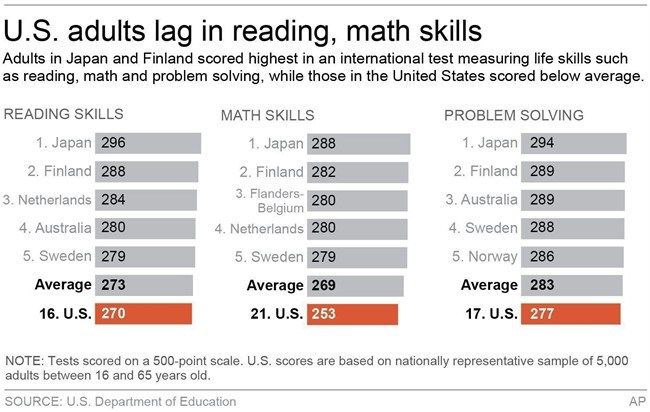
Adults in Japan, Canada, Australia, Finland and multiple other countries scored significantly higher than the United States in all three areas on the test. Beyond basic reading and math, respondents were tested on activities such as calculating mileage reimbursement due to a salesman, sorting email and comparing food expiration dates on grocery store tags.
Not only did Americans score poorly compared to many international competitors, the findings reinforced just how large the gap is between the nation’s high- and low-skilled workers and how hard it is to move ahead when your parents haven’t.
In both reading and math, for example, those with college educated parents did better than those whose parents did not complete high school.
The study, called the Program for the International Assessment of Adult Competencies, found that it was easier on average to overcome this and other barriers to literacy overseas than in the United States.
Researchers tested about 157,000 people ages 16 to 65 in more than 20 countries and subnational regions. It was developed and released by the Organization for Economic Cooperation and Development, which is made up of mostly industrialized member countries. The Education Department’s Center for Education Statistics participated.
The findings were equally grim for many European countries — Italy and Spain, among the hardest hit by the recession and debt crisis, ranked at the bottom across generations. Unemployment is well over 25 per cent in Spain and over 12 per cent in Italy. Spain has drastically cut education spending, drawing student street protests.
But in the northern European countries that have fared better, the picture was brighter — and the study credits continuing education. In Finland, Denmark, and the Netherlands, more than 60 per cent of adults took part is either job training or continuing education. In Italy, by contrast, the rate was half that.
As the American economy sputters along and many people live paycheque-to-paycheque, economists say a highly-skilled workforce is key to economic recovery. The median hourly wage of workers scoring on the highest level in literacy on the test is more than 60 per cent higher than for workers scoring at the lowest level, and those with low literacy skills were more than twice as likely to be unemployed.
“It’s not just the kids who require more and more preparation to get access to the economy, it’s more and more the adults don’t have the skills to stay in it,” said Anthony Carnevale, director of the Georgetown University Center on Education and the Workforce.
Education Secretary Arne Duncan said in a statement the nation needs to find ways to reach more adults to upgrade their skills. Otherwise, he said, “no matter how hard they work, these adults will be stuck, unable to support their families and contribute fully to our country. “
Among the other findings:
—Americans scored toward the bottom in the category of problem solving in a technology rich environment. The top five scores in the areas were from Japan, Finland, Australia, Sweden and Norway, while the U.S. score was on par with England, Estonia, Ireland and Poland. In nearly all countries, at least 10 per cent of adults lacked the most basic of computer skills such as using a mouse.
—Japanese and Dutch adults who were ages 25 to 34 and only completed high school easily outperformed Italian or Spanish university graduates of the same age.
—In England, Germany, Italy, Poland, and the United States, social background has a big impact on literacy skills, meaning the children of parents with low levels of education have lower reading skills.
America’s school kids have historically scored low on international assessment tests compared to other countries, which is often blamed on the diversity of the population and the high number of immigrants. Also, achievement tests have long shown that a large chunk of the U.S. student population lacks basic reading and math skills — most pronounced among low-income and minority students.
This test could suggest students leaving high school without certain basic skills aren’t obtaining them later on the job or in an education program.
The United States will have a tough time catching up because money at the state and local level, a major source of education funding, has been slashed in recent years, said Jacob Kirkegaard, an economist with the Peterson Institute for International Economics.
“There is a race between man and machine here. The question here is always: Are you a worker for whom technology makes it possible to do a better job or are you a worker that the technology can replace?” he said. For those without the most basic skills, he said, the answer will be merciless and has the potential to extend into future generations. Learning is highly correlated with parents’ education level.
“If you want to avoid having an underclass — a large group of people who are basically unemployable — this educational system is absolutely key,” Kirkegaard said.
Dolores Perin, professor of psychology and education at Teachers College, Columbia University, said the report provides a “good basis for an argument there should be more resources to support adults with low literacy.”
Adults can learn new skills at any age and there are adult-geared programs around the country, Perin said. But, she said, the challenge is ensuring the programs have quality teaching and that adults regularly attend classes.
“If you find reading and writing hard, you’ve been working hard all day at two jobs, you’ve got a young child, are you actually going to go to class? It’s challenging,” Perin said.
Some economists say that large skills gap in the United States could matter even more in the future. America’s economic competitors like China and India are simply larger than competitors of the past like Japan, Carnevale said. Even while America’s top 10 per cent of students can compete globally, Carnevale said, that doesn’t cut it. China and India did not participate in this assessment.
“The skills in the middle are required and we’re not producing them,” Carnevale said.
Respondents were selected as part of a nationally represented sample. The test was primarily taken at home using a computer, but some respondents used a printed test booklet.
Among the other findings:
—Japan, Finland, Canada, Netherlands, Australia, Sweden, Norway, Flanders-Belgium, Czech Republic, Slovak Republic, and Korea all scored significantly higher than the United States in all three areas on the test.
—The average scores in literacy range from 250 in Italy to 296 in Japan. The U.S. average score was 270. (500 was the highest score in all three areas.) Average scores in 12 countries were higher than the average U.S. score.
—The average scores in math range from 246 in Spain to 288 in Japan. The U.S. average score was 253, below 18 other countries.
—The average scores on problem solving in technology-rich environments scale for adult ranged from 275 in Poland to 294 in Japan. The U.S. average score was 277, below 14 other countries.
_____

Online: http://www.oecd.org/site/piaac/publications.htm
_____
Follow Kimberly Hefling at http://www.twitter.com/khefling
_____
Lori Hinnant contributed to this report from Paris.