

Add a bounce to your step
Doing 'plyos' in training and everyday life will make you stronger
Advertisement
Read this article for free:
or
Already have an account? Log in here »
To continue reading, please subscribe:
Monthly Digital Subscription
$1 per week for 24 weeks*
- Enjoy unlimited reading on winnipegfreepress.com
- Read the E-Edition, our digital replica newspaper
- Access News Break, our award-winning app
- Play interactive puzzles
*Billed as $4.00 plus GST every four weeks. After 24 weeks, price increases to the regular rate of $19.95 plus GST every four weeks. Offer available to new and qualified returning subscribers only. Cancel any time.
Monthly Digital Subscription
$4.99/week*
- Enjoy unlimited reading on winnipegfreepress.com
- Read the E-Edition, our digital replica newspaper
- Access News Break, our award-winning app
- Play interactive puzzles
*Billed as $19.95 plus GST every four weeks. Cancel any time.
To continue reading, please subscribe:
Add Free Press access to your Brandon Sun subscription for only an additional
$1 for the first 4 weeks*
- Enjoy unlimited reading on winnipegfreepress.com
- Read the E-Edition, our digital replica newspaper
- Access News Break, our award-winning app
- Play interactive puzzles
*Your next Brandon Sun subscription payment will increase by $1.00 and you will be charged $17.95 plus GST for four weeks. After four weeks, your payment will increase to $24.95 plus GST every four weeks.
Read unlimited articles for free today:
or
Already have an account? Log in here »
Hey there, time traveller!
This article was published 19/04/2014 (4407 days ago), so information in it may no longer be current.
Whatever your sport; football, biking, climbing, running, even golfing — there’s a way to improve fast. You can make yourself quicker, stronger, and more powerful, just by incorporating plyometrics into your life.
“Plyos” are an impact type of exercise. Jumping rope is a plyometric exercise. So is hopping, skipping and other types of jumping. Some folks have the misconception that this is a workout just for the lower body. Not true. There are plyo moves for the arms, shoulders, and especially the core.
Nor is it just for power sports. Golfers will find that plyometric core training will increase the power of their swings, and the distance of their drives.
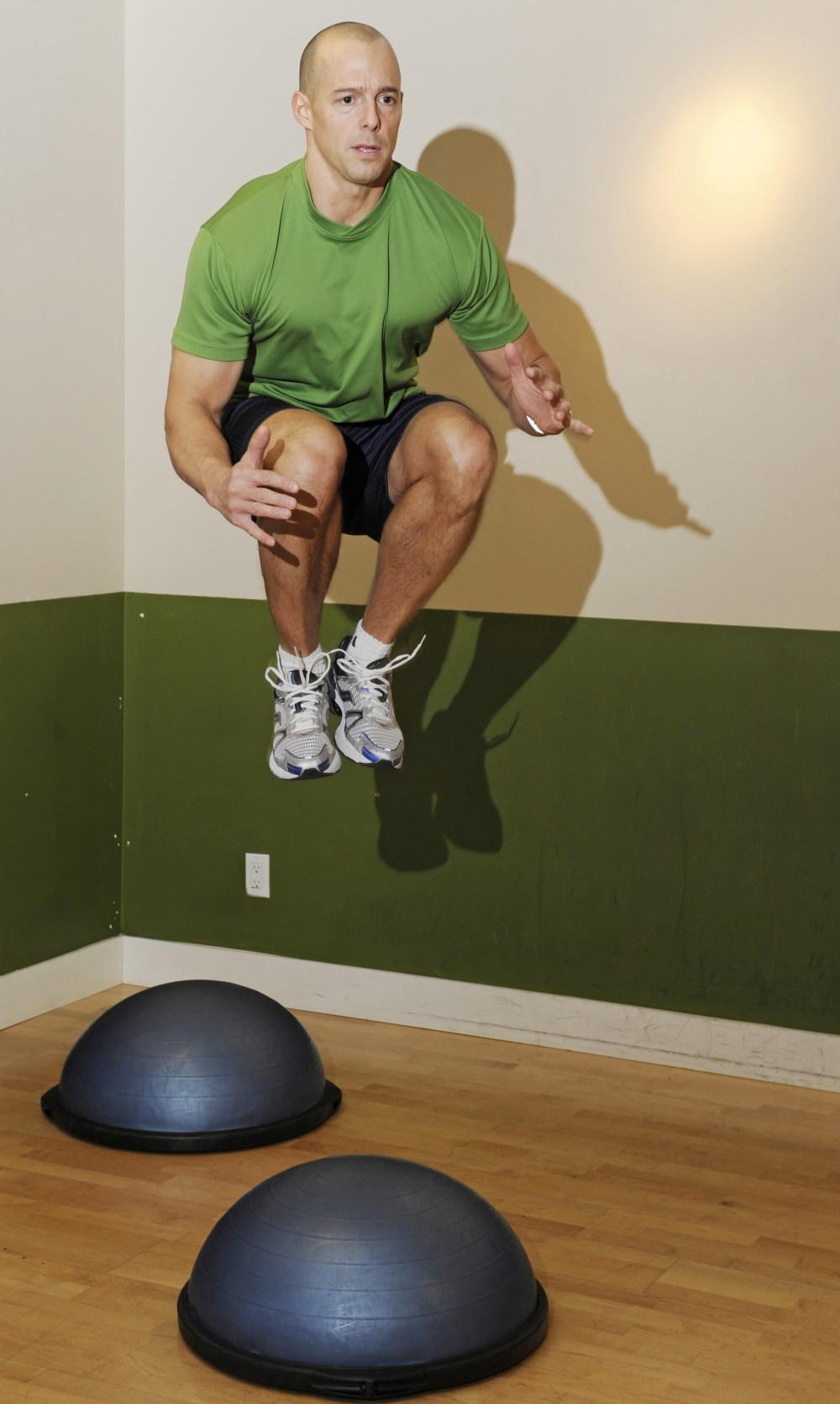
Plyos train muscles to make a quick “snap” that greatly increases the force that the muscles can generate. They also strengthen the tendons and ligaments, while making you physically faster.
There are three ways to make your life more plyometric. You can do the exercises in a gym or outdoors — or you can make them a natural part of your day, which is probably the best way of all.
First, plyo exercises at the gym or outdoors: jump rope for 30 seconds. Do it fast, trying to spend as little time on the floor as possible. Imagine the ground as “hot”, you want to get your feet off it quickly.
A plyometric pushup is a great example of how these exercises train you to be faster. Forcefully push yourself up, clap your hands, and get them back to the floor in time to prevent a faceplant. It may take some training time until you can do it. This works the arms and shoulders. For specific shoulder conditioning, use a cable pulldown. Put it at shoulder height. Step back a few feet until your arm is stretched out straight, then yank the weighted cable towards your chest. Immediately allow the weight of the cable to quickly stretch your arm out straight again.
Here are two plyos for the core:
1. Hold a weighted bar at waist level. Get into a slight squat. Bend over at the hips and lower the bar to your ankles, without letting it touch the floor. Immediately pull the bar up to your sternum by bending your elbows and standing up straight.
2. Find a partner with whom you can catch and throw balls. The mass of the ball will recruit different muscles, so use balls of various sizes. For example, it takes different dynamics to catch a baseball than to catch a basketball. Vary the force of the throw as well. A hard throw is more plyometric. If the ball is coming at you fast, your core muscles must snap into position quickly to give strength to your arms and stabilize your body for the catch.
For legs and butt, mark off a line 15 metres long. Hop the length of it first on one leg, then the other. Outside, do one minute of ‘bounding’, jumping off one foot as far forward as possible, then the other, leaping into the air, again, as if the ground were hot and you want to dab it briefly and leap up again.
Now for making plyos an everyday part of your life. First, stairs. Don’t trudge up them. Push off the stair hard, almost in a one-footed jump. Absorb the landing by letting the other leg flex with your body weight. Go down stairs by allowing each leg to flex at the hip, knee and ankle, then slightly pushing off to the next step down. Start by doing only four or five stairs at a time; let your tendons and ligaments adjust before adding more stairs.
For the upper body, find an uncrowded place to do wall pushups. Lean against the wall with your hands on the wall and your elbows deeply flexed, shoulders as close to the wall as possible. Forcefully push yourself back upright, then fall into the leaning position again. Repeat 10 times.
Remember to always start out lightly and adjust the plyometric force only as your muscles, tendons and ligaments get stronger.
— Adventure Sports Weekly