

Whip it good
Collector cherishes two summers of Triple-A baseball in Winnipeg, even if few dare to remember
Advertisement
Read this article for free:
or
Already have an account? Log in here »
To continue reading, please subscribe:
Monthly Digital Subscription
$1 per week for 24 weeks*
- Enjoy unlimited reading on winnipegfreepress.com
- Read the E-Edition, our digital replica newspaper
- Access News Break, our award-winning app
- Play interactive puzzles
*Billed as $4.00 plus GST every four weeks. After 24 weeks, price increases to the regular rate of $19.95 plus GST every four weeks. Offer available to new and qualified returning subscribers only. Cancel any time.
Monthly Digital Subscription
$4.99/week*
- Enjoy unlimited reading on winnipegfreepress.com
- Read the E-Edition, our digital replica newspaper
- Access News Break, our award-winning app
- Play interactive puzzles
*Billed as $19.95 plus GST every four weeks. Cancel any time.
To continue reading, please subscribe:
Add Free Press access to your Brandon Sun subscription for only an additional
$1 for the first 4 weeks*
*Your next subscription payment will increase by $1.00 and you will be charged $16.99 plus GST for four weeks. After four weeks, your payment will increase to $23.99 plus GST every four weeks.
Read unlimited articles for free today:
or
Already have an account? Log in here »
Hey there, time traveller!
This article was published 31/05/2014 (4324 days ago), so information in it may no longer be current.
Brian Hrynick was two years old when the Buffalo Bisons baseball club moved to Winnipeg in 1970.
The Bisons, rechristened the Whips, were only around for a pair of summers. But that wasn’t due to a lack of fan support; the Winnipeg Whips led the International League in attendance in 1970 and 1971 despite finishing dead last in their division both seasons.
No, the biggest obstacle facing the Whips wasn’t around-the-horn double plays but their geographical location. The International League was an eastern-based circuit. Winnipeg’s nearest opponent — the Toledo Mud Hens — was some 1,700 kilometres away, which, in the long run, rendered the team’s travel expenses unsustainable. (It’s rumoured that in order to land the franchise, the Whips’ ownership group had to agree to cover the airfare for all visiting sides to and from Manitoba.)
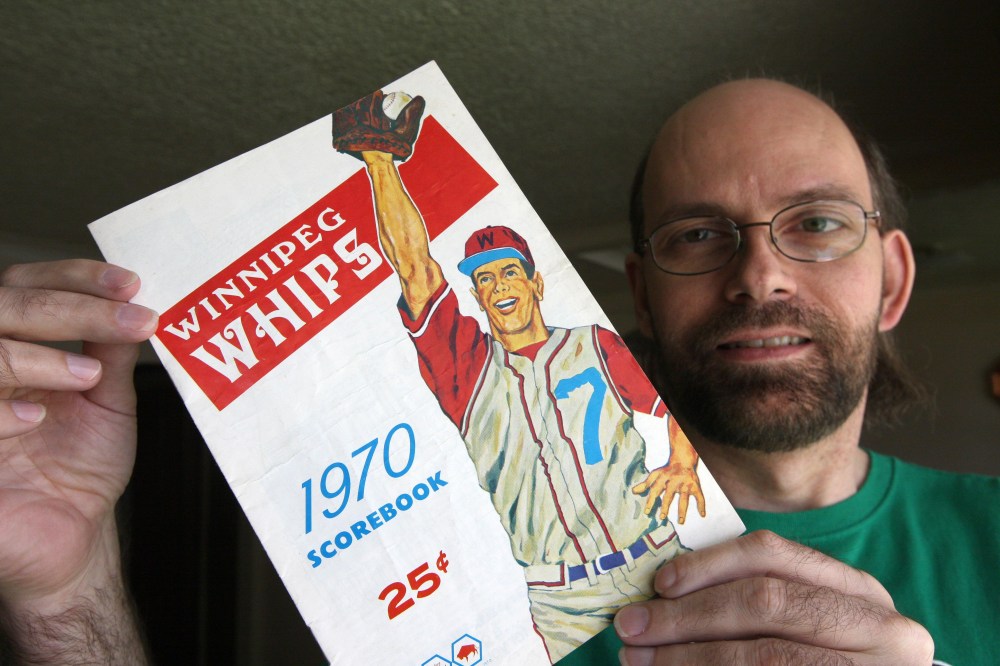
Hrynick’s father was a big fan of the Whips’ parent club, the Montreal Expos. When Hrynick was growing up, his dad would regale him with stories of seeing the Whips in action at Winnipeg Stadium — back when the infield was situated in the southwest corner of the Blue Bombers’ old stomping grounds.
So in 1985, a month or so before that structure’s baseball grandstands were razed to make way for the Blue and Gold Room – also since-demolished – Hrynick snuck into the bowels of the building to hunt for remnants of former Whips like Steve Rogers, John Olerud Sr. and Boots Day — players he’d come to hold dear despite the fact he’d never seen any of them fire a fastball or leg out a triple in person.
“I figured there had to be some stuff down there, old ticket stubs, programs, baseballs… anything,” Hrynick says. “I saw plenty of garbage — and rats the size of poodles — but that was about it.”
Unfazed, Hrynick opted for Plan B, which was to chronicle every tidbit of information concerning the Whips he could get his hands on.
But this was before the birth of the Internet. Before, when, at the stroke of a key, one could discover that the Whips’ team ERA in 1970 was a lofty 5.74. Or that future-Toronto Blue Jays manager Jimy Williams led the Whips in a number of categories, including most times hit by a pitch.
“Every Saturday, I’d head to the downtown library and pour through the microfiche. I’d just spin and spin, looking for whatever I could find,” Hrynick says. In time, Hrynick began to turn up the odd artifact at flea markets and garage sales — a team photo here, an embroidered crest there. But when it came to acquiring big-ticket items like caps or jerseys, Hrynick got used to striking out time and time again.
“To this day, it’s practically impossible to find anything; it’s almost like (the Whips) didn’t exist at all,” Hrynick says, showing off a couple of his latest treasures — a game-day program from 1970 and a stub from a contest between the Whips and Syracuse Chiefs, which cost him substantially more than the ducat’s printed price of $1.50.
“Apparently they had promotions when they handed out plastic batting helmets. But I’ve never seen one. I also read that they gave out souvenir balls on occasion. But who knows where those are, either?”
Ideally, what Hrynick would like to do is put together two framed collections of Whips memorabilia: one for himself and one for the Manitoba Sports Hall of Fame and Museum.
“I was at an antique show about 10 years ago when I spotted a Whips pennant. But it was heavily damaged and way over-priced. And about three years ago, there was a pocket schedule available on eBay. But I got out-bid — it went for $75 — and I’ve never seen another one like it, again. So who knows when I’ll be able to get this done.”
“I can’t understand why there isn’t any Whips stuff around,” says Bob Picken, a Winnipeg sports legend who covered the team for CBC during the team’s two-year run. “They were a pretty big hit so you’d think there has to be some of their stuff kicking around, somewhere.” (Picken is correct to a certain degree: if you have $195 burning a hole in your baseball pants pocket, you can order a custom-made, Whips jersey from a Seattle-based company called Ebbets Field Flannels. The all-wool top, white in colour with red and blue trim, comes with a stitched number on the front and back, and takes six to eight weeks to arrive in the mail.)
Picken recalls how excited his cohorts in press row were after it was announced Winnipeg had landed the Whips. “We were all like, ‘Triple-A baseball? Wow, we’ve really come up in the world.”
The first thing that comes to mind when Picken hears “Winnipeg Whips” is the oddly-shaped ball park the team called home. Because the Bombers extended the stadium’s eastside grandstand the year before the Whips’ arrival, the centre-field fence was about 300 feet from home plate, Picken says, as opposed to the normal distance of about 400 feet
“When the team stepped on the field for the first time for batting practice, the first thing out of everybody’s mouth was ‘Uh, how far is that fence, exactly?'” Picken says with a chuckle. “And the pitchers, well when they had a look at it they just about died.
“I think most of the guys who played here have a good memory of their time, though,” Picken goes on. “They were treated like royalty. I interviewed Steve Rogers one time when he was pitching for the Expos in the late ’70s. He looked at me and said ‘Winnipeg? Is that crazy little ballpark still there?'”
While it’s true there is a dearth of Whips keep-sakes around, Dan Chase has no doubt that in 10, 20 or 40 years’ time, one will still be able to view sizable collections of items associated with Winnipeg’s current boys of summer, the Goldeyes.
“A lot of our fans have built what I can only call shrines to the team in their rec rooms; some of the collections I’ve seen are absolutely unbelievable,” says Chase, the club’s director of sales and marketing.

This year, the Goldeyes will add to their fans’ caches with a number of game-day giveaways, including an insulated lunch bag made to look like a jersey, radio headphones and Chase’s favourite – a pair of Rayban-style sunglasses featuring the Goldeyes insignia.
Chase was in his teens during the Whips’ tenure. He distinctly remembers the team’s logo “because it looked so much like the Expos” and he recollects the ball park “even though it was terrible from a stadium point of view.”
But like most ball fans, Chase’s most distinct memory is the experience of having been in the stands, on a sweat-soaked, July afternoon.
“Yes, the team didn’t always win and sure, the stadium wasn’t like what we have today (at Shaw Park). But in the end, the baseball still won,” says Chase, who patrolled center field during his playing days at Border Community Centre. “Whenever you go to a ball game, it’s the sights and the sounds and the smells you take home with you. Every sport is that way to a certain degree, I guess, but I have a special spot in my heart reserved for baseball.”
david.sanderson@freepress.mb.ca
Dave Sanderson was born in Regina but please, don’t hold that against him.
Our newsroom depends on a growing audience of readers to power our journalism. If you are not a paid reader, please consider becoming a subscriber.
Our newsroom depends on its audience of readers to power our journalism. Thank you for your support.
Dave Sanderson was born in Regina but please, don’t hold that against him.
Our newsroom depends on a growing audience of readers to power our journalism. If you are not a paid reader, please consider becoming a subscriber.
Our newsroom depends on its audience of readers to power our journalism. Thank you for your support.
Advertisement Advertise With Us
Advertisement Advertise With Us