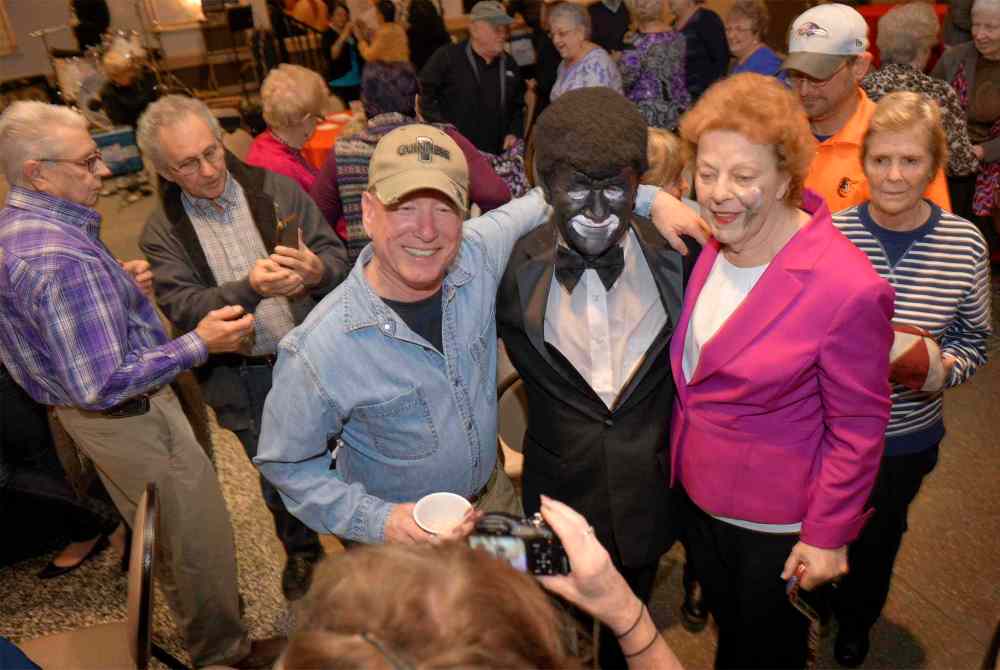
A final night in blackface
Fans flock to unapologetic Jolson impersonator's farewell show
Advertisement
Read this article for free:
or
Already have an account? Log in here »
To continue reading, please subscribe:
Monthly Digital Subscription
$1 per week for 24 weeks*
- Enjoy unlimited reading on winnipegfreepress.com
- Read the E-Edition, our digital replica newspaper
- Access News Break, our award-winning app
- Play interactive puzzles
*Billed as $4.00 plus GST every four weeks. After 24 weeks, price increases to the regular rate of $19.95 plus GST every four weeks. Offer available to new and qualified returning subscribers only. Cancel any time.
Monthly Digital Subscription
$4.99/week*
- Enjoy unlimited reading on winnipegfreepress.com
- Read the E-Edition, our digital replica newspaper
- Access News Break, our award-winning app
- Play interactive puzzles
*Billed as $19.95 plus GST every four weeks. Cancel any time.
To continue reading, please subscribe:
Add Free Press access to your Brandon Sun subscription for only an additional
$1 for the first 4 weeks*
*Your next subscription payment will increase by $1.00 and you will be charged $16.99 plus GST for four weeks. After four weeks, your payment will increase to $23.99 plus GST every four weeks.
Read unlimited articles for free today:
or
Already have an account? Log in here »
Hey there, time traveller!
This article was published 15/11/2015 (3799 days ago), so information in it may no longer be current.
EDGEWOOD, Md. — The black greasepaint had thickened to the consistency of toothpaste. Bobby Berger slapped it onto his face in clumps, then rubbed it in circles, covering his 67-year-old white skin.
He couldn’t remember how old this tube was, but he was glad he had stocked up. When he decided to revive his act this summer, he went back to A.T. Jones and Sons costume shop in Baltimore, just a few kilometres from his home. Blackface paint had been discontinued, they said.
And now the same was about to happen to his act.
For nearly for 40 years, Berger had been trying to explain he’s not mocking anyone — that he isn’t even impersonating a black person. He impersonates a white man who wore blackface makeup “before it was taboo.”‘Thousands, thousands of black people have seen this show. They had no problem with it.’
-Bobby Berger
Berger’s act is a tribute to Al Jolson, the vaudeville superstar of nearly a century ago who had his biggest hit in The Jazz Singer, the 1927 movie that is remembered as the first full-sound “talking picture.” Jolson donned blackface not in jest, it is said, but to introduce white audiences to the thrilling blues and ragtime music pioneered by African-Americans.
“When I do the makeup, I look exactly like Al Jolson, which adds a whole lot to the performance. It’s just hard for me to believe that anybody that looks at it logically…,” Berger said, pausing.
“Thousands, thousands of black people have seen this show. They had no problem with it.”
It was this assertion, Berger seemed confident, that should shield him from criticism. Outside his dressing room, there were a few hundred people drinking beer out of plastic cups and dancing under oversized chandeliers in a worn suburban Baltimore ballroom.
But outside this rented venue, it seemed the United States was insisting putting on another skin tone is wrong — cultural appropriation at the least, racist and hateful at the worst.
He rubbed the makeup over his ears and around the back of his neck.
“When it got — what’s the word I’m looking for? — popular to scream about it, people start screaming.”
So on this November night, he would perform his last show. No more singing Mammy, no more black-stained shirt collars. He would end it on his terms, without conceding to his critics.
Berger tucked a few wispy grey hairs under a custom-made wig and smoothed out the black bow tie his face now matched. A thick white outline was drawn around his mouth and under his eyes. He looked nothing like a black person, more like a black-and-white clown. He assessed himself in the mirror, then turned to a reporter.
“Let me ask you something,” he said. “Do I seem like a racist to you?”
Not for the first time, Bobby Berger made national headlines this summer. It was just a few months after six Baltimore police officers were charged in the death of Freddie Gray, an African-American man who suffered a fatal spine injury while restrained during an arrest. The riots that followed made Baltimore an epicentre of the conflict over police brutality and race relations in the U.S.
Perhaps this wasn’t the best time or place to sing and dance in blackface. Yet Berger, a former police officer, planned a show as a fundraiser for the accused cops.
“I told him, ‘Your timing is very bad,’ ” said Daryl Davis, a R&B and blues artist who plays with Berger. “Baltimore was burning to the ground with riots over racism, and you’re gonna wear blackface? But he just wasn’t thinking in those terms.”
Jolson, say Davis and Berger, was not a racist. In the 1920s and ’30s, the star used his clout to advocate for black performers to gain entry on Broadway. That’s why Davis, who is black, so adamantly supports Berger’s act.
”At a time when it was not popular to stand up and defend black people, Al Jolson did,” Davis said. “He opened the doors for lots of black people and was revered by many black entertainers. Duke Ellington, Louis Armstrong — those were his friends. Had it not been for Jolson, they would not have risen to the success they had as rapidly.”‘At a time when it was not popular to stand up and defend black people, Jolson did.’
-Daryl Davis, a R&B and blues artist
Though history might remember Jolson as a friend to black people, it doesn’t look kindly upon the tradition he perpetuated with his blackface performances. They were, after all, a callback to the minstrel shows of the 1800s — comedy skits performed by singing, dancing white men who painted their faces with burnt cork.
Minstrel shows helped shape American entertainment, historians acknowledge, but also belittled and dehumanized blacks as “other.” Today “Jim Crow” refers to the laws that codified government-enforced segregation in the U.S., but the name originally came from a popular minstrel character — a fictional black man who would act like a buffoon in public places.
Where Berger was growing up as the youngest of eight siblings in south Baltimore in the ’50s and ’60s, he didn’t think much about Jim Crow, or racism. He recalls having black friends, delivering newspapers to black families and his older brother’s black co-worker coming around for dinner.
Every Saturday night, his family would get together to eat, drink and sing. His father, who owned a window-cleaning company, sang Jolson songs.
Berger grew up to become a police officer who played in a ’50s cover band on the side. When his brother, Albert, opened a club called Old Shantytown in 1978, his mother demanded he come sing. He performed Heart of My Heart and Come Around Any Old Time. Then he did a Jolson song, and the crowd went wild. He did it again the following night, and the crowd loved it again. The next day, he went out to buy some makeup.
For three years, no one seemed to notice or care that he was performing in blackface. He had dance moves that always wowed. People who saw his act at Old Shantytown invited him to perform at parties, country clubs and hotels.
In 1981, he scheduled a show at a downtown hotel, and the NAACP showed up in protest. Berger remembers quizzing their representatives on the names of Al Jolson songs to prove they didn’t know Jolson’s history. They protested anyway.
When the Baltimore Police Department ordered its employee to stop performing in blackface that year, Berger sued, citing his First Amendment rights. He lost and was fired. Then he won on appeal and was rehired. They gave him a desk but nothing to do. He sued again, won, and was forced to retire.
He took his retirement cheques and, in 1997, opened his own restaurant, Bobby B’s Palace. Until Berger officially retired in 2013, you could always find him there. He decorated with a nostalgic theme: phone booths, jukeboxes and old records on the walls.
“A place for older people to feel alive again,” he liked to call it. They served steak and crab cakes, booked live music a few times a week, and every Sunday, showcased a one-of-a-kind tribute performance to Al Jolson.

The Richlin Ballroom was filled with Berger believers, some 290 of them, who had heard by word of mouth or printed flier the man had organized his own last hurrah. They paid US$45 to sit at big round tables eating oysters, salad and ice cream sundaes while a lineup of singers impersonated artists from past generations. The only black person in sight was Davis on the piano.
“Look at him,” a woman in the audience said. “He’s black. Do you think he’d be here if this was racist?”
She was one of the many fans who mobbed Berger every time he emerged from his dressing room. He worked the room like a politician. Men wanted to shake his hand; women wanted to hug him for a photo, then hold on a little too long.
Berger’s 29-year-old daughter weaved between the tables, holding a gold bucket for raffle tickets.
“I don’t want to be in the paper,” she said.
In-between performances from Tom Jones and Brenda Lee impersonators, her father took the stage in a deep V-neck jumpsuit. Before Jolson, he would be Elvis.
He strutted with the confidence of a man who’d spent his life with a microphone in hand. He twisted and jived and jailhouse-rocked. The big-haired ladies in the front row squealed and sang, and one threw a pair of hot pink panties on the stage.‘I’m sorry that black people went through a lot of stuff. But Bobby has just been an inspiration, for all these years, for his music.’
-Fan Deborah Muir
No one listening to his crooning or watching his hips could deny Bobby Berger had talent.
Why not sing just Jolson songs, without the makeup? Because to Berger, it’s part of the act. Just like the Elvis suit.
Berger’s fans tend to provide the same answer, though there is more than a hint of defensiveness in the way they talk about it. Again and again, they stand up for Berger’s act by saying it “isn’t racial.” It’s an imprecise but seemingly deliberate choice, as if to carefully sidestep the word “racist” even in the context of denying racism.
“Bobby Berger is the greatest entertainer of all time, and this has nothing to do with black people, nothing at all,” said Mary Smith, 75, who used to frequent Bobby B’s Palace every Sunday.
“I’m sorry that black people went through a lot of stuff,” said Deborah Muir, a 63-year-old fan from Baltimore. “But Bobby has just been an inspiration, for all these years, for his music.”
“Political correctness has run amok,” said Ralph Jordan, 75. “Diversity is perversity, it’s a sickness. We’re forced to accept things we wouldn’t be forced to if things were in a natural basis.”
He later added: “There’s not a person in here that is a white racist homophobic.”

The wig was secure, the black paste was caked over every bit of exposed skin and tucked into his tuxedo. His hands were covered in white gloves.
Berger walked through the ballroom doors and up onto his stage. He had ditched the band for a boom box and a CD of Jolson tracks he recorded 20 years ago. He read out the number of the winning raffle ticket, then tried to quiet those who had been taking advantage of the open bar.
“Pay attention a minute. Listen. I’m gonna show you the most important thing in this game called life. You ready? I want all of the members of my family to stand up.”
Nearly a fifth of the room stood, to the applause of the rest. His brothers and sisters, nephews and grandnephews.
“See, that’s what it’s all about. And my friends — some of you guys have been my friends for 40 years. When it comes down to it, it’s all family and friends.”
He hit ‘play’ on his own introduction music.
“Ladies and gentleman… the hardest-working man in show business!” a recorded voice announced.
And the man in blackface started to sing. Rock-a-Bye Your Baby With a Dixie Melody and Toot, Toot, Tootsie, Sonny Boy and Swanee. A few songs in, his daughter marched up to the stage and told him one of his speakers wasn’t working and some people were having a hard time hearing him.
He messed with the boom box and continued on for 25 minutes — throwing out his arms, can-can kicking his legs, flirting with the ladies in the front row and howling towards the ceiling.
“At any rate, this really is the last show,” he said. The crowd booed.
He ended on Mammy, the hit song Al Jolson performed at the end of The Jazz Singer. As Berger tells it, Mammy is a song about a boy who is tired of listening to his mother, so he leaves home.
“In his mind,” Berger told the audience. “He didn’t give a s . It was his life, and he was going to live it.”
He sang about the man coming back to his mother, then ended the show to a standing ovation. He bowed and waved and stepped off the stage to hug and kiss his fans. They each walked away with a smudge of black makeup on their cheeks.
— Washington Post