

Non-lethal snakes just as swift
Study finds venomous serpents no faster than others
Advertisement
Read this article for free:
or
Already have an account? Log in here »
To continue reading, please subscribe:
Monthly Digital Subscription
$1 per week for 24 weeks*
- Enjoy unlimited reading on winnipegfreepress.com
- Read the E-Edition, our digital replica newspaper
- Access News Break, our award-winning app
- Play interactive puzzles
*Billed as $4.00 plus GST every four weeks. After 24 weeks, price increases to the regular rate of $19.95 plus GST every four weeks. Offer available to new and qualified returning subscribers only. Cancel any time.
Monthly Digital Subscription
$4.99/week*
- Enjoy unlimited reading on winnipegfreepress.com
- Read the E-Edition, our digital replica newspaper
- Access News Break, our award-winning app
- Play interactive puzzles
*Billed as $19.95 plus GST every four weeks. Cancel any time.
To continue reading, please subscribe:
Add Free Press access to your Brandon Sun subscription for only an additional
$1 for the first 4 weeks*
*Your next subscription payment will increase by $1.00 and you will be charged $16.99 plus GST for four weeks. After four weeks, your payment will increase to $23.99 plus GST every four weeks.
Read unlimited articles for free today:
or
Already have an account? Log in here »
Hey there, time traveller!
This article was published 20/03/2016 (3687 days ago), so information in it may no longer be current.
They say to kill a rattlesnake, just shoot in its general direction, and it’ll intercept the bullet, inadvertently killing itself.
The lunging movements of rattlesnakes and other vipers have been described as “lightning fast” and the “fastest strike on the planet.” The G-forces they employ to capture their food would be enough to cause even experienced jet pilots to black out.
But some of the conventional wisdom about the speed of viper strikes may not be entirely correct, new research reveals. It turns out vipers aren’t necessarily the fastest snakes in the world. Non-venomous snakes can move just as fast.
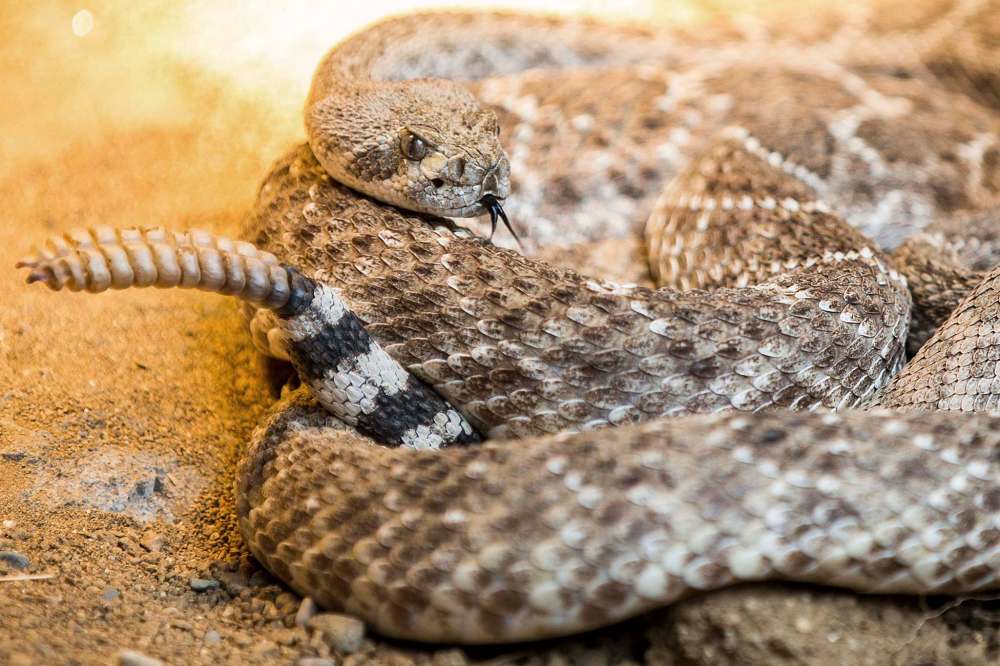
Snakes rely on their ultra-quick ability to strike in order to eat and to defend themselves. When necessary, they can hit a target in as little as 50 to 90 milliseconds. By comparison, a blink of an eye takes 202 milliseconds.
“It’s such a cheesy sentence, but it’s literally true: they strike within a blink of an eye,” said David Penning, who studies functional morphology at the University of Louisiana at Lafayette.
Penning, a graduate student, was trying to see how a snake’s size affected its ability to strike. One day, undergraduate researcher Baxter Sawvel clocked a harmless Texas rat snake striking with similar speed to what they’d expect of a viper. Surprised, they ran the test again and again and soon a new question emerged: are vipers really the fastest snakes?
To find out, Penning and his colleagues tested the reflexes of 14 Texas rat snakes and snakes from two venomous species: six western cottonmouth vipers and 12 western diamond-backed rattlesnakes.
The snakes were filmed with a high-speed video camera as they lashed out at a waving glove stuffed with paper towels or foam, meant to elicit a defensive response. (The lab’s venomous snakes still have all their fangs and venom glands, so Penning had to build a special case to make sure they couldn’t escape.)
It turns out the harmless rat snakes struck just as fast as — if not faster than — the vipers across short distances.
On average, the rat snakes accelerated towards their target at a rate of 190 metres per second squared, or 19 Gs. (A snake at rest experiences a force of just one G.) The cottonmouths and rattlesnakes were slightly slower, with average accelerations of 173 m/s2 and 169 m/s2, respectively.
The single fastest snake in the experiment was a rattlesnake, but it didn’t win by much. Its strike hit 28 Gs, but a rat snake followed closely with 27 Gs.
These are G-forces that would make lesser animals — including humans — pass out. Fighter-jet pilots experience a mere two to five Gs when taking off from an aircraft carrier. At about eight Gs, pilots wearing protective suits lose the ability to move their limbs. At 10 to 15 Gs, even the best pilots start to lose vision.
The snakes not only maintain consciousness, they also show some degree of control as they ready an attack.
And while more tests are needed to find out how exactly they do this, it’s possible the short duration of the strike prevents injury to the critter.
People seem to have a built-in assumption vipers are especially quick, but there’s no reason for this, Penning said.
‘It’s such a cheesy sentence, but it’s literally true: they strike within a blink of an eye’
Rat snakes and rattlesnakes alike want to catch the same types of food, so they use similar means to close the distance between predator and prey.
And rat snakes don’t seem to be special among non-venomous snakes, Penning said. Preliminary evidence suggests several other species are capable of moving as fast as vipers, too.
“Prey aren’t just passively waiting to be eaten,” Penning said.
“They have their own defences and lives. They don’t care what kind of snake you are. They just don’t want to get caught.”

The strike is over before most mammals can muster a startle response or jump out of the way.
That goes for humans as well.
“Our startle-response time is pathetically slow compared to a snake’s ability to strike,” Penning said. “You should just never mess with a venomous snake in the wild.
“You won’t be able to grab it before it’s able to do something back, and that ‘something back’ is a hospital visit, or worse.”
— Los Angeles Times