

‘Gimme an S!’
Powerful athletes want competition recognized as legitimate team 'sport'

Advertisement
Read this article for free:
or
Already have an account? Log in here »
To continue reading, please subscribe:
Digital Subscription
One year of digital access for only $1.44 a week*
- Enjoy unlimited reading on winnipegfreepress.com
- Read the E-Edition, our digital replica newspaper
- Access News Break, our award-winning app
- Play interactive puzzles
*Billed as $5.77 plus GST every four weeks. After 52 weeks, price increases to the regular rate of $19.95 plus GST every four weeks. Offer available to new and qualified returning subscribers only. Cancel any time.
To continue reading, please subscribe:
Add Free Press access to your Brandon Sun subscription for only an additional
$1 for the first 4 weeks*
- Enjoy unlimited reading on winnipegfreepress.com
- Read the E-Edition, our digital replica newspaper
- Access News Break, our award-winning app
- Play interactive puzzles
*Your next Brandon Sun subscription payment will increase by $1.00 and you will be charged $17.95 plus GST for four weeks. After four weeks, your payment will increase to $24.95 plus GST every four weeks.
Read unlimited articles for free today:
or
Already have an account? Log in here »
Hey there, time traveller!
This article was published 03/05/2016 (3684 days ago), so information in it may no longer be current.
It’s Sunday night, and the 23 women who make up the Central Cheer Queen Katz — one of Manitoba’s top competitive all-girl cheerleading teams — are running their routine. It’s fast.
A medley of Top 40 remixes booms as they effortlessly flip through the air and catch each other. The team is divided into groups and they are executing a move called the toss liberty. The flyer, usually the smallest woman, must hold a one-legged stance suspended high in the air, with arms held overhead in a V, before rolling down into the dismount where she will be caught by the women forming the base. Their megawatt smiles and glittery regulation cheer bows belie the incredible athleticism and power required to execute such physically demanding — and, frankly, terrifying-looking — stunts; that’s revealed through the beads of sweat shimmering underneath the fluorescent gym lights, and the shake of a quad straining to hold a pose.
Synchronicity is key for optimal visual effect, and their timing is a bit off. Head coach Brittany Kuz, affectionately called Beej by her team, stops them. “Talk to me — what happened?” Like any good coach, she’s encouraging but direct. She pushes her girls hard because she knows what they can do.
While the Queen Katz perfect their stunts in a Winnipeg gym on this night, the 2016 Cheerleading Worlds are underway in Orlando, Fla. And next April, these women will be there. Only two cheerleading teams from Manitoba have ever gone to Worlds — essentially, the Olympics of the competitive cheer world — in its 12-year history.
“It’s huge,” Kuz says.
The Queen Katz are winding down what’s been a banner season, which saw them return from Vancouver’s 2016 Sea to Sky Championships with a few big wins, including the bid to attend the 2017 Worlds. It was a hard-won victory for a team its coach describes as an underdog that had to work hard.
“We’ve had a really good season,” Kuz says. “We focused on building the bond as a team, not just building talent as a team, and that was the game-changer.”
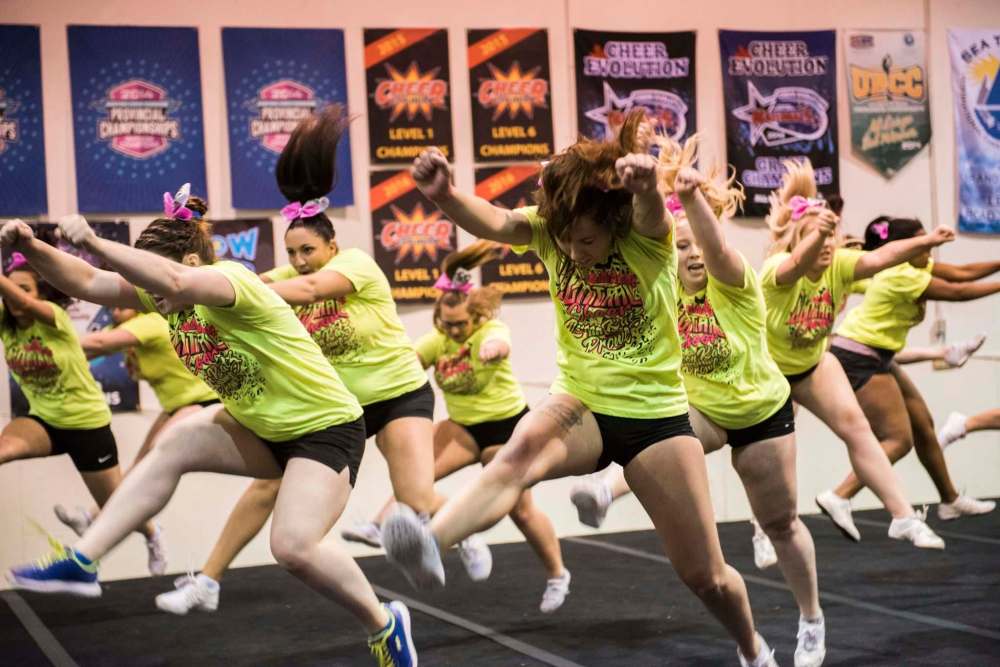
Still, their successes are quiet. Their sport is often overlooked and dismissed. Many organizations, big and small, don’t consider it a sport at all. It’s not considered an Olympic medal sport, even though it bears similarities to ice dancing and gymnastics. Sport Manitoba, an agency that provides more than $10 million in funding and services to support the development of amateur sport in this province, also doesn’t consider it a sport — at least, not yet. A partnership is something Central Cheer is actively working on. (The club belongs to the Manitoba Cheer Federation, which is a small not-for-profit organization focused on regulation and promotion, but not funding.)
And, not to get too meta, but you’ll notice this story is not running in the sports section.
“I guess technically we aren’t a sport, but what is a sport?” Kuz asks. “We work really hard, we train really hard, we’re committed for a long season, we compete.
“When you say you’re a cheerleader, everyone always says, ‘Oh, what for?’ They always think you have to cheerlead for a sports team,” says Serena Stuart, 23, a Queen Katz member and coach at Central Cheer.
“We are a sports team.”
Mallory Mitchell, 31, is the program director of Central Cheer as well as a coach of one of the senior teams. She and Kuz, 28, met via cheer — they cheered for the Winnipeg Rifles — and commiserated over a lack of competitive cheerleading opportunities for women.
“Once you aged out of high school, you were done,” Mitchell says. She’s sitting in the back office at Central Cheer, which just moved into its space in an industrial strip on Midland Street a year ago. Securing a gym was a big boon for Central Cheer; requirements such as a large, spring-loaded floor and high ceilings are tricky to meet when you are stuck renting gyms at various community clubs.
Central Cheer joins a handful of other clubs not affiliated with high schools in the province, Winnipeg Dynamite Cheering, Manitoba Cheer Force and Scorpions Elite Cheer among them. When Mitchell and Kuz founded Central Cheer in 2009, they had two teams. Now, the club is home to eight competitive teams made up of 130 athletes and three recreational teams with 25. Those 11 teams include a mix of youth, junior, senior and co-ed teams, as well as an abilities team for athletes with developmental disabilities. The Central Cheer mascot is the cheetah, so all the team names are stylized plays on “cats”; Glamour Katz, Crown Katz, Claw Katz, and so on.
Some of the men on the co-ed teams came from football teams, looking for a challenging way to stay in shape during the offseason. They’ve stuck with it.
The women on the Queen Katz team range in age from 17 to 35. They have two two-hour practices a week from September until May, as well as training outside the gym. All the coaches at Central Cheer are volunteers. Like any other organized sport, one must pay to play. Season fees for the Queen Katz are $1,270.50 per member, which helps to pay for choreography, music and training camps.
Each season is spent working on and perfecting a two-minute-and-30-second routine to take on the competition circuit. During the summer, the club hires outside choreographers to help come up with next season’s routine so all the moves and stunts from the competition scoresheets are incorporated.
The kind of cheer that competitive teams such as Queen Katz do is very different from what happens on sidelines during sporting events. In addition to having more rigorous routines, competitive cheerleaders don’t wave pompoms, nor do they actually cheer. The debate around whether cheerleading is a sport or an athletic activity heated up again over the past couple decades due, in large part, to the advent of competitive cheerleading in the 1980s. And the debate has also changed; some pundits would argue, as ESPN columnist and former cheerleader Alyssa Roenigk did in 2014, that competitive championship cheering is indeed a sport — but it’s not actually cheerleading.
Sideline cheerleading has certainly evolved, with more of the skilled stunts you’d see at a competitive level making it into routines — but that hasn’t necessarily translated into more respect or even value: National Football League cheerleaders are still fighting to make a living wage. Canadian Football League cheerleaders, meanwhile, are largely volunteers.
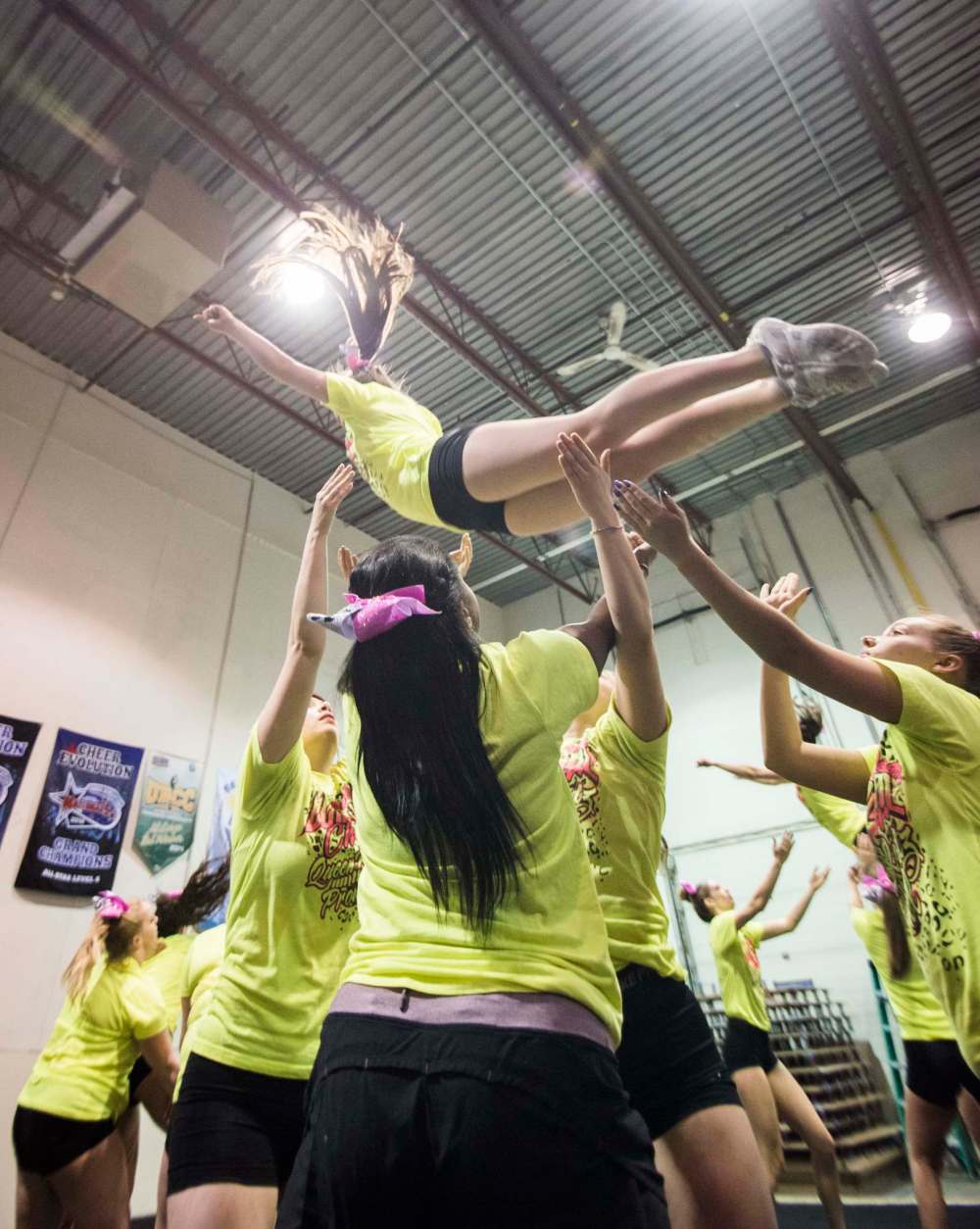
Then, of course, there are the sexist stereotypes that continue to dog cheerleading — at all levels — and the people who do it. Pop culture would have us believe that cheerleading is a vacuous activity reserved for midriff-baring high school girls, and that cheerleaders are always popular, preternaturally peppy, ditzy, bitchy, slutty or some combination thereof. And it’s little wonder so many people believe cheerleading is inherently objectifying and bad for girls; cheerleader-as-accessory or cheerleader-as-male-sex-fantasy are well-worn movie tropes. These stereotypes hurt everyone involved: when cheerleaders are reduced to short skirts, spangles and spray tans, it’s hard to see them for what they really are: skilled athletes.
“People don’t see us as athletes,” says Ceiandra Lyons, 22, a member of the Queen Katz. “They see us preppy girls who get together and jump around.”
Those stereotypes also affected how some of these women saw the sport themselves. Stuart was a gymnast who shared a gym with a cheerleading team. “When they would come in, I’d see them and I didn’t take it seriously,” she admits. “Once you try it, you realize it’s extremely hard. You need to trust your teammates, you need stamina, you need to be athletic. It’s different than what you expect.”
Their teammate, Carla Switzer, 17, is more pointed. “I never thought I’d be a cheerleader. Like, ever,” she says with a laugh. Like Stuart, she came around once she actually tried it.
And now, all three are part of a dedicated team gearing up to compete against the best in the world. “To see us grow and win a Worlds bid is surreal and something we never thought would happen,” Lyons says. “Coming home with that was a huge accomplishment. This team has come along way.”
While making it to Worlds is certainly a great goal to have, many of these cheerleaders are here simply for the sake of the challenge, or for the camaraderie found in the club. Many of the women on the Queen Katz team are deeply involved with Central Cheer, coaching younger teams. Switzer, the girl who never thought she’d be a cheerleader, is going on her sixth year with the club. For Lyons, it’s five.
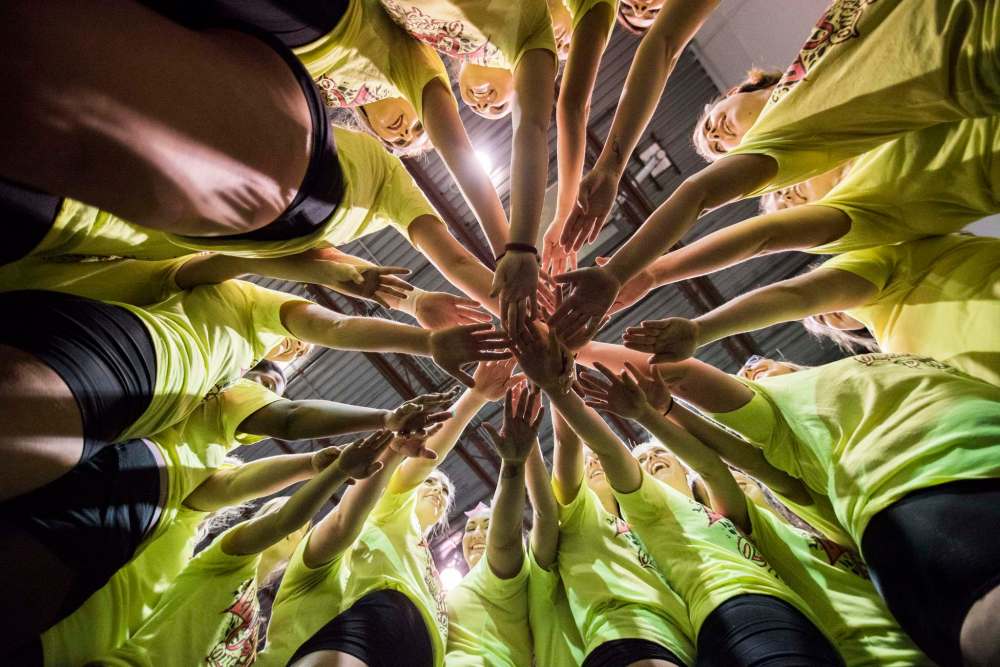
“I’ve never been on a team that has a bond like this one,” Stuart says.
“We’re 23 girls, and we’re all like sisters,” Lyons adds.
For her part, Mitchell is often rewarded by seeing the parents’ response. “They’ll be like, ‘Oh, we didn’t really know what this was.’ You see girls in crop tops and you hear all the stereotypes of cheerleading. And then their kids start and they see their confidence build, they see them make friends, seeing them be accepted. It’s so nice to see.”
What these athletes get out of being involved in cheer — discipline, commitment, the value of teamwork — is really no different than what a player gets out of being on any other sports team. To that end, Kuz says it’s a shame that many schools don’t or can’t put time and resources into establishing and running cheer programs that are accessible to anyone with an interest.
“In a school, it’s going to be a lot cheaper,” Mitchell acknowledges. “All-star cheerleading is very expensive.”
Mitchell would love to see competitive cheerleading earn wider recognition and respect — one of her dreams is to see it become an Olympic medal sport — but she’s focusing on what she can do here at home. She wants to continue to be able to send her girls to competitions, and offer more opportunities for kids to get involved at the club.
The latter goal comes from a personal place. Mitchell credits high school cheerleading with putting her on a positive path, and she’s happy to provide the same opportunity for other young people — especially those who may be struggling to find themselves outside of the gym.
“Here, they have their team, and their team is there for them, no matter what.”
jen.zoratti@freepress.mb.ca
Jen Zoratti is a columnist and feature writer working in the Arts & Life department, as well as the author of the weekly newsletter NEXT. A National Newspaper Award finalist for arts and entertainment writing, Jen is a graduate of the Creative Communications program at RRC Polytech and was a music writer before joining the Free Press in 2013. Read more about Jen.
Every piece of reporting Jen produces is reviewed by an editing team before it is posted online or published in print – part of the Free Press‘s tradition, since 1872, of producing reliable independent journalism. Read more about Free Press’s history and mandate, and learn how our newsroom operates.
Our newsroom depends on a growing audience of readers to power our journalism. If you are not a paid reader, please consider becoming a subscriber.
Our newsroom depends on its audience of readers to power our journalism. Thank you for your support.
Jen Zoratti is a columnist and feature writer working in the Arts & Life department, as well as the author of the weekly newsletter NEXT. A National Newspaper Award finalist for arts and entertainment writing, Jen is a graduate of the Creative Communications program at RRC Polytech and was a music writer before joining the Free Press in 2013. Read more about Jen.
Every piece of reporting Jen produces is reviewed by an editing team before it is posted online or published in print – part of the Free Press‘s tradition, since 1872, of producing reliable independent journalism. Read more about Free Press’s history and mandate, and learn how our newsroom operates.
Our newsroom depends on a growing audience of readers to power our journalism. If you are not a paid reader, please consider becoming a subscriber.
Our newsroom depends on its audience of readers to power our journalism. Thank you for your support.
Advertisement Advertise With Us
Advertisement Advertise With Us
History
Updated on Tuesday, May 3, 2016 8:12 AM CDT: Adds photos
Updated on Tuesday, May 3, 2016 9:10 AM CDT: Adds slideshow