

‘Death row’ dog cleared
Belfast council rules Hank no risk to public
Advertisement
Read this article for free:
or
Already have an account? Log in here »
To continue reading, please subscribe:
Digital Subscription
One year of digital access for only $75*
- Enjoy unlimited reading on winnipegfreepress.com
- Read the E-Edition, our digital replica newspaper
- Access News Break, our award-winning app
- Play interactive puzzles
*Billed as $5.77 plus GST every four weeks. After 52 weeks, price increases to the regular rate of $19.95 plus GST every four weeks. Offer available to new and qualified returning subscribers only. Cancel any time.
Monthly Digital Subscription
$4.99/week*
- Enjoy unlimited reading on winnipegfreepress.com
- Read the E-Edition, our digital replica newspaper
- Access News Break, our award-winning app
- Play interactive puzzles
*Billed as $19.95 plus GST every four weeks. Cancel any time.
To continue reading, please subscribe:
Add Free Press access to your Brandon Sun subscription for only an additional
$1 for the first 4 weeks*
- Enjoy unlimited reading on winnipegfreepress.com
- Read the E-Edition, our digital replica newspaper
- Access News Break, our award-winning app
- Play interactive puzzles
*Your next Brandon Sun subscription payment will increase by $1.00 and you will be charged $17.95 plus GST for four weeks. After four weeks, your payment will increase to $24.95 plus GST every four weeks.
Read unlimited articles for free today:
or
Already have an account? Log in here »
Hey there, time traveller!
This article was published 02/08/2016 (3580 days ago), so information in it may no longer be current.
Hank, dubbed the “death row dog” after it was seized by Northern Ireland police who thought it was a breed banned in the country, has been cleared by Belfast City Council, which ruled he does not pose a threat to the public.
Leonard Collins came home to his Belfast flat on July 14 to a notice on his door telling him that his apartment had been searched — and Hank, seized.
Earlier in the day, as many as eight Northern Ireland police officers — some with riot gear,” neighbours later told him — entered his apartment to capture Hank, a large sandy-coloured dog with big, sad eyes who, the Belfast City Council said, could possibly be a “pit bull.”
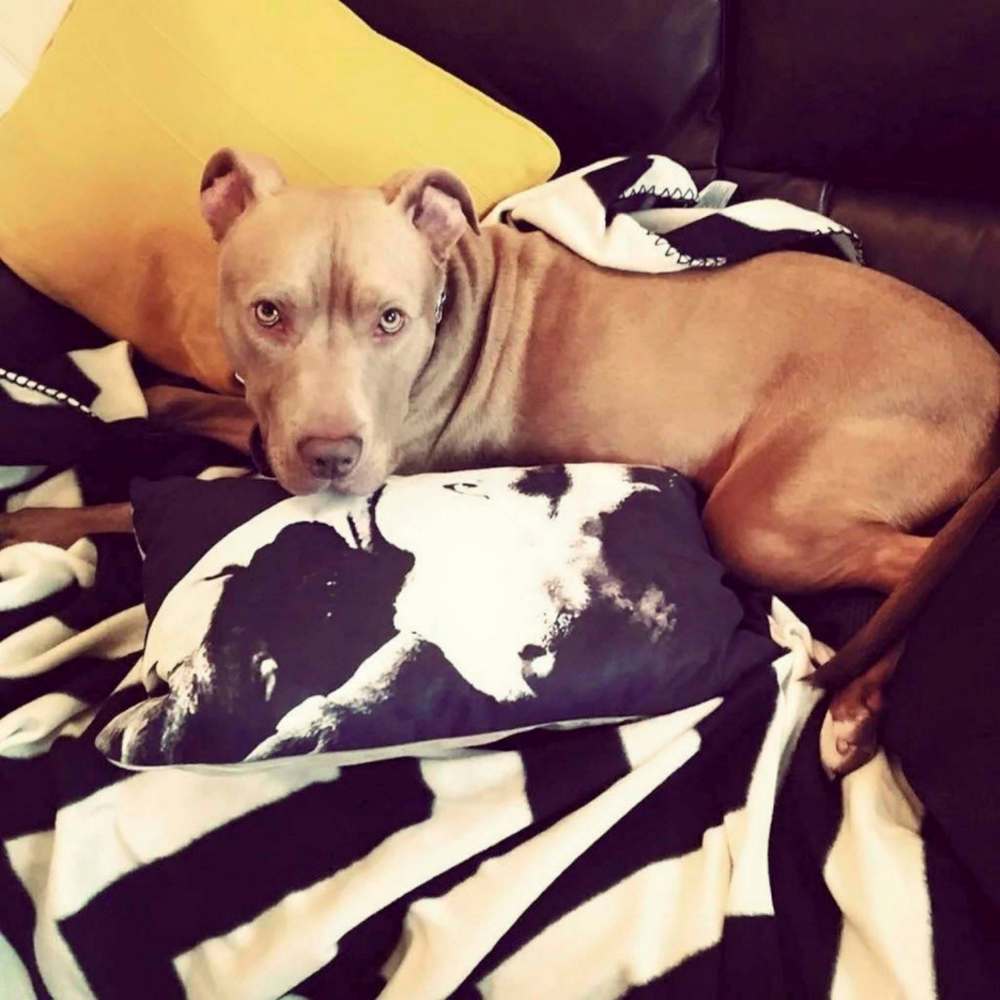
“I couldn’t believe what I was reading,” he said. “I was flabbergasted. I am flabbergasted.”
Collins and his ex-girlfriend Joanne Meadows (“We share responsibility for Hank,” he says.) immediately took to social media to plead Hank’s case and launch a #savehank campaign that has drawn nearly 300,000 signatures to an online petition, raised at least $25,000 for a legal defence fund and made “death row dog Hank” a British media obsession.
For nearly two weeks, they waited. The city could have decided to euthanize Hank — under one of the many scientifically dubious “pit bull bans” — without any evidence that he has ever been aggressive.
An official even told Collins he might not ever see his dog again.
In a letter to Collins, the city council noted that “pit bull terrier type dog is illegal in Northern Ireland” and that it would “undertake a full assessment of his characteristics” to determine whether he is a pit bull. But the council wouldn’t tell Collins what sort of assessment that would be, only that it would be carried out by a former police dog handler, Peter Tallack, who had somewhat famously ruled several years ago that another confiscated pet, Lennox, was “unpredictable and dangerous.”
The council euthanized Lennox in 2012.
On Friday, the Belfast Telegraph reported that council recommended Hank be exempted from the law and be returned to Collins once a judge grants an approval.
Collins says the initial complaint that put Hank’s life at risk was overblown.
“A couple of times people had stopped us and said, ‘Oh, he looks like a pit bull,’” Collins says. “But I never had a real concern. One or two people over a couple of years was not enough to worry over.”
Meanwhile, Collins made sure Hank was vaccinated and microchipped, regularly applied medicine to help combat a case of dermatitis and keeps him on a special diet that helps (“he only eats fish and rice,” he says). He also has occasionally taken him to animal trainers to help train his rambunctious puppy.
“I’m not going to lie: He’s a bit boisterous. And that’s probably my fault,” Collins says. He says Hank can bark at strangers and suspects that’s what caused someone to complain to the city council. He admits he probably should be sterner with him.
“But I think of him as my best friend,” he says.
If Hank had been determined to be both a banned breed and a “present danger to the public,” he would likely have faced a death sentence.
The case shines a harsh light on the breed-specific legislation that started in the United States in the mid-1980s, amid the start of a pit-bull panic and eventually swept overseas. Its popularity has slowed in recent years — Italy and the Netherlands even dropped their bans — with opposition from nearly all animal welfare groups, including the U.S. Centers for Disease Control and the White House.
Among the many problems with this type of legislation, many animal experts are quick to point out, the bans usually target the “pit bulls,” which is not an exact breed but, rather, a vague classification that loosely targets a wide variety of breeds.

Collins says he thinks Hank is half-Labrador retriever and half Staffordshire bull terrier. The United Kingdom’s sweeping Dangerous Dog Act of 1991, which specifically bans the American pit bull terrier (along with Japanese Tosa, Dogo Argentino and Fila Brasileiro) — but not the very closely related Staffordshire (a British breed). But Northern Ireland’s ban (similar, but not the same, as the U.K.’s) targets only “the pit bull terrier” — a particularly vague description.
Whether a dog expert can even differentiate between a Staffordshire and an American Pit mix is highly debatable. A recent study in the Veterinary Journal surveyed four different shelters, asking their workers to identify which of their dogs were “pit-bull breeds.“ Out of 120 dogs, the shelter staff identified 62 as pit bulls — but DNA tests revealed that only 25 were.
“Targeting dogs by dog breed just makes no sense at all,” says Páraic Ó Súilleabháin, the study’s author.
He says he thinks laws should punish bad owners, whose poor treatment of their dogs is what more likely leads to bad behaviour. Focusing on the breed of the dog ends up ignoring the root cause, he says. “It’s really unscientific and quite possibly a threat to public health.”
— Washington Post