Your furry friend might not be green

Advertisement

Advertise with us

You’ve heard about the carbon footprint, but what about the carbon paw-print? According to a new study, United States cats’ and dogs’ eating patterns have as big an effect as driving 13.6 million cars for a year.

Read this article for free:


or

Already have an account? Log in here »

To continue reading, please subscribe:

Subscribe and receive a limited-edition Free Press branded hat or tote.

Digital Subscription

One year of digital access for only $205*

  • Enjoy unlimited reading on winnipegfreepress.com
  • Read the E-Edition, our digital replica newspaper
  • Access News Break, our award-winning app
  • Play interactive puzzles

*First annual payment billed as $205.00 + GST for one year. This annual subscription will automatically renew at $233.00 + GST every 52 weeks (10% off the regular annual price of $259.35). Offer available to new and qualified returning subscribers only. Cancel any time.

To continue reading, please subscribe:

Add Free Press access to your Brandon Sun subscription for only an additional

$1 for the first 4 weeks*

  • Enjoy unlimited reading on winnipegfreepress.com
  • Read the E-Edition, our digital replica newspaper
  • Access News Break, our award-winning app
  • Play interactive puzzles
Start now

*Your next Brandon Sun subscription payment will increase by $1.00 and you will be charged $17.95 plus GST for four weeks. After four weeks, your payment will increase to $24.95 plus GST every four weeks.

Hey there, time traveller!
This article was published 08/08/2017 (3295 days ago), so information in it may no longer be current.

You’ve heard about the carbon footprint, but what about the carbon paw-print? According to a new study, United States cats’ and dogs’ eating patterns have as big an effect as driving 13.6 million cars for a year.

The findings, published in the journal PLOS ONE, reveal how our furry, four-legged companions’ consumption of meat and other animal products adds a sizable, and largely overlooked, climate cost.

When it comes to environmental effects, meat-eating takes the cake. A 2014 study in the Proceedings of the National Academy of Sciences found that producing a kilogram of chicken results in about 3.7 kilograms of carbon dioxide, while a kilogram of pork comes with 24 kilograms of carbon dioxide. The same amount of beef, however, can be responsible for up to 1,000 kilograms of CO² —a worrisome figure given that climate researchers say this greenhouse gas is largely responsible for the significant warming of the Earth’s climate.
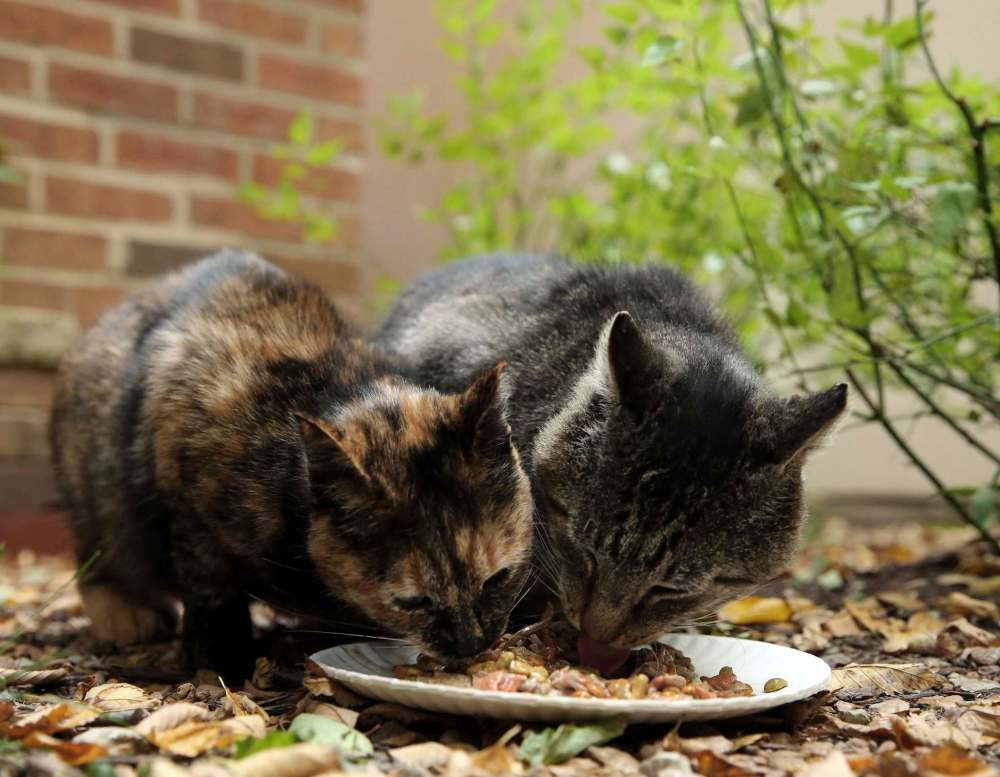
Kevin Tanaka / Chicago Tribune
According to one researcher, ‘the tradition of pet ownership in the U.S. has considerable costs’ in terms of climate change.
Kevin Tanaka / Chicago Tribune According to one researcher, ‘the tradition of pet ownership in the U.S. has considerable costs’ in terms of climate change.

That’s not even counting the livestock’s water-usage footprint, which dwarfs that of agricultural crops.

It’s a growing concern given that developed countries such as the U.S. consume lots of animal protein, and that developing countries that are economically on the rise seem to be increasing their share of meat consumption too.

But one sleepless night about five years ago, UCLA geographer Gregory Orkin realized something: those environmental assessments rarely, if ever, took into account the consumption by dogs and cats. The thought gave him pause — perhaps even paws.

“Because I couldn’t sleep, I got up and just kind of started throwing some numbers together,” he said. “It’s evolved a lot since then.”

He calculated the likely number of calories needed by the United States’ pet dogs and cats, who number around 163 million, and examined the ingredients in pet food and tallied up which ones were derived from animals.

The results? Cats’ and dogs’ overall caloric consumption was about 19 per cent that of humans in the U.S.

“Just to put that in context, that’s about the same amount of calories that the country of France consumes, and so that whet my appetite a little bit,” Orkin said.

Notably, dogs and cats actually consumed about 33 per cent of the animal-derived calories that humans did, perhaps because their diets are generally more meat-heavy than ours, Orkin said. On the other end, they also produce about 30 per cent of the feces that humans do (and much of that gets thrown in the trash in plastic bags, instead of treated how human waste is).

In short, Orkin concluded, American dogs and cats eat enough animal product to account for about 64 million tons of methane and nitrous oxide, two other powerful greenhouse gases. That’s about the same impact on our warming climate as driving 13.6 million cars for a year.

“Americans are the largest pet owners in the world, but the tradition of pet ownership in the U.S. has considerable costs,” he wrote. “As pet ownership increases in some developing countries, especially China, and trends continue in pet food toward higher content and quality of meat, globally, pet ownership will compound the environmental impacts of human dietary choices.”

Orkin stressed that he wasn’t advocating giving up beloved furry friends — far from it. But for people who want to be aware of their environmental impact so that they can try to reduce it, it’s probably worth knowing the full effect of their household, canines and felines included.

There’s also a movement toward putting more meat in pet foods, perhaps driven by what Orkin called the “humanization” of pet products. But dogs aren’t pure carnivores. They’re omnivorous, having developed the ability to readily digest starches — possibly from the trash heaps that accumulated around ancient human encampments. So dogs, at least, could potentially get even more of their required protein from non-animal sources than pet owners may commonly think.

“I certainly hope these kinds of numbers will encourage the market to consider adding those as market choices, and I also think that individuals can make choices,” Orkin said.

— Los Angeles Times

History

Updated on Tuesday, August 8, 2017 8:22 AM CDT: Photo added.

Report Error Submit a Tip

More Stories

WRHA directs three care homes to accommodate surge of hospital patients

Malak Abas 5 minute read Preview

WRHA directs three care homes to accommodate surge of hospital patients

Malak Abas 5 minute read Friday, Aug. 14, 2026

The Winnipeg Regional Health Authority has directed three long-term care centres to make space for hospital patients, citing “exceptionally high demand for care across the health-care system.”

Read
Friday, Aug. 14, 2026

Poilievre’s lips moving, but Canadians aren’t interested in what he’s saying

Tom Brodbeck 5 minute read Preview

Poilievre’s lips moving, but Canadians aren’t interested in what he’s saying

Tom Brodbeck 5 minute read Thursday, Aug. 6, 2026

Pierre Poilievre’s biggest political challenge right now isn’t Prime Minister Mark Carney’s popularity.

It’s the fact that he still seems to be campaigning against a political landscape that no longer exists.

More than a year after the 2025 federal election, the Conservative leader is still relying on the same message, the same themes and the same attacks that defined his party’s campaign before voters went to the polls.

And Canadians appear to be tuning it out.

Read
Thursday, Aug. 6, 2026

Rainbow Stage’s Legally Blonde a lovely legal musical

Holly Harris 6 minute read Preview

Rainbow Stage’s Legally Blonde a lovely legal musical

Holly Harris 6 minute read Friday, Aug. 14, 2026

Omigod, you guys! Rainbow Stage kicked off its penultimate summer production Thursday with a high-octane joy machine bathed in a sea of pink.

Inspired by the 2001 Hollywood film starring Reese Witherspoon, and Amanda Brown’s same-titled novel, the award-winning Legally Blonde: The Musical — featuring a book by Heather Hach, with music/lyrics by Laurence O’Keefe and Nell Benjamin — opened on Broadway in April 2007, followed by a subsequent West End run.

The tale — equal parts cheesy rom-com and potent siren call for female autonomy and empowerment — focuses on quintessential Cali-girl Elle Woods (a pitch-perfect Claire Mac Master). A proud daughter and president of Delta Nu sorority house, she enrols at Harvard Law School to win back her upwardly mobile ex-boyfriend, Warner Huntington III (Duncan Cox).

Laser-focused on marrying a “Jackie, not a Marilyn,” Warner dreams of becoming an American senator, latching onto uber-preppy fellow pupil Vivienne Kensington (Julie Davis), who becomes Elle’s arch nemesis.

Read
Friday, Aug. 14, 2026

Foster mom pleads guilty to assault that left six-year-old-girl paralyzed

Dean Pritchard 4 minute read Preview

Foster mom pleads guilty to assault that left six-year-old-girl paralyzed

Dean Pritchard 4 minute read Friday, Aug. 14, 2026

A Winnipeg foster mother has admitted to violently assaulting her ill foster daughter and leaving her paralyzed after the girl resisted the woman’s efforts to provide her with medication, a court has heard.

Marilyn Keno, 26, pleaded guilty Friday to one count of aggravated assault.

Keno remains in custody and will be sentenced at a later date following the completion of a court-ordered pre-sentence report.

The maximum sentence for aggravated assault is 14 years in prison. Crown attorney Alanna Littman and defence lawyer Jeremy Kostiuk did not disclose what sentences they will be recommending.

Read
Friday, Aug. 14, 2026

West Kildonan Industrial residents call for speed bumps after child hit by truck

Morgan Modjeski 3 minute read Preview

West Kildonan Industrial residents call for speed bumps after child hit by truck

Morgan Modjeski 3 minute read Updated: Yesterday at 3:09 PM CDT

Residents in the West Kildonan Industrial neighbourhood are calling on the city to install speed bumps in their area after a child was hit and dragged by a vehicle Thursday.

Katelyn Bemister lives near the area where the child — who was hospitalized as a result of the incident and has been upgraded to stable condition — was struck. She says people frequently speed in the area.

“They’re going really fast, and they’re not really paying attention at all to the pedestrians in the area,” says Bemister.

In video supplied to the Free Press by a resident, the child can be seen riding a bike down a sidewalk along the 500 block of North Point Boulevard.

Read
Updated: Yesterday at 3:09 PM CDT

Impaired driving victim honoured

Morgan Modjeski 5 minute read Preview

Impaired driving victim honoured

Morgan Modjeski 5 minute read Yesterday at 6:16 PM CDT

Ten years after he was killed in a collision involving an impaired driver in 2016, Robbie Anderson’s name has been added to MADD Canada’s Manitoba Memorial honouring those killed in drunk and drug-impaired-related crashes.

His older brother Chris Anderson, was one of two dozen people who gathered at the Glen Eden Funeral Home and Cemetery in West St. Paul Saturday to remember their loved ones, 86 victims whose names are etched into the granite monument near the heart of the graveyard.

“It’s heavy,” said Anderson when asked what it was like to be part of the ceremony and see his brother’s name added. “It’s been something I’ve been thinking about for a while.”

Grateful for MADD’s work and its efforts to honour Robbie, who was 27 when he died, Anderson said his brother, represented the “absolute best of us.”

Read
Yesterday at 6:16 PM CDT