WEATHER ALERT

In Conversation with Amy Goodman

Advertisement

Advertise with us

At Knox United Church last weekend, award-winning American journalist Amy Goodman shared insights from more than two decades spent working in independent journalism.

Read this article for free:

or

Already have an account? Log in here »

To continue reading, please subscribe:

Subscribe and receive a limited-edition Free Press branded hat or tote.

Digital Subscription

One year of digital access for only $205*

  • Enjoy unlimited reading on winnipegfreepress.com
  • Read the E-Edition, our digital replica newspaper
  • Access News Break, our award-winning app
  • Play interactive puzzles

*First annual payment billed as $205.00 + GST for one year. This annual subscription will automatically renew at $233.00 + GST every 52 weeks (10% off the regular annual price of $259.35). Offer available to new and qualified returning subscribers only. Cancel any time.

To continue reading, please subscribe:

Add Free Press access to your Brandon Sun subscription for only an additional

$1 for the first 4 weeks*

  • Enjoy unlimited reading on winnipegfreepress.com
  • Read the E-Edition, our digital replica newspaper
  • Access News Break, our award-winning app
  • Play interactive puzzles
Start now

*Your next Brandon Sun subscription payment will increase by $1.00 and you will be charged $17.95 plus GST for four weeks. After four weeks, your payment will increase to $24.95 plus GST every four weeks.

Hey there, time traveller!
This article was published 07/10/2017 (3201 days ago), so information in it may no longer be current.

At Knox United Church last weekend, award-winning American journalist Amy Goodman shared insights from more than two decades spent working in independent journalism.

Goodman’s radio and broadcast program, Democracy Now!, has been on the air since 1996, when it began covering the U.S. presidential election that saw Bill Clinton re-elected for a second term. Her reporting on the Dakota Access pipeline protests in North Dakota last year helped spur national debate and nearly got her arrested.

Here are excerpts from Goodman’s speech, which spanned more than an hour and emphasized the importance of independent journalism and having networks separated from corporate interests.
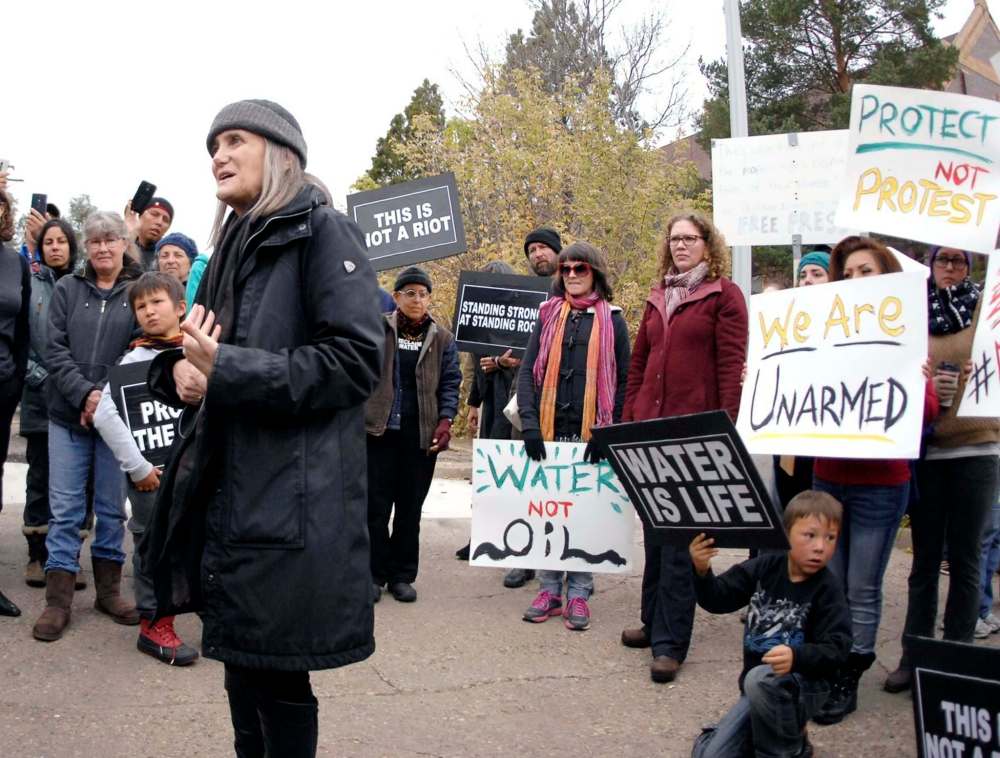
Mike McCleary / The Bismarck Tribune Files
Journalist Amy Goodman of Democracy Now! speaks to supporters in Mandan, N.D.
Mike McCleary / The Bismarck Tribune Files Journalist Amy Goodman of Democracy Now! speaks to supporters in Mandan, N.D.

“The media is a huge kitchen table that stretches across the globe that we all sit around and debate and discuss the most important issues of the day — war and peace, life and death,” Goodman said. “Anything less than that is a disservice to the servicemen and women of our countries.”

On the beginnings of Democracy Now!

“There was more demand for the show after than before (the election) and it just kept growing. Our mission was to go to where the silence was — to go to communities all over the country in the midst of an election where most people didn’t vote… I didn’t think it was apathy.

“But I wanted to know what people were doing in their communities and so that’s where we went — to where the power and the truths are.

“We’re not like the rest of the corporate networks, as you know, and neither are your public media in Canada. We don’t bring you this small circle of pundits who know so little about so much, explaining the world to us and getting it so wrong.

“No, it’s our mission to provide forum for people to speak for themselves. There is nothing more powerful.”

On the media’s relationship with Donald Trump

“We now in the United States have a much more oppositional media because the president of the United States… attacks the media directly, calling individuals names, you know talking about the ‘failing New York Times’ and ‘fake news CNN.’

“And so in order to defend themselves… they are fighting back and they are sounding a lot like Democracy Now! when they say, ‘We must fight for an independent media. Media is essential to the functioning of a democratic society.’

“And it is. You just don’t usually hear them talking like this and calling out the president. For example, calling out his lies. The New York Times has just listed a litany of lies and they don’t say ‘misstatements’ or ‘misinformation.’ They say lies. That’s a very big deal.”

On climate change

“We know that well over 95 per cent of the scientific establishment in the world believes that human beings have something to do with climate change and we have to do something about it.

“Our president calls it a Chinese hoax. And it is really something that in the midst of hurricanes Harvey and Irma, and Houston and the south of the United States, Florida and the Caribbean, who are drowning, he comes to North Dakota and holds a speech outside of an oil refinery. Not far from where hundreds of Native Americans were jailed and imprisoned and tried (near Standing Rock) for trying to save the planet…

“When it comes to the corporate media and hurricanes, (it’s) 24-hour-a-day coverage… but they almost never raise those two words: climate change, or climate disruption, climate chaos.

“I mean, they’ll flash the words, ‘extreme weather,’ ‘severe weather,’ repeatedly. People tune into television just to see what they should wear that day. But we have to tune in to see what we can do about it.”

On political protests and taking a knee

“This past weekend, beginning on Friday night, (Trump) starts to attack black athletes. This is as Puerto Rico is drowning. Fifteen tweets attack-ing African-American athletes and not one tweet about what he was going to do about Puerto Rico.

“Yes, they both had something in common with each other: the people he was tweeting against and the people of Puerto Rico largely, of course, didn’t vote for him and were people of colour.

“It’s the very population he has campaigned against and his family has worked against for so long. His dad was arrested, Fred Trump, in 1927 at a Ku Klux Klan rally. And then his father took him into the fold, into his development business, and one of the first things Donald Trump as a young developer had to deal with was a justice department lawsuit for not allowing African-Americans into their community housing projects.

“I mean, he is nothing if he is not consistent. So don’t believe the hype when they say he is pure chaos and he changes his mind every day. He’s surely very consistent on these issues and certainly showed that right through to today…

“I don’t think any of us thought this was possible. Let’s just say the owners of the NFL and the players don’t exactly get along… Trump managed to do something that no one has managed to do before and that is bring all of them together, locking arms, standing shoulder to shoulder or taking a knee. It has been just astounding. And the owners are some of his biggest supporters right through his presidency, but they couldn’t take this.

“Where this goes, we will see. I mean, whoever thought I would be looking forward to this football season?”

j.botelho.urbanski@gmail.com
 

Report Error Submit a Tip

More Stories

‘Very quiet around here’: Duck Mountain biz owners plead for assistance after flooding washes out park

Morgan Modjeski 5 minute read Preview

‘Very quiet around here’: Duck Mountain biz owners plead for assistance after flooding washes out park

Morgan Modjeski 5 minute read Saturday, Jul. 11, 2026

Business owners at Duck Mountain Provincial Park who have lost thousands in revenue say they’re feeling left out of flood-recovery assistance in the Parkland region.

Dawn Dowsett, owner of Blue Lake Resort, said life has been chaotic since the park closed on June 30 due to road washouts.

While there is limited access to the park, with some seasonal campers and cabin owners returning, it’s listed as closed on the Government of Manitoba’s website, with no nightly camping available until July 23.

She says the resort, which includes a restaurant and store, is missing out on part of the summer, a peak time for the business.

Read
Saturday, Jul. 11, 2026

Top prospect Viggo Björck plans future with Jets

Mike McIntyre 5 minute read Preview

Top prospect Viggo Björck plans future with Jets

Mike McIntyre 5 minute read Yesterday at 2:19 PM CDT

The stage appears to be set for Viggo Björck to make an immediate impact with the Winnipeg Jets.

A significant development occurred this weekend when Djurgården — the Swedish team Björck was under contract for the coming season — announced the 18-year-old was departing the organization under very positive terms.

“Viggo Björck has chosen to leave Djurgården to continue his career in the Winnipeg Jets organization next season,” the news release stated.

The announcement prompted vastly different reactions depending on your perspective.

Read
Yesterday at 2:19 PM CDT

‘Cautious optimism’ in Brandon as river crests

Scott Billeck 2 minute read Preview

‘Cautious optimism’ in Brandon as river crests

Scott Billeck 2 minute read 11:17 AM CDT

Water levels on the Assiniboine River, which have threatened Manitoba’s second-largest city over the past week, crested overnight, Brandon officials said Monday.

The river reached 1,179.46 feet, “indicating the river level has stabilized and reached its peak overnight,” according to an update posted on the city’s website.

The level stood at 1,179.23 feet on Sunday morning after rising 1.63 feet from Saturday. Officials had expected it to climb by as much as another foot before cresting. Overall, the river has risen about 7.5 feet over the past week.

Despite the crest, residents are still being urged to remain prepared as conditions could change.

Read
11:17 AM CDT

U of W falls back on tuition hikes amid budget crunch

Maggie Macintosh 5 minute read Preview

U of W falls back on tuition hikes amid budget crunch

Maggie Macintosh 5 minute read 6:00 AM CDT

The University of Winnipeg has joined other public post-secondary institutions across the province in hiking tuition rates by four per cent — as high as possible — for the fall.

Domestic fees are increasing by more annually in 2026-27 than they have in eight years in Manitoba.

International rates, which are unregulated and roughly four times those paid by their Canadian peers, are rising even higher.

U of W’s board of regents approved a $180.7-million budget on June 22 that increases costs in undergraduate and graduate programs and phases out “low rate” courses on the downtown campus.

Read
6:00 AM CDT

First-aid volunteers treat folk fest attendees suffering from heat

Eva Wasney and Jill Wilson 4 minute read Preview

First-aid volunteers treat folk fest attendees suffering from heat

Eva Wasney and Jill Wilson 4 minute read Yesterday at 11:16 PM CDT

Shade was at a premium at Birds Hill Provincial Park over the weekend as Winnipeg Folk Festival goers tried to keep cool during an extreme heat wave.

Heat warnings were issued across southern Manitoba and temperatures peaked at 35 C Sunday afternoon.

First-aid volunteers were seen administering cold compresses to several overheated attendees. STARS air ambulance responded to a medical call at the park on Saturday night, but did not transport the patient to hospital. By Sunday at noon, EMS had been called to the festival nine times.

“This is not an unusual number of calls for us or other events of our size,” festival executive director Valerie Shantz said.

Read
Yesterday at 11:16 PM CDT

If it works in Ontario, why not in Manitoba?

James Wilt 5 minute read Preview

If it works in Ontario, why not in Manitoba?

James Wilt 5 minute read 2:00 AM CDT

Grid-scale battery storage has fundamentally changed the global energy landscape — and Manitoba needs to get on board.

Battery systems store large amounts of excess electricity for when it’s most needed. While they can be charged from any generation source, they are especially beneficial for integrating wind and solar power, which vary with weather and time of day. Batteries allow electrical grids to meet the need for firm, dispatchable and affordable capacity using renewable energy, rather than relying on coal, nuclear and fossil gas. They also provide numerous other benefits, including reducing overloading of transmission infrastructure and helping to regulate the grid’s frequency and voltage.

Average costs for grid-scale batteries plummeted by more than half between 2023 and 2025 and installations have skyrocketed in China, the U.S., Australia and Europe. Texas now has 16,500 megawatts (MW) of battery storage, while California has 15,200 MW. Closer to home, Ontario recently awarded 640 MW of contracts to three battery storage projects in a competitive auction, with batteries beating out fossil gas-fired power plants on cost every time. One of these projects will be built near Dryden, only four hours east of Winnipeg.

Each battery system will provide eight hours of capacity but will cost considerably less than Ontario’s previous battery procurements, which provide only four hours of capacity. With this latest auction, Ontario has now secured 3,600 MW of battery storage capacity, including the operational Oneida (250 MW), Hagersville (300 MW) and Napanee (250 MW) projects. Almost all have significant Indigenous participation, with the latest procurements boasting 50 per cent First Nations ownership.

Read
2:00 AM CDT