Modern bike helmets far from perfect

Experts call for dramatic changes in protective gear

Advertisement

Advertise with us

Whether helmet use should be mandatory for bicycle riders is a heated topic.

Read this article for free:

or

Already have an account? Log in here »

To continue reading, please subscribe:

Subscribe and receive a limited-edition Free Press branded hat or tote.

Digital Subscription

One year of digital access for only $205*

  • Enjoy unlimited reading on winnipegfreepress.com
  • Read the E-Edition, our digital replica newspaper
  • Access News Break, our award-winning app
  • Play interactive puzzles

*First annual payment billed as $205.00 + GST for one year. This annual subscription will automatically renew at $233.00 + GST every 52 weeks (10% off the regular annual price of $259.35). Offer available to new and qualified returning subscribers only. Cancel any time.

To continue reading, please subscribe:

Add Free Press access to your Brandon Sun subscription for only an additional

$1 for the first 4 weeks*

  • Enjoy unlimited reading on winnipegfreepress.com
  • Read the E-Edition, our digital replica newspaper
  • Access News Break, our award-winning app
  • Play interactive puzzles
Start now

*Your next Brandon Sun subscription payment will increase by $1.00 and you will be charged $17.95 plus GST for four weeks. After four weeks, your payment will increase to $24.95 plus GST every four weeks.

Hey there, time traveller!
This article was published 07/10/2017 (3219 days ago), so information in it may no longer be current.

Whether helmet use should be mandatory for bicycle riders is a heated topic.

You’re undoubtedly better off wearing a helmet if an accident occurs, and the importance of wearing a helmet increases with the significance of the accident. But while helmets have come a long way since the strappy leather head coverings some cyclists wore before the 1970s, they still don’t do much to protect us from concussions.

Helmet experts are calling for radically new designs to improve safety.

Douglas Barnes / The Associated Press Files
A city report sidestepped the issue about whether bike helmets should be mandatory.
Douglas Barnes / The Associated Press Files A city report sidestepped the issue about whether bike helmets should be mandatory.

Studies have found that in an accident, you’re much less likely to suffer a severe brain injury if you’re wearing a helmet than if you’re not, but your odds of experiencing minor brain trauma are similar. That’s because modern helmets are lined with hard foam. The design can withstand a serious impact, protecting your skull from fracturing against a hard surface such as pavement, but the rigid foam doesn’t absorb as much energy as a softer liner, such as those found in football helmets.

The best protection for a bicyclist would be a helmet made from a softer material thick enough to absorb any impact, but “nobody wants to bike around with a mushroom on their head,” said Mehmet Kurt, who studies head injury prevention at the Stevens Institute of Technology in Hoboken, N.J.

Consumer preference has often driven helmet design, and not always in the direction of safety.

Randy Swart, director of the Bicycle Helmet Safety Institute, a non-profit based in Arlington, Va., said the transition from round helmets to elliptical or oval-shaped ones in the 1990s was “certainly not an improvement” safety-wise. But people wanted to look like Lance Armstrong.

According to Roy Burek, a visiting professor at the Concussion and Traumatic Brain Injury Prevention Group at Cardiff University in Wales, cyclists can face four basic types of brain injury: skull fractures, interior brain bruising and swelling, brain bleeding, and twisting or distortion of the brain.

Skull fractures and brain bruising result from direct impact and linear energy — the sort you would experience if you fell and hit your head on a curb.

Bike helmets protect from these injuries quite well. The hard-to-crack polycarbonate layer on the outside of helmets prevents skull fractures. Microscopic air pockets in the hard foam lining inside helmets burst in a crash, allowing the lining to compress to about 25 per cent of its volume and absorbing much of the impact that would send the skull smashing into the brain.

When a rider goes flying and skids to a stop, the brain experiences the effects of rotational energy, which can produce internal bleeding and contortion.

“The brain is a little bit like an orange in a glass of water,” Burek said.

“If you twist the glass quickly, the orange won’t follow immediately behind.”

Now imagine that the orange is attached to the glass by little vessels. Those vessels will tear when the glass moves but the orange doesn’t (or when the orange moves much more slowly).

That’s what happens with the brain inside the skull.

As the skull whips around, the small blood vessels that stretch from the brain to the skull break, causing bleeding in the brain.

In addition to tearing blood vessels, the brain itself also twists.

Helmets do a pretty good job of protecting riders from skull fractures and brain bruising. They don’t do much to prevent injuries resulting from rotational energy.

Helmet design could go in many directions. Swart envisions a smooth, round helmet with a softer material that survives more-dramatic impacts but wouldn’t need to be impractically thick.

Burek noted that most bicycle accidents occur at low speeds, so an ideal material for a helmet would be soft when you land at low speeds, to allow the brain to move and thus decrease damage from rotational energy. But that material would also be “smart” — firming up when a high-speed crash occurred, thus preventing a skull fracture.

Helmets are not designed to move when you crash, because you really don’t want them falling off.

“We need to come up with materials that don’t collapse head on, but twist and move in different directions like a second scalp,” Burek said.

It’s a bit like landing on a water bed instead of a firm mattress.

— Special to The Washington Post

Report Error Submit a Tip

More Stories

Body of 11-year-old Calgary boy missing for two weeks found in water pipe

Dayne Patterson and Bill Graveland, The Canadian Press 5 minute read Preview

Body of 11-year-old Calgary boy missing for two weeks found in water pipe

Dayne Patterson and Bill Graveland, The Canadian Press 5 minute read Updated: Yesterday at 6:24 AM CDT

CALGARY - An 11-year-old Calgary boy who disappeared two weeks ago has been found dead in a labyrinth of pipes under the city, police announced Wednesday.

Chief Katie McLellan said the boy, named Parker, was discovered in a small water pipe underneath Deerfoot Trail, the city's major north-south expressway.

"For nearly two weeks, so many people woke up hoping it would be the day Parker came home," McLellan told reporters.

"Instead, we are here sharing news that is heartbreaking for his family and for everyone who has been carrying that hope."

Read
Updated: Yesterday at 6:24 AM CDT

Drug site open house called off after media tipped off

Nicole Buffie 5 minute read Preview

Drug site open house called off after media tipped off

Nicole Buffie 5 minute read Updated: Yesterday at 7:09 AM CDT

Local business owners are miffed an open house for the upcoming supervised consumption site was cancelled after the media found out about it and interest swelled.

Read
Updated: Yesterday at 7:09 AM CDT

Giant Tiger to close downtown, area residents bemoan dwindling grocery options

Nicole Buffie 4 minute read Preview

Giant Tiger to close downtown, area residents bemoan dwindling grocery options

Nicole Buffie 4 minute read Yesterday at 6:34 PM CDT

One of the only remaining grocery-store options for people living downtown and in the Exchange District is closing its doors.

Red notices on the windows at Giant Tiger’s Donald Street and Ellice Avenue location advised passersby the store will close on Nov. 7.

Chain spokesperson Jessica Charbonneau said in an email the decision to shutter stores is “not taken lightly and is made with careful consideration and thorough analysis.”

The store was busy Thursday afternoon.

Read
Yesterday at 6:34 PM CDT

South Osborne residents fail in bid to prevent construction of 131-unit apartment tower

Malak Abas 4 minute read Preview

South Osborne residents fail in bid to prevent construction of 131-unit apartment tower

Malak Abas 4 minute read Wednesday, Jul. 29, 2026

A proposed 10-storey highrise on an empty south Osborne lot will move forward despite concerns from residents about the impact the building will have on nearby parking and traffic.

The city-owned lot at 425 Osborne St., which previously served as a gas station but has long sat vacant, will be developed into a mixed-use residential building with 131 units, 39 of which would be affordable, along with additional office space for the adjacent Winnipeg Transit garage and the Transit customer service centre across the street, along with a two-level parkade for tenants and Transit employees.

The property is being developed by the University of Winnipeg Community Renewal Corp. 2.0, and designed by Prairie Architects Inc.

At a meeting held by city council’s appeal committee Wednesday, several residents said while they supported the idea of more housing in the Lord Roberts neighbourhood, they had lingering concerns about the impact the development will have on the already-busy area.

Read
Wednesday, Jul. 29, 2026

Wild weather uproots trees across city, leaves thousands in Manitoba without power

Chris Kitching 8 minute read Preview

Wild weather uproots trees across city, leaves thousands in Manitoba without power

Chris Kitching 8 minute read Updated: Yesterday at 5:06 PM CDT

This summer’s latest barrage of severe thunderstorms caused widespread property damage and power outages for more than 30,000 Manitoba Hydro customers, mostly in Winnipeg, as winds of up to 133 km/h wreaked havoc.

Charleswood resident Ian Glover’s house had minor damage compared with a neighbour’s home, where a large, uprooted poplar tree crashed through the roof while the storm pummelled Winnipeg late Wednesday night and early Thursday.

“I opened the window after I woke up (around 6 a.m.) and the tree — oh my God,” Glover said. “I got my wife up and she couldn’t believe it. I was totally blown away. (Our neighbour) said the branch went right through the house into their living room.”

Glover was thankful his neighbours were not injured. Some of the tree’s outer branches clipped the corner of his home.

Read
Updated: Yesterday at 5:06 PM CDT

Squash-ing the competition

Grace Penner 7 minute read Preview

Squash-ing the competition

Grace Penner 7 minute read Yesterday at 5:30 PM CDT

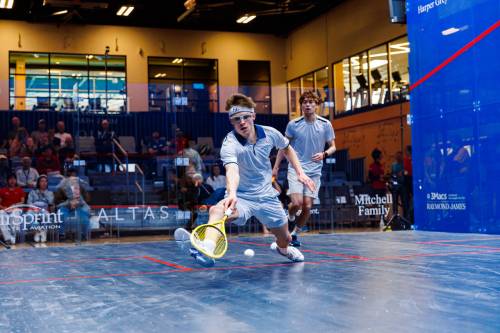
The Thiessen bloodline is no stranger to racquet sport, and 19-year-old Ivo Thiessen is no different as an up and coming Manitoban squash player.

Thiessen started the sport at a young age, first introduced to the enclosed court and rubber ball by his father, John — an avid squash player himself.

“When I was younger, he was just taking me down (to the Racquet Club), throwing me on the court and making me hit a ball,” Thiessen explained. “Then it just progressed. He kept putting me in lessons, kept pushing me and then I started to actually begin enjoying it once I figured it out a bit.”

Thiessen not only had the support from his father, but from other family members who had a personal love of the game.

Read
Yesterday at 5:30 PM CDT