Finns show us they’re a close-knit society
Advertisement
Read this article for free:
or
Already have an account? Log in here »
To continue reading, please subscribe:

Digital Subscription
One year of digital access for only $205*
- Enjoy unlimited reading on winnipegfreepress.com
- Read the E-Edition, our digital replica newspaper
- Access News Break, our award-winning app
- Play interactive puzzles
*First annual payment billed as $205.00 + GST for one year. This annual subscription will automatically renew at $233.00 + GST every 52 weeks (10% off the regular annual price of $259.35). Offer available to new and qualified returning subscribers only. Cancel any time.
To continue reading, please subscribe:
Add Free Press access to your Brandon Sun subscription for only an additional
$1 for the first 4 weeks*
- Enjoy unlimited reading on winnipegfreepress.com
- Read the E-Edition, our digital replica newspaper
- Access News Break, our award-winning app
- Play interactive puzzles
*Your next Brandon Sun subscription payment will increase by $1.00 and you will be charged $17.95 plus GST for four weeks. After four weeks, your payment will increase to $24.95 plus GST every four weeks.
Read unlimited articles for free today:
or
Already have an account? Log in here »
Hey there, time traveller!
This article was published 20/02/2018 (3127 days ago), so information in it may no longer be current.
There are a lot of scary ways Olympic athletes can get hurt at the Winter Games in Pyeongchang, South Korea.
For instance, they can shatter a limb while rocketing down the side of a mountain on a pair of fibreglass planks in one of the treacherous Alpine skiing events.
• Or lose a medically important organ while sliding down an ice-filled chute at speeds of up to 140 km/h in the terrifying luge races.
• Or batter their helmeted heads flipping and flopping in mid-air while attempting a “switch-frontside 1080 double cork” during a jump in the hair-raising halfpipe snowboarding competition.
• Or accidentally stab themselves in the eyeball with a knitting needle while trying to escape the stress of competition on the world’s biggest athletic stage.
It’s mostly that last Olympic hazard I want to talk about today.
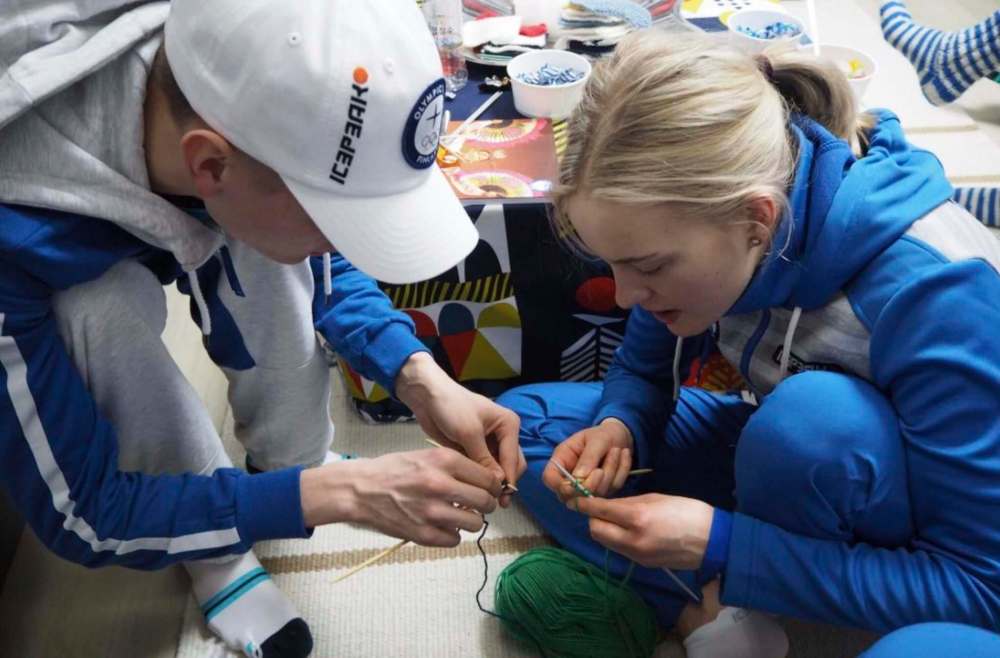
For those of you who have not been spending every waking hour on your couch watching the action in Pyeongchang, what you need to know is members of the Finnish team have taken the world by storm — partly for their athletic prowess, but mostly because of their passion for knitting.
Seriously, about half of Finland’s 102-strong Olympic team have been spotted pulling out their knitting needles as a form of stress relief.
The head coach of Finland’s snowboarding team, Antti Koskinen, became a social media sensation last week when photos were posted online showing him furiously knitting at the top of one of the runs in Pyeongchang.
Chirped one enthusiastic Twitter user: “The Finnish coach is KNITTING at the top of the Slopestyle course. Someone please find out what this man is making!!!”
“It has become something of a hobby for me,” Koskinen explained at a news conference where the Finnish athletes put their knitting chops on display. “I mean I do it every four years… it is a nice, Finnish thing… it means no unnecessary chit-chat is needed.”
Chit-chat aside, the Finns started their knitting experiment four years ago at the Sochi Games, where they knitted a scarf as a present for their team at the Summer Games in Rio, not that anyone in Rio would need a scarf.
In Pyeongchang, however, the Finns are knitting for a much smaller recipient.
“We are knitting a blanket for our president’s (newborn) child,” the snowboard coach told the media. “Everyone is knitting a little square, and then we will join them together.”
When we first saw TV footage of one of the Finnish Olympians knitting, my wife and I expressed widely differing sentiments.
What with me being an insensitive North American lout, my initial reaction was something along the lines of: “Huh?”
Whereas my wife, She Who Must Not Be Named, who was busy knitting at that moment, thought the idea of Olympians knitting themselves together through knitting was a heart-warming yarn.
“I think it’s absolutely wonderful!” she chirped.
“And they are only knitting little squares so it will most definitely help to keep them calm.
“If they were tackling something more intricate like the hand warmers I’m knitting at the moment it would make them more stressed.”
I am not surprised that a Nordic nation is at the forefront of Olympic knitting,.
But I am surprised the Finns are leading the way instead of the athletes from Norway, which is where my wife’s ancestors are from.
The Norwegians are such giant knitting fans that, a few years back, their state-run TV channel dedicated five hours of live airtime to something called National Knitting Night.
That’s a show wherein a team of eight needle-wielding Norwegian knitters attempted to break the world record for completing a sweater, starting with shearing the wool off the back of a live sheep. Yes, FIVE HOURS OF LIVE TELEVISED KNITTING!
I don’t know about you, but I think that sounds even more exciting than televised bowling.
(For the record, it took the Norwegians eight hours and 33 minutes of non-stop knitting to finish their sweater, well off the record of four hours, 45 minutes and 53 seconds held by a joint team of knitters from the Netherlands and Germany.)
Before you drop a stitch, allow me to confess that, while I am inspired by the Finnish Olympians, I personally fear the practice of knitting is driving my family apart.
I base this on the fact that, every second week, when my wife hosts a gathering of her women-only knitting club (Wine, Women and Wool), I am ordered to leave the house and spend time with my buddy Bob.
Otherwise I will “get on their nerves.”
Even worse, as we sit in the den watching the Winter Games, I will try to focus on the TV, whereas my wife will devote all her mental energy to her non-stop stitching.
“Wow! That skater just landed a Triple Lutz!” I will chirp.
“KLIK-KLAK! KLIK-KLAK!” my wife’s knitting needles will reply.

“Ooh, that was a nice triple-toe loop with a Quad Axel, eh?” I will continue.
“KLIK-KLAK! KLIK-KLAK!” her needles will reply.
On the one hand, I find this extremely annoying. On the other hand, it looks like she’s making me a new sweater.
So, for now, I’m willing to have the wool pulled over my eyes.
doug.speirs@freepress.mb.ca