Humanized lives for pets the new norm
From offices to airplanes, the welcome mats are coming out for animals
Advertisement
Read this article for free:
or
Already have an account? Log in here »
To continue reading, please subscribe:

Digital Subscription
One year of digital access for only $205*
- Enjoy unlimited reading on winnipegfreepress.com
- Read the E-Edition, our digital replica newspaper
- Access News Break, our award-winning app
- Play interactive puzzles
*First annual payment billed as $205.00 + GST for one year. This annual subscription will automatically renew at $233.00 + GST every 52 weeks (10% off the regular annual price of $259.35). Offer available to new and qualified returning subscribers only. Cancel any time.
To continue reading, please subscribe:
Add Free Press access to your Brandon Sun subscription for only an additional
$1 for the first 4 weeks*
- Enjoy unlimited reading on winnipegfreepress.com
- Read the E-Edition, our digital replica newspaper
- Access News Break, our award-winning app
- Play interactive puzzles
*Your next Brandon Sun subscription payment will increase by $1.00 and you will be charged $17.95 plus GST for four weeks. After four weeks, your payment will increase to $24.95 plus GST every four weeks.
Read unlimited articles for free today:
or
Already have an account? Log in here »
Hey there, time traveller!
This article was published 20/02/2018 (3085 days ago), so information in it may no longer be current.
If you want to understand why “emotional support animals” on airplanes have become such a flashpoint, consider a striking seasonal statistic.
This Valentine’s Day, the National Retail Federation projected that about 21 per cent of Americans will have bought a present for a pet, spending a total of US$751 million.
That’s up from 17 per cent in 2008, when the group began tracking the category. (About two-thirds of U.S. households own pets.) People under 35 are more likely to buy Valentine’s Day presents for their pets and spend significantly more when they do.
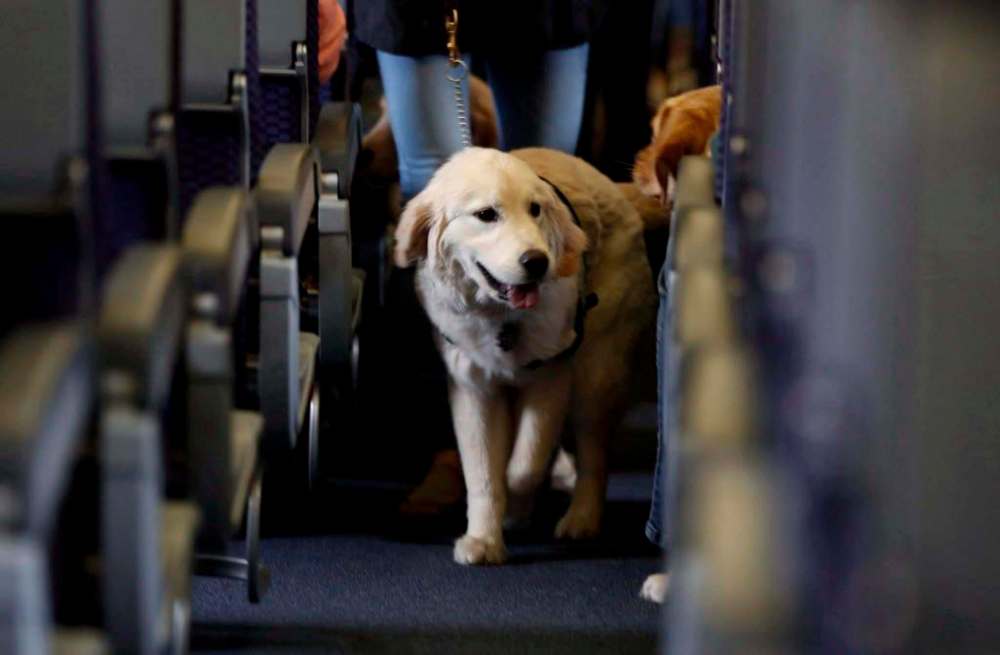
The debate over animals on airplanes is part of a bigger cultural shift that is overturning existing norms about when and where pets are appropriate.
Animal owners have long loved their pets, but lately they’ve taken their devotion to a new level.
“The humanization of pets continues to be a driving factor for the pet industry,” reports a study by the American Pet Products Association. Pet owners born between 1980 and 1994 — a.k.a. millennials — are leading the way. They’re feeding their pets organic foods, taking them to day care instead of leaving them home alone, buying them health insurance, paying extra for flavoured medications, throwing them parties, and, of course, lavishing them with gifts.
“Pets have come a long way in the past couple of decades, going from being outside dogs to sleeping in our beds and having their own Instagram accounts,” New York veterinary technician Natasha Feduik says.
Pet owners increasingly treat their animals as full-fledged members of the family and extensions of themselves — and expect everyone else to treat them that way as well. “I emotionally see myself as a ‘mom’ to my fur babies,” Feduik writes, speaking for many. “I have two dogs, a cat, and three birds, and they are my world. My life revolves around my four-legged and winged children.”
If the skyrocketing number of animals on planes represents “a fascinating case study of how mass cheating can become acceptable,” as David Leonhardt of the New York Times argues, it’s also a prime example of the humanization of pets. After all, you wouldn’t put your children in the baggage compartment.
Besides, it’s not as though pet owners without serious medical issues are exactly lying when they claim they need their fur kiddies for emotional support.
Flying is stressful even to those without outright phobias and, barring the occasional hunting dog or guide dog for blind people, emotional support is the whole point of having a pet.
The animal is there to be adorable and make its owner feel loved — to provide comfort, pleasure, solace and joy amid the strains of daily life.
So it’s easy to rationalize your online purchase of an Emotional Support Animal vest, and even to justify your furry friend as a public good. The other passengers will light up to see your adorable pooch! Only meanies don’t love animals!
And here’s where the breakdown of existing norms starts to bite — in some cases, literally.
Until recently, the norm was for people who disliked, feared or were allergic to animals to tolerate brief interactions on the street or in a pet owner’s home. They understood that theirs was a minority view that marked them as weird, and they’d pretend not to mind your dog the same way people used to pretend that cigarette smoke didn’t bother them.
But they could also count on spending most of their day without animal encounters. Offices, restaurants, hotels and restaurants — not to mention airplanes — were pet-free zones.
No longer. Pet evangelists have been gaining ground, especially in making workplaces dog-friendly.
“Dogs — with their non-judgmental, unconditional love, team spirit, sense of humour, and the ability to lower blood pressure among ‘co-workers’ — can immediately transform any workplace into an ‘executive retreat,’” animal trainer Bashkir Dibra writes in the introduction to K9-5: New York Dogs at Work, a 2015 book featuring portraits of dogs at workplaces including The Daily Show With Jon Stewart and Martha Stewart Living Omnimedia.
About 11 per cent of U.S. pet owners now work in places that allow animals (the Winnipeg Free Press newsroom welcomes staff members’ dogs on select days), compared to eight per cent in 2014, according to the American Pet Products Association’s most recent National Pet Owners Survey.
Pet-friendly workplaces include such high-profile companies as Alphabet Inc., whose official code of conduct declares that “Google’s affection for our canine friends is an integral facet of our corporate culture. We like cats, but we’re a dog company,” and Amazon.com Inc., whose campus includes a dog-level water fountain next to every one for humans.
“Amazon’s dog-friendly environment helps reduce stress for all its employees,” declares Seattle DogSpot, which named it the city’s most dog-friendly business.
That’s not true, of course, unless the business hires only dog lovers. For some people, dogs increase stress. And dog lovers can’t imagine anyone who isn’t one of their number.
“We live in such a dog-adoring culture that it’s hard to admit when you aren’t totally enamoured of them. What you are supposed to feel — what you must always feel — is love,” writes former Amazon employee Corina Zappia.
As the company planned its move to a fancy new complex, Zappia, who had a traumatic canine encounter as a child, hoped for an office on a dog-free floor.
“I am allergic, but to be honest I don’t really love the idea of working around dogs,” she confessed in an email to her department head. “I would like to be on a dog-free floor, if that’s OK.”
It wasn’t.
Even with a note from her allergist, Zappia had to settle for sharing a windowless dog-free office on a dog-populated floor.
One employee regularly walked his dog around the office, while others kept their office doors shut so their dogs couldn’t escape. At Halloween, a memo went out urging everyone to dress their dogs in costume. Maybe, she thought, she’d like the dogs more “if our dog-loving culture wasn’t so weird: there were buckets of doggie treats at the receptionist desk and $4 gourmet sweet-potato dog biscuits in the vending machine.”
The conflict isn’t just a matter of clashing tastes. Despite what you may have read online, there aren’t any reliable figures for how many people are allergic to dogs and cats, but 10 per cent seems like a decent estimate.
For most, the allergy means a runny nose or itchy eyes, but in some cases, the reaction can be life-threatening. (Zappia at times wished hers rose to that level, which would legally require accommodation.)

Yet even then, pet lovers have trouble empathizing.
“People that are dog lovers, they go bananas over this,” says a friend with serious allergies. “They’re really willing to go to the mat” to keep bringing their dogs to work.
So a new culture war is brewing, not over race or sex or religion this time but over pets in public places. Will we welcome them? Must we? And what happens to the minority who object? Are they destined to be ostracized and unemployable? Or will we again sort ourselves into tribes, with some of the country’s most desirable jobs marked Dog Lovers Only?
The fights over emotional support animals in the air could be the start of a long and nasty struggle.
— Bloomberg
History
Updated on Tuesday, February 20, 2018 8:16 AM CST: Adds photo