Toxic work environment
Russia allegedly behind numerous poisoning deaths of political foes
Advertisement
Read this article for free:
or
Already have an account? Log in here »
To continue reading, please subscribe:

Digital Subscription
One year of digital access for only $205*
- Enjoy unlimited reading on winnipegfreepress.com
- Read the E-Edition, our digital replica newspaper
- Access News Break, our award-winning app
- Play interactive puzzles
*First annual payment billed as $205.00 + GST for one year. This annual subscription will automatically renew at $233.00 + GST every 52 weeks (10% off the regular annual price of $259.35). Offer available to new and qualified returning subscribers only. Cancel any time.
To continue reading, please subscribe:
Add Free Press access to your Brandon Sun subscription for only an additional
$1 for the first 4 weeks*
- Enjoy unlimited reading on winnipegfreepress.com
- Read the E-Edition, our digital replica newspaper
- Access News Break, our award-winning app
- Play interactive puzzles
*Your next Brandon Sun subscription payment will increase by $1.00 and you will be charged $17.95 plus GST for four weeks. After four weeks, your payment will increase to $24.95 plus GST every four weeks.
Read unlimited articles for free today:
or
Already have an account? Log in here »
Hey there, time traveller!
This article was published 10/03/2018 (3044 days ago), so information in it may no longer be current.
It has all the trappings of a Hollywood spy thriller.
Last Sunday afternoon, a man and a woman were found unconscious on a bench in a shopping mall in Salisbury, a quaint English city about 145 kilometres west of London.
It was soon revealed the man was Sergei Skripal, a 66-year-old former Russian army colonel, and the woman was his 33-year-old daughter, Yulia.
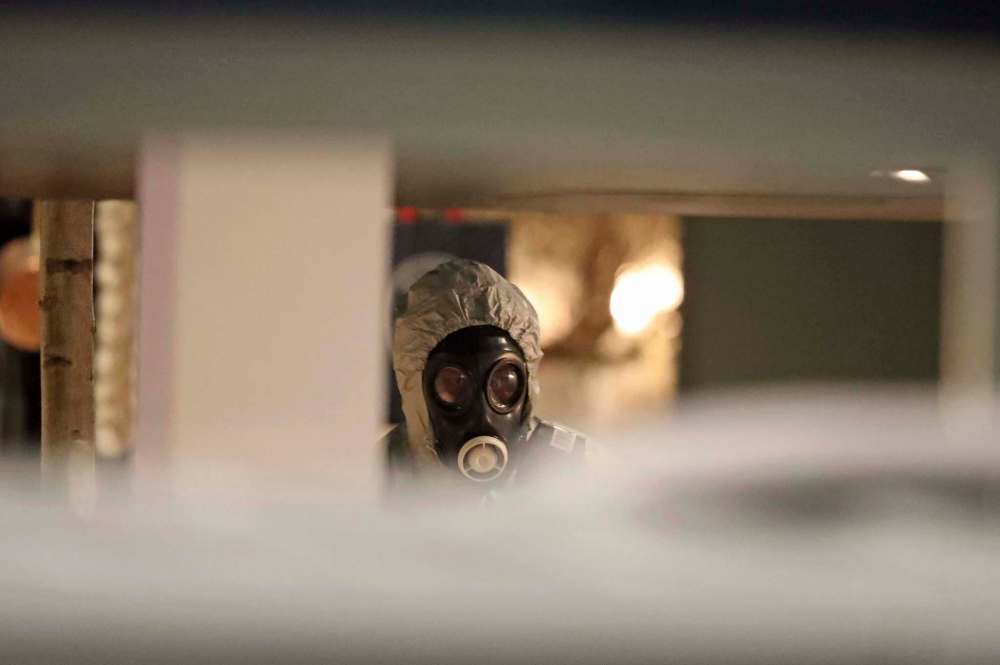
The pair were rushed to hospital in critical condition for what British authorities first described as “suspected exposure to an unknown substance.”
They now say the pair were deliberately poisoned with a nerve agent, and there is open speculation the pair may have been targeted by Russian operatives.
A former Russian double agent, Sergei Skripal was convicted in Russia on charges of spying for Britain and sentenced in 2006 to 13 years in prison. He was released to the U.K. in 2010 as part of a prisoner swap.
Not surprisingly, the Russians are denying any involvement in the poison attack.
If the investigation does, in fact, reveal Skripal and his daughter were poisoned by fellow Russians, it would be far from the first time this international intrigue has played out.
Russian agents have turned this style of retaliation into a deadly art form, as we see from today’s heart-stopping list of Five Infamous Political Poisonings Blamed on Russia:
5) The target: Russian defector Nikolai Khokhlov
The poisoning: In February 1954, according to Britain’s Daily Mirror newspaper, Georgi Okolovich answered his front door in Frankfurt, West Germany, and came face to face with a pale, blond man with spectacles and an excellent German accent.
“Are you Herr Okolovich?” the mystery man asked.
After the prominent Russian dissident confirmed his identity, the man at the door, switching to Russian, replied: “I am Capt. Khokhlov of the KGB. I am here because the Central Committee of the Communist Party has ordered your liquidation.”
The intended murder weapon was a gun disguised as a cigarette case, but Nikolai Khokhlov famously spared the dissident’s life. Prior to the mission, the KGB agent had discussed the plan with his wife, Yanina, who told him: “If this man is killed, you will be a murderer. I cannot be the wife of a murderer.”
After sparing his target, Khokhlov defected to the U.S., while his wife was sentenced to five years in exile in a remote part of the Soviet Union. Khokhlov’s refusal to carry out an assassination almost cost him his life.
“The KGB decided to kill me,” he told the Daily Mirror shortly before his death in 2007 of a heart attack. “The message was, ‘We will get the traitor wherever he is in the world.’”
In September 1957, attending an anti-Soviet conference in West Germany, Khokhlov accepted a cup of coffee he had not ordered and soon began to convulse. “Things began to whirl about me,” he later recalled. “My body was convulsed in a terrible struggle… I saw and then felt that my eyelids were oozing blood.”
Months later, military scientists discovered a heavy metal, thallium, had been exposed to high doses of radiation before being slipped into his coffee, burning through his stomach lining into his bloodstream. It has been viewed as the first radiological attack by the KGB. Khokhlov’s survival was something of a miracle.
4) The target: Russian banker Ivan Kivelidi
The poisoning: In the 1990s, Ivan Kivelidi was one of Russia’s most prominent businessmen. He was the founder and president of Rosbiznesbank and the political and business newspaper Vek, but he was best known for creating the Russian Business Roundtable, a prestigious group that brought together the country’s top bankers and industrialists.
His murder in 1995 is one of Russia’s most infamous killings, and one of the most bizarre. At the time, Russia’s business elite were dropping like flies, but Kivelidi’s killing — he was poisoned together with his secretary — sent shock waves through crime-jaded Russian society.
According to the Los Angeles Times, the 46-year-old mogul was the ninth member of his roundtable to be slain in one year. “There has not been one conviction. The police are incapable of doing anything, or else they are in league with the criminals,” the roundtable’s vice-president, Vladimir Shcherbakov, said at the time.
The assassination method was terrifying: after the banker was rushed to hospital in a coma, dying three days later, police sources said he appeared to have been poisoned by heavy metal salts, possibly cadmium, which is deadly to the touch.
His secretary, Zara Ismailova, 35, was hospitalized with the same symptoms and died the following day. Police reportedly found a high level of radiation coming from Kivelidi’s telephone, and it was believed the poisoner used a radioactive metal planted in the phone receiver that both victims used.
There was no shortage of theories about the motives behind the banker’s murder, which police called a contract killing. Two weeks before his death, after a fellow bank president was found with his throat slit, Kivelidi had vowed to rally the business community to fight organized crime. That led to speculation that hitmen had made a pre-emptive strike on Kivelidi after a televised promise to find the killers.
Another theory suggested his death was the work of a mysterious syndicate of former KGB officials opposed to private enterprise. In 2006, a former friend, Vladimir Khutsishvili, was arrested, but denies any involvement in the poisoning.
3) The target: Aleksandr (Alexander) Perepilichnyy
The poisoning: Security guard Neil St. Clair-Ford was driving through Weybridge in Surrey, England, in November 2012 when he spotted something lying in the road ahead of him, according to the BBC. The guard pulled over and discovered Alexander Perepilichnyy, an exiled Russian banker, in the fetal position, pale, cold and displaying “very faint” signs of life.
It was believed the defector had collapsed of a heart attack during a run near his home on the day he returned from a short trip to Paris. By all accounts, he had been in excellent health. At the time, St. Clair-Ford called a local former navy colleague, Liam Walsh, to help administer first aid, and Walsh later told an inquest that Perepilichnyy vomited “greeny-yellow” bile during mouth-to-mouth resuscitation with a strange taste like “licking a battery.”
Born in Ukraine, the exile had made his fortune as a financier in Russia, where he allegedly helped government-connected Russians launder money. In 2009, he fled to Britain and began to co-operate with authorities by providing evidence against corrupt officials in Moscow. Shortly before he collapsed and died at age 44, news reports say he had told colleagues about receiving death threats.
Initial toxicology tests on Perepilichnyy’s body revealed nothing suspicious and it was ruled a natural death. Two years later, however, a fresh round of tests arranged by a life insurance company found traces of a rare and deadly plant toxin in his stomach that could only have come from the gelsemium plant. A flowering plant native to China, gelsemium is known as “heartbreak grass” because its leaves, if swallowed, cause cardiac arrest. Lacing food with the grass is a known method of assassination by Russian and Chinese contract killers.
U.S. intelligence officials have told the BBC they believe the whistleblower was murdered. It’s said he was poisoned after the substance was slipped into his sorrel soup.
2) The target: Former spy Aleksandr (Alexander) Litvinenko
The poisoning: While the investigation into the Sergei Skripal case is in its early days, the affair is already being likened to another poisoning in the U.K. — the assassination in 2006 of one-time Russian spy Aleksandr Litvinenko.
A former officer in Russia’s FSB security service who specialized in organized crime, Litvinenko fled to London with his family in 2000 and was granted political asylum. He had publicly accused his superiors of ordering the assassination of a Russian tycoon, and later wrote two books accusing Russian secret services of staging “terrorist” incidents in a bid to bring Vladimir Putin to power.
In November 2006, Litvinenko was rushed to hospital after collapsing in a London restaurant. With the world looking on, a rare and highly radioactive isotope destroyed his organs one by one, and he died three weeks later. An autopsy found his body contained traces of polonium-210, a highly radioactive element about 250,000 times more toxic than hydrogen cyanide. A single gram of it purified could kill as many as 50 million people, Britain’s Daily Mirror newspaper says.
British experts say he was likely the first person ever to die of the acute radiation effects of polonium-210. In 2016, a British inquiry concluded there was “strong circumstantial evidence of Russian state responsibility” and that Putin and his spy chief at the time “probably approved” Litvinenko’s poisoning. The inquiry also concluded a former KGB agent and ex-Kremlin bodyguard carried out the assassination by placing the poison in a teapot served to Litvinenko.
Russia denies the charges. Commenting on the Skripal case, Litvinenko’s widow, Marina, said: “If it was poison, it would mean people are still not protected. It’s a very bad message for other people. The lessons from my husband’s death have not been properly learned.”
1) The target: Dissident Georgi Markov
The poisoning: Death by poison-tipped umbrella? It could only happen in a cheesy spy film, right? Wrong! This is a shocking real-life story, one of the great unsolved mysteries of the Cold War.
In September 1978, Georgi Markov, a Bulgarian dissident writer and constant thorn in the side of Bulgaria’s Communist regime, was waiting for a bus on London’s Waterloo Bridge. At age 49, he had lived in political exile in London since 1969 and was on his way to work at the BBC. As he stood on the bridge, he felt a sudden sharp pain in his thigh. He thought little of it at the time — there was only a small red pimple at the site of the sting — but three days later, Markov was dead.
The unknown killer — a mystery man who ran away and climbed in a taxi — had stabbed him in the back of the leg with an umbrella that was modified to inject poison into its target with the press of a trigger. In Markov’s case, the umbrella contained a metal pellet the size of a pinhead laced with ricin, a poison so deadly that, in its purified form, a few grains the size of table salt can kill an adult human.
His killers have never been found, though in 2013, British papers reported a suspect had emerged: a spy known in Bulgarian files as “Agent Piccadilly.” Markov was believed assassinated on the orders of the Bulgarian Secret Service, allegedly with KGB help.

His murder came on the birthday of the Bulgarian State Council chairman Todor Zhivkov, who had frequently been the target of Markov’s stinging criticism. A similar poison umbrella equipped with ricin was used in the failed assassination attempt against Bulgarian dissident journalist Vladimir Kostov the same year in the Paris Métro.
A replica of the deadly umbrella, produced in Moscow, is displayed in the International Spy Museum’s collection in Washington, D.C. Museum historian Thomas Boghardt says that in 1991, a room full of similar poison umbrellas was uncovered in Bulgaria.
In 2012, a German man died of mercury poisoning a year after being jabbed in the buttocks by a poison-laced umbrella. So if you see someone with a brolly, and it isn’t raining…
doug.speirs@freepress.mb.ca