Lending a helping paw
There's more to becoming a certified therapy dog than just being lovable
Advertisement
Read this article for free:
or
Already have an account? Log in here »
To continue reading, please subscribe:

Digital Subscription
One year of digital access for only $205*
- Enjoy unlimited reading on winnipegfreepress.com
- Read the E-Edition, our digital replica newspaper
- Access News Break, our award-winning app
- Play interactive puzzles
*First annual payment billed as $205.00 + GST for one year. This annual subscription will automatically renew at $233.00 + GST every 52 weeks (10% off the regular annual price of $259.35). Offer available to new and qualified returning subscribers only. Cancel any time.
To continue reading, please subscribe:
Add Free Press access to your Brandon Sun subscription for only an additional
$1 for the first 4 weeks*
- Enjoy unlimited reading on winnipegfreepress.com
- Read the E-Edition, our digital replica newspaper
- Access News Break, our award-winning app
- Play interactive puzzles
*Your next Brandon Sun subscription payment will increase by $1.00 and you will be charged $17.95 plus GST for four weeks. After four weeks, your payment will increase to $24.95 plus GST every four weeks.
Read unlimited articles for free today:
or
Already have an account? Log in here »
Hey there, time traveller!
This article was published 04/08/2018 (2902 days ago), so information in it may no longer be current.
It may come as a surprise, but some of the finest therapists in Manitoba have four legs.
For the past 21 years, St. John Ambulance therapy dogs and their human handlers have brought comfort and joy to lonely hospital patients, stressed-out students during exams and, more recently, terrified air travellers.
In Manitoba, there are about 130 active therapy dog-and-handler teams. Their rewards can be simple, such as a pat on the head, or incredibly powerful, as in the case of a non-verbal child whose first spoken word was the name of a therapy dog that visited her school.
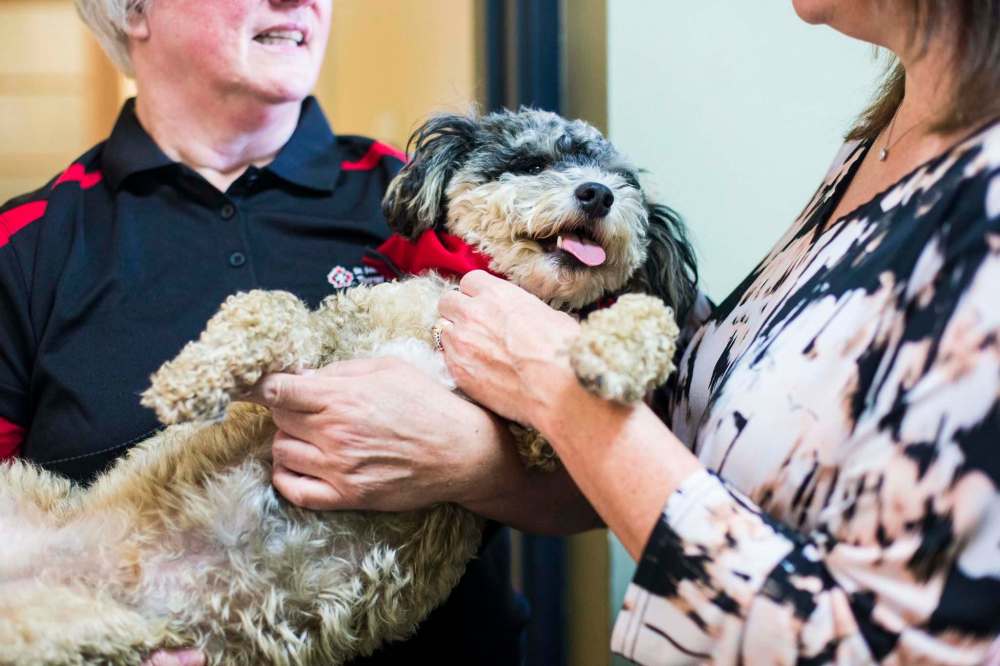
It’s personal for this columnist, because the latest addition to the Manitoba team is his sister-in-law, Donamae Hilton, and her two-year-old rescue dog, Mark-Cuss, a playful mutt she describes as “some kind of doodle. Maybe a Yorkie-doodle, but who knows?”
On July 23, Mark-Cuss passed his intense, 90-minute evaluation and was certified to take part in the St. John Ambulance Therapy Dog Program.
But there’s a lot more involved in becoming a certified therapy dog than just showing up and getting a badge.
For Hilton, 66, who retired in 2016 from her job as an administrative assistant with the Manitoba Dental Association, it all began with a lengthy hospital stay last year.
“When I was in St. Boniface Hospital for 23 days for surgery, the best days were the days the dogs visited,” she recalled this week as Mark-Cuss romped in the backyard with this columnist’s three dogs. “Those were the days I lived for.
“If you didn’t invite the dogs in, they couldn’t come in. So I put a note on the door saying, ‘If there’s a therapy dog, please come to Bed No. 1 and wake me up.’
“It made me feel so happy to have a dog visit. They bring instant comfort and they don’t want anything from you. They just give you their love and I want to do the same for other people.”
When she got out of hospital, Hilton — a passionate dog lover who also owns a grumpy basset-beagle cross named Norman — decided to return the favour, so she contacted the Winnipeg office of St. John Ambulance and attended one of the six orientation sessions held each year for would-be volunteers.
There was no shortage of paperwork, which includes a criminal-record check, a child-abuse registry check, a veterinary exam certificate and personal references.
In an effort to boost Mark-Cuss’s chances of passing his evaluation, Hilton enrolled him in three obedience classes. “I wanted him to be the best little guy he could,” she said, laughing.
In July, Mark-Cuss was one of six dogs St. John Ambulance put through their paces in a series of about a dozen tests designed to determine the bond between them and their owners.
“There are three things that are automatic failures: 1) If they’re aggressive; 2) If they go to the bathroom during the test; and 3) If they jump. Old people are frail and they can fall down,” Hilton explained. “I was almost physically sick at the beginning, because I was nervous he was going to be overly friendly. But he listened.”
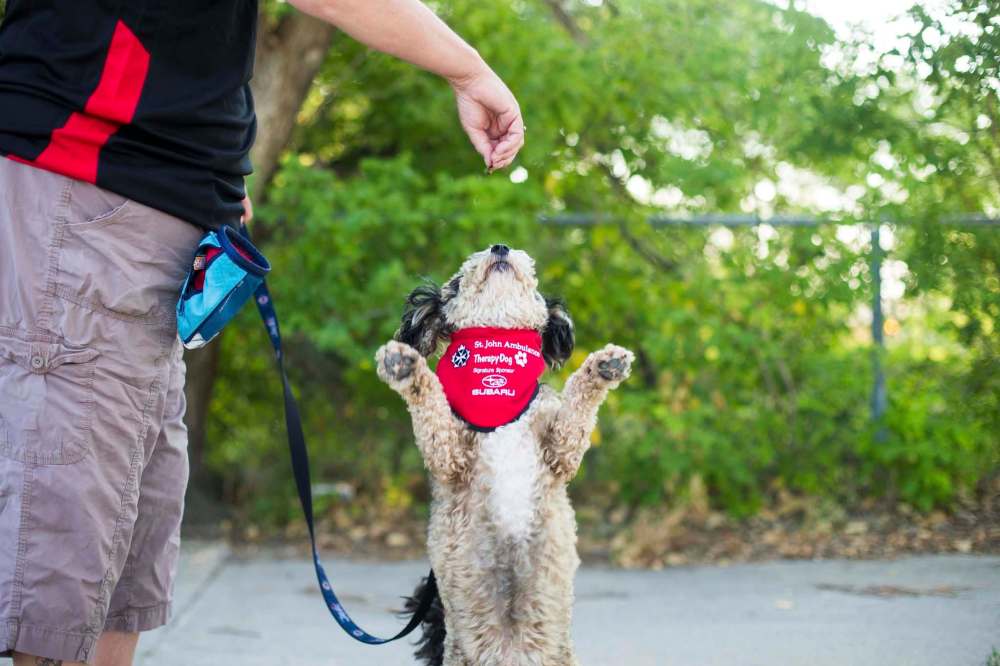
The evaluation tested the level of control each volunteer owner had over their pet. “The first test was to greet your dog. Just come up and see how they are. One dog failed immediately. He kept wanting to jump up. It was a big Labrador,” Hilton said.
“Then they had four volunteers in four stations with crutches and canes walking as if they were in a seniors home, and you had to manoeuvre through them without knocking them over.
“You also had to go up to four people — one touched his head, one his ears, one his tail and one his feet to see how calm he was. The last test was to go in and face the wall with our backs to the testers, and a lady in a wheelchair was pushed around behind us.
“Then, all of a sudden, someone went thumping across the floor and someone dumped a metal pan to see if the dogs would startle. Mark-Cuss just looked over his shoulder, and that was it.”
Having been handed their uniforms — a T-shirt for Hilton and a bandana for Mark-Cuss — the newly certified therapists are champing at the bit for their first assignment.
“I’d like to do it all, but I think I’d like to do the seniors the most to bring some happiness to them,” she said. “A lot of people in seniors’ homes don’t have anyone to come see them. My hope is that after a year of getting good reports, we’ll be able to visit schools. What I last heard was there were 29 schools on the waiting list for therapy dogs to help the kids with reading or staying calm.”
Teresa Toutant, St. John’s director of community services for Manitoba, the Northwest Territories and Nunavut, said Manitoba’s 130 dog-and-handler teams are in constant demand at hospitals, Stony Mountain Institution, personal-care homes, mental-health facilities, Ronald McDonald House, Health Sciences Centre’s family room, colleges and universities and, in recent years, Winnipeg’s airport.
You could sense Toutant’s pride as she discussed the impact therapy dogs have on schoolchildren struggling with anxiety issues.
“What we do is go into the schools and work with children with special needs,” she said. “We work with them in small groups. There’s a variety of activities. For a child with anxiety issues, it’s definitely a calming factor. It brings out confidence in a child. The emotional connection with a dog is really powerful.”
One recent dog-child interaction is etched forever in her memory. “One success story was a nine-year-old girl who was non-verbal and spoke her first word ever to a dog,” Toutant gushed. “She said the dog’s name. You know it’s a success and something worthwhile when you see that.”
In recent years, Toutant helped the 21-year-old therapy dog program expand to Winnipeg’s Richardson International Airport, helping stressed-out travellers reclaim their sense of calm.
“We try to spread ourselves to as many places as we can attend,” she said. “As a community service initiative, we’re trying to touch as many lives as possible. We’ve been really well received at the airport. We touch a lot of people there.
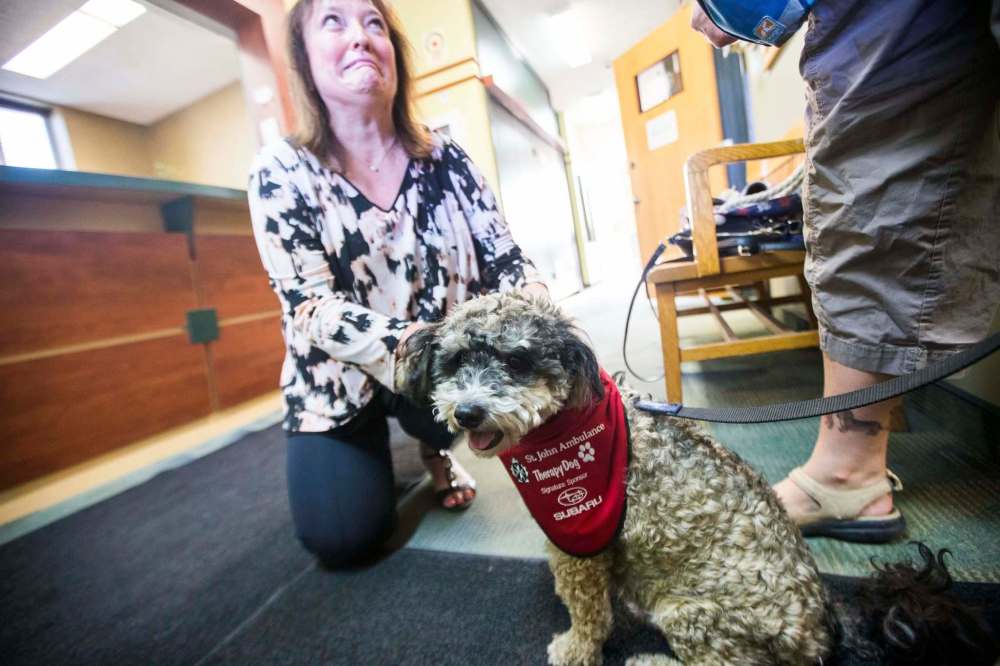
“We’ve had all kinds of interesting stories at the airport. It really helps people with a fear of flying to be with a dog before getting on a flight. Airports are crazy busy places and you don’t know from one hour to the next what will happen. Just to have the opportunity to be around the calming effects of a dog is wonderful for everyone.”
She was reluctant to describe the kind of dog St. John Ambulance is looking for, saying therapy dogs come in all shapes, sizes and temperaments. (Potential volunteers can find information at sja.ca or by calling 204-784-7000.)
“Not every dog has to be super calm,” she noted. “It really depends on the relationship between a dog and a handler. We have dogs ranging from about four pounds up to 280 pounds. From chihuahuas up to mastiffs and everything in between.”
She said the agency is always on the lookout for a few good dogs (and their human handlers) to join the therapy team.

“Unfortunately, dogs become ill and pass away, just like people, so our numbers fluctuate,” she said. “We are constantly recruiting all the time… We have schools on the waiting list, waiting for dogs and handlers.
“It’s a very rewarding career and a very rewarding volunteer opportunity. Our volunteers are amazing people. They are really really passionate about sharing their dogs. The people coming to volunteer are often people who have been touched by a therapy dog.”
But you don’t have to tell that to that to this columnist’s sister-in-law and her canine sidekick. “I think it’s something that other dog owners should aspire to do,” Hilton declared.
“There’s a need and it brings joy to people and it’s something to do with your dog.”
doug.speirs@freepress.mb.ca