Economic chill dulls Chinese appetite for some luxury brands
Advertisement
Read this article for free:
or
Already have an account? Log in here »
To continue reading, please subscribe:

Digital Subscription
One year of digital access for only $205*
- Enjoy unlimited reading on winnipegfreepress.com
- Read the E-Edition, our digital replica newspaper
- Access News Break, our award-winning app
- Play interactive puzzles
*First annual payment billed as $205.00 + GST for one year. This annual subscription will automatically renew at $233.00 + GST every 52 weeks (10% off the regular annual price of $259.35). Offer available to new and qualified returning subscribers only. Cancel any time.
To continue reading, please subscribe:
Add Free Press access to your Brandon Sun subscription for only an additional
$1 for the first 4 weeks*
- Enjoy unlimited reading on winnipegfreepress.com
- Read the E-Edition, our digital replica newspaper
- Access News Break, our award-winning app
- Play interactive puzzles
*Your next Brandon Sun subscription payment will increase by $1.00 and you will be charged $17.95 plus GST for four weeks. After four weeks, your payment will increase to $24.95 plus GST every four weeks.
Read unlimited articles for free today:
or
Already have an account? Log in here »
Hey there, time traveller!
This article was published 04/12/2018 (2825 days ago), so information in it may no longer be current.
BEIJING – The designer boutiques of Manhattan and Paris are feeling the chill of a Chinese economic slowdown that has hammered automakers and other industries.
It’s a rude awakening for such designer brands as Louis Vuitton and Burberry that increasingly rely on Chinese customers who spend $90 billion a year on jewelry, clothes and other high-end goods. The industry already is facing pressure to keep up as China’s big spenders, mainstays for American and European retailers, shift to buying more at the spreading networks of luxury outlets in their own country.
Last week, Tiffany & Co. showed how much well-heeled Chinese tourists matter to retailers abroad. Shares in the jeweler known for $5,000 watches and $400 silver baby spoons fell 12 per cent after its CEO said they were spending less.
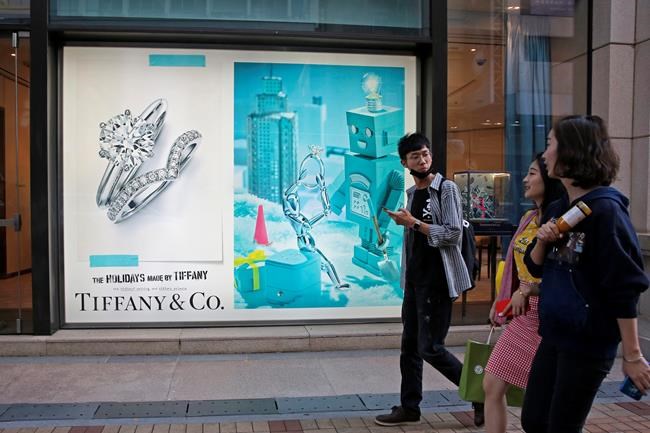
In Hong Kong, the top shopping destination for mainland travellers, only a dozen visitors were in Tiffany’s flagship store one afternoon last week. Many looked without buying.
“The name brand goods are too pricey,” said Zhou Jiqing, from the neighbouring mainland city of Shenzhen. “I’m waiting for the Christmas sale.”
Forecasters including Euromonitor International and Bain & Co. say Chinese customers will be the luxury industry’s main growth engine over the next decade. But this year, shoppers are skittish amid cooling economic growth, trade tension with Washington and weak real estate and stock markets.
The spending shift could have big implications for retailers who’ve been catering to them and now will have to work even harder to get their dollars.
“Consumers are just not as excited about spending that kind of money right now,” said Ben Cavender of China Market Research Group.
Demand for Tom Ford suits and Jimmy Choo shoes held up better than some other Chinese spending as economic activity slowed following a government clampdown on bank lending to cool a debt boom.
China’s economy, the world’s second largest, is forecast to grow by a relatively robust 6.5 per cent this year, easing from 2017’s 6.7 per cent. But that is propped up by higher government spending on public works construction that helps to mask weakness in other areas.
Auto sales in the global industry’s biggest market plunged 13 per cent in October from a year earlier. Housing sales are so weak that some developers are cutting prices. The main Chinese stock market index is down 22 per cent from a year ago.
Even before the economy cooled, the industry was under pressure from shifts in Chinese tastes and buying habits.
Luxury brands, some of them centuries old, have raced to serve China as its consumers emerged as a powerhouse market.
Brands designed watches, clothes and other goods for Chinese tastes. Hermes created its first single-country brand, Shang Xia, for China. Department stores from London to Los Angeles hired Mandarin-speaking salespeople.
Chinese traders fly home from Paris or Rome with stacks of designer bags and other goods to re-sell.
The incentive to shop abroad has eroded as major brands opened their China stores and prices fell closer to U.S. and European levels.
“Now, lots of world brands have shops in first-tier mainland cities,” said Alex Bi, who was visiting Hong Kong from the mainland city of Guangzhou. He and his sister, Jessica, were window-shopping in the bustling Kowloon district.
At the same time, Beijing has stepped up efforts to reduce reliance on trade and encourage self-sustaining economic growth based on consumer spending. Import taxes on luxury goods were cut to lure shoppers home.
Luxury spending abroad is forecast to keep rising, but not as fast as in China.
The share of spending that goes to retailers in China should rise from one-quarter of last year’s $90 billion to half of 2025’s projected total of $170 billion to $190 billion, according to a Bain report this month. Under that scenario, spending abroad would rise to $85 billion to $95 billion from $67 billion.
Meanwhile, the customs agency is cracking down on informal imports by searching the luggage of travellers returning from Europe and other shopping destinations.
In November, a trader was sentenced to 10 years in prison for smuggling designer clothing from Hong Kong without paying the mainland’s higher import duty, according to news reports.
“This shocked the whole industry. Nobody dares to continue to act as purchasing agents,” said market researcher Li Chengdong of Donge Investment Management Co. in Beijing. “This has an immediate impact on the sales of the overseas retailers.”
Anxiety over possible terrorist attacks has prompted some Chinese to avoid Paris, London and other shopping destinations.
In the United States, retailers face pressure from China’s weak yuan, which makes prices in dollars more expensive for Chinese shoppers.
Chinese tourist are also changing the way they tour, forgoing big organized tours that involve taking buses to specific tourist sites including key shopping destinations, according to David Becker, CEO of a Brooklyn, New York-based Attract China, a Chinese travel consultancy. Instead, they’re going on their own, he said. That hurts retailers expecting big busloads of tourists at their front door.
Tighter visa restrictions under President Donald Trump also make it harder for Chinese shoppers to get to the United States, Cavender said.
Chinese tourist arrivals in the United States fell 20 per cent from a year earlier to 880,000 in the three months ending in September, according to an estimate by the China Outbound Tourism Research Institute in Hamburg, Germany. The number going to France rose 20.7 per cent to 664,800 and those bound for Italy rose 18.9 per cent to 850,000.
“If people previously were going to the U.S. to buy an American luxury brand, that’s not their first choice anymore,” Cavender said. “They would rather go to Japan, New Zealand or someplace in Europe where the process is easier.”

Becker says he’s been working with several clients, including designer stores on New York’s Madison Avenue and Brookfield Place, on how to better cater to the Chinese. That includes allowing Chinese customers to use their preferred mobile payments systems, such as Alipay or WeChat.
He says he has heard there’s been some weakening in sales to Chinese tourists in the past three months because of the economy. But he says the political tensions between China and the U.S. haven’t been a factor — yet.
“When your confidence in the economy is off, whether it’s here in the United States or in the China, you’re going to cut back on your overall spending,” he said.
___
AP Writers Violet Law and Alice Fung in Hong Kong, AP researchers Yu Bing and Shanshan Wang in Beijing and AP Business Writers Colleen Barry in Milan, Dee-Ann Durbin in Detroit and Anne D’Innocenzio in New York contributed.