Father-daughter rowing team arrives in Antigua after crossing the Atlantic

Advertisement

Advertise with us

After spending three months rowing a small boat across the moody Atlantic Ocean, father-daughter duo John and Libby Beeden say they're wobbly but relieved to have arrived on solid land.

Read this article for free:


or

Already have an account? Log in here »

To continue reading, please subscribe:

Subscribe and receive a limited-edition Free Press branded hat or tote.

Digital Subscription

One year of digital access for only $205*

  • Enjoy unlimited reading on winnipegfreepress.com
  • Read the E-Edition, our digital replica newspaper
  • Access News Break, our award-winning app
  • Play interactive puzzles

*First annual payment billed as $205.00 + GST for one year. This annual subscription will automatically renew at $233.00 + GST every 52 weeks (10% off the regular annual price of $259.35). Offer available to new and qualified returning subscribers only. Cancel any time.

To continue reading, please subscribe:

Add Free Press access to your Brandon Sun subscription for only an additional

$1 for the first 4 weeks*

  • Enjoy unlimited reading on winnipegfreepress.com
  • Read the E-Edition, our digital replica newspaper
  • Access News Break, our award-winning app
  • Play interactive puzzles
Start now

*Your next Brandon Sun subscription payment will increase by $1.00 and you will be charged $17.95 plus GST for four weeks. After four weeks, your payment will increase to $24.95 plus GST every four weeks.

Hey there, time traveller!
This article was published 01/03/2019 (2773 days ago), so information in it may no longer be current.

After spending three months rowing a small boat across the moody Atlantic Ocean, father-daughter duo John and Libby Beeden say they’re wobbly but relieved to have arrived on solid land.

It wasn’t always a given, John Beeden said. The winds and currents were working against them for the last leg of their 91-day journey from Portugual to the Caribbean island of Antigua.

“We’re happy to be on terra firma,” he said in a phone interview from Antigua. “The weather’s been really difficult the whole way. Over the past two weeks things just got harder and harder. So we’re just so happy to make Antigua, because for a while it didn’t look like we were going to make Antigua.”
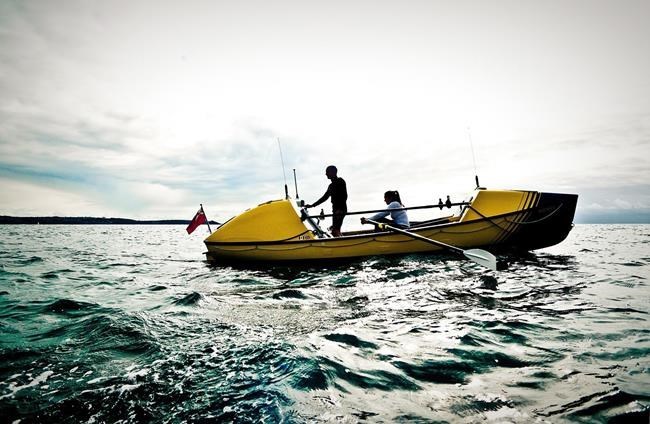
John Beeden and his 20-year-old daughter, Libby, are seen in this undated handout photo. An Ontario-based father-daughter rowing team has arrived on solid land in Antigua after spending three months crossing the Atlantic. John and Libby Beeden, who are 56 and 20 respectively, rowed their small boat from Portugal to the Caribbean island over the course of 91 days. THE CANADIAN PRESS/HO-Nick Bowring MANDATORY CREDIT

Libby Beeden, 20, described waves as tall as six metres crashing into their six-metre-long yellow boat, made of close-cell foam with shells of kevlar and fibreglass.

The frustration was palpable on the blog they updated via satellite phone over the course of their journey. “ARE WE THERE YET?” the headline of one blog post screams. “WHAT THE B****Y HECK HAVE WE DONE TO DESERVE THIS?” another reads.

“Desperate to get off this boat,” Libby Beeden wrote in the days leading up to their journey’s end. “It’s too hot, I’m melting!”

The elder Beeden, who is from the U.K. but now lives in Collingwood, Ont., was already a record-setting rower when he set out in November. In 2015, he became the first person to row solo, non-stop from North America to Australia in a journey that took 209 days.

His daughter had considerably less experience.

“I look at things from a jaded old man’s approach, and Libby’s only 20,” John Beeden said. “She conquered all these fears of high waves and rowing at night.”

They took turns rowing in a bid to keep moving forward 24 hours a day.

But in spite of the largely harrowing journey, there were some high points.

“I was cleaning barnacles off the bottom of the boat, and Libby shouted at me and there was a whale about 10 feet (three metres) away from me,” John Beeden said, noting that while they aren’t sure, they think it was a minke whale.

“You can be quite depressed with how bad the conditions are, but if a whale or a pod of dolphins comes by, it kind of lifts your spirits,” he said. “It’s cool that they choose to come of their own volition.”

The younger Beeden said that on the last full day of their journey, she and her father saw a leatherback sea turtle swimming in their wake. The sea turtles can weigh up to 700 kilograms, and measure up to 2.2 metres in length.

Now that they’ve reached their destination, the Beedens said they’re going to take some time to decompress.

“I’m sat with a plate of avocado toast and fresh fruit at the moment,” Libby Beeden said. “I’ve got ice in my drink!”


Report Error Submit a Tip

More Stories

International flavour: Canadian investors may want to make like Ottawa, diversify beyond U.S.

Joel Schlesinger 6 minute read Preview

International flavour: Canadian investors may want to make like Ottawa, diversify beyond U.S.

Joel Schlesinger 6 minute read 2:01 AM CDT

Canada is learning the hard way about the dangers of putting too many eggs in its U.S. economic basket.

Much has been made about the need to diversify our economy away from the United States.

Diversification is understandably beneficial. The more varied streams of revenue a nation has, the less affected the economy will be when one of those sources is interrupted.

The same can be said about investment portfolios.

Read
2:01 AM CDT

Clock ticks down on destruction of records documenting residential school abuses

Marsha McLeod 13 minute read Preview

Clock ticks down on destruction of records documenting residential school abuses

Marsha McLeod 13 minute read Yesterday at 12:49 PM CDT

In less than a year, a private company is set to destroy the largest cache of records detailing the widespread abuse of Indigenous children at residential schools in Canada.

The destruction, which was ordered by an Ontario court in 2014 and later upheld by the Supreme Court, is set to take place on Sept. 19, 2027.

This countdown is igniting emotional conversations that seek to balance the immense historical value of the records alongside the confidentiality survivors were promised as part of the process of providing detailed testimony about abuses they’d suffered.

The records were created as part of the Indian Residential Schools Settlement Agreement, a class-action settlement stemming from survivors who began suing the federal government in the late 1990s over the harm they’d been subjected to at residential schools.

Read
Yesterday at 12:49 PM CDT

May be whiff of truth to ex’s odour ardour

Maureen Scurfield 5 minute read 2:01 AM CDT

DEAR MISS LONELYHEARTS: I ran into an old boyfriend I used to curl on a team with, and we went for drinks. We’ve been almost eight years apart, and I couldn’t remember why we broke up, as we always had such a great time together.

It wasn’t until the second date — this time on a weekend — that it came back to me, with a jolt. Pee-yew! I remembered he doesn’t use deodorant on weekends. Why? He enjoys his own body odour. I recalled that a bit too late, and it was just as awful as ever! I went home early.

Tonight, he called and I refused him another date. I said, “Think back. You remember why we broke up?” Then he said, “Oh yeah, you hated my no-deodorant weekend policy. Well, guess what? Some women don’t mind!” I said I really doubted that, and that ended the conversation. Miss L., wouldn’t any women find stinky underarms offensive?

— Sensitive Nose, Fort Richmond

Jets bench boss Arniel talks rebuilding from last season’s struggles

Mike McIntyre and Ken Wiebe 12 minute read Preview

Jets bench boss Arniel talks rebuilding from last season’s struggles

Mike McIntyre and Ken Wiebe 12 minute read Thursday, Oct. 1, 2026

Scott Arniel has a lot on his plate these days.

But the head coach of the Winnipeg Jets took some time Thursday to sit down with Free Press hockey writers Mike McIntyre and Ken Wiebe to discuss a number of topics on the eve of a new hockey season. This interview has been condensed and edited for clarity.

Wiebe: What was the evaluation of last season like? What did you personally do in an attempt to improve after going from first-overall to 26th-overall?

I just went back and looked at things and made sure my communication was where it needed to be with my players. Was my communication where it needed to be with my boss, with my general manager (Kevin Cheveldayoff)? How our coaching staff worked. How we handled highs and lows. Things I felt I could have done better.

Read
Thursday, Oct. 1, 2026

Kent Monkman debuts beaver sculpture in Toronto’s ambitious new waterfront park

Alex Nino Gheciu, The Canadian Press 2 minute read Preview

Kent Monkman debuts beaver sculpture in Toronto’s ambitious new waterfront park

Alex Nino Gheciu, The Canadian Press 2 minute read Updated: Yesterday at 3:33 PM CDT

TORONTO - Kent Monkman’s first-ever public art installation is dam good.

The celebrated Cree artist’s new permanent sculpture, dubbed “The Colony,” debuts Wednesday in Toronto’s east end.

The 15-foot-high bronze structure features beavers dancing, feasting and celebrating, evoking Indigenous ceremonies.

It highlights the vital role of beavers in the natural, Indigenous and colonial histories of Turtle Island, says a release.

Read
Updated: Yesterday at 3:33 PM CDT

A spiritual vision will help anchor a health civic outlook

John Longhurst 5 minute read 2:01 AM CDT

We have an election coming up. With that in mind, the Free Press asked some of their columnists to write about the challenges ahead and how the city can become better.

For Tom Brodbeck, the main challenge is finances — and how candidates will pay for their many promises for fixing roads, improving public safety and making transit better.

Rebecca Chambers said that the concerns of inner-city residents need to be taken seriously by those who aspire to work at city hall.

Niigaan Sinclair said the most pressing issue in Winnipeg isn’t construction projects, light-rail transit, public safety, taxes or social services. For him, it’s the city’s relationship with Indigenous people.