Gene-edited food quietly arrives in restaurant cooking oil

Advertisement

Advertise with us

NEW YORK - Somewhere in the Midwest, a restaurant is frying foods with oil made from gene-edited soybeans. That's according to the company making the oil, which says it's the first commercial use of a gene-edited food in the U.S.

Read this article for free:


or

Already have an account? Log in here »

To continue reading, please subscribe:

Subscribe and receive a limited-edition Free Press branded hat or tote.

Digital Subscription

One year of digital access for only $205*

  • Enjoy unlimited reading on winnipegfreepress.com
  • Read the E-Edition, our digital replica newspaper
  • Access News Break, our award-winning app
  • Play interactive puzzles

*First annual payment billed as $205.00 + GST for one year. This annual subscription will automatically renew at $233.00 + GST every 52 weeks (10% off the regular annual price of $259.35). Offer available to new and qualified returning subscribers only. Cancel any time.

To continue reading, please subscribe:

Add Free Press access to your Brandon Sun subscription for only an additional

$1 for the first 4 weeks*

  • Enjoy unlimited reading on winnipegfreepress.com
  • Read the E-Edition, our digital replica newspaper
  • Access News Break, our award-winning app
  • Play interactive puzzles
Start now

*Your next Brandon Sun subscription payment will increase by $1.00 and you will be charged $17.95 plus GST for four weeks. After four weeks, your payment will increase to $24.95 plus GST every four weeks.

Hey there, time traveller!
This article was published 12/03/2019 (2762 days ago), so information in it may no longer be current.

NEW YORK – Somewhere in the Midwest, a restaurant is frying foods with oil made from gene-edited soybeans. That’s according to the company making the oil, which says it’s the first commercial use of a gene-edited food in the U.S.

Calyxt said it can’t reveal its first customer for competitive reasons, but CEO Jim Blome said the oil is “in use and being eaten.”

The Minnesota-based company is hoping the announcement will encourage the food industry’s interest in the oil, which it says has no trans fats and a longer shelf life than other soybean oils. Whether demand builds remains to be seen, but the oil’s transition into the food supply signals gene editing’s potential to alter foods without the controversy of conventional GMOs, or genetically modified organisms.
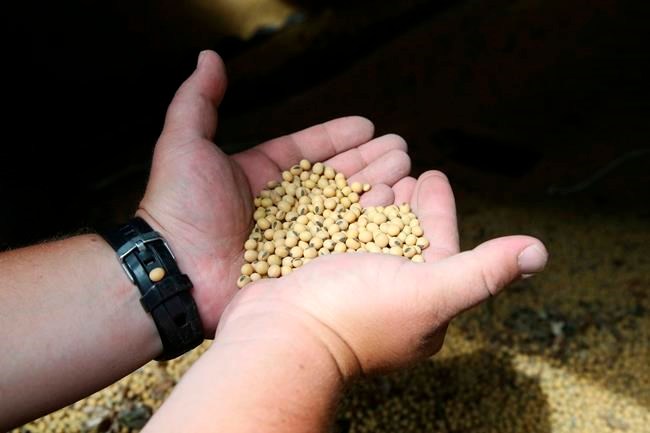
FILE - In this July 18, 2018 file photo, a farmer holds soybeans from the previous season's crop at his farm in southern Minnesota. Most soy grown in the U.S. are conventional, herbicide-tolerant GMOs. Though regulators say GMOs are safe, health and environmental worries have persisted and companies will soon have to disclose when products have “bioengineered” ingredients. (AP Photo/Jim Mone)

Among the other gene-edited crops being explored: Mushrooms that don’t brown, wheat with more fiber, better-producing tomatoes, herbicide-tolerant canola and rice that doesn’t absorb soil pollution as it grows.

Unlike conventional GMOs, which are made by injecting DNA from other organisms, gene editing lets scientists alter traits by snipping out or adding specific genes in a lab. Startups including Calyxt say their crops do not qualify as GMOs because what they’re doing could theoretically be achieved with traditional crossbreeding.

So far, U.S. regulators have agreed and said several gene-edited crops in development do not require special oversight. It’s partly why companies see big potential for gene-edited crops.

“They’ve been spurred on by the regulatory decisions by this administration,” said Greg Jaffe of the Center for Science in the Public Interest, a health watchdog group.

But given the many ways gene editing can be used, Jaydee Hanson of the Center for Food Safety said regulators should consider the potential implications of each new crop. He cited the example of produce gene-edited to not brown.

“You’ve designed it to sit around longer. Are there problems with that?” he said.

Already, most corn and soy grown in the U.S. are herbicide-tolerant GMOs. Just last week, regulators cleared a hurdle for salmon genetically modified to grow faster. The fish is the first genetically modified animal approved for human consumption in the U.S.

Though regulators say GMOs are safe, health and environmental worries have persisted, and companies will soon have to disclose when products have “bioengineered” ingredients.

Calyxt says its oil does not qualify as a GMO. The oil is made from soybeans with two inactivated genes to produce more heart-healthy fats and no trans fats. The company says the oil also has a longer shelf life, which could reduce costs for food makers or result in longer-lasting products.

Soybean oils took a hit when regulators moved to ban oils with trans fats. Other trans fat-free soybean oils have become available in the years since, but the industry has found it difficult to win back food makers that already switched to different oils, said John Motter, former chair of the United Soybean Board.

Calyxt said the first customer is a company in the Midwest with multiple restaurant and foodservice locations, such as building cafeterias. It said the customer is using it in dressings and sauces and for frying, but didn’t specify if the oil’s benefits are being communicated to diners.

Calyxt is working on other gene-edited crops that it says are faster to develop than conventional GMOs, which require regulatory studies. But Tom Adams, CEO of biotech company Pairwise, said oversight of gene-edited foods could become stricter if public attitude changes.

“You should never think of regulation as settled,” Adams said. Pairwise is partnering with Monsanto-parent Bayer on developing gene-edited crops.

Views on gene-editing vary too. The National Organic Standards Board said foods made with gene editing cannot qualify as organic . And last year, Europe’s highest court said gene-edited foods should be subject to the same rules as conventional GMOs.

____

Follow Candice Choi at www.twitter.com/candicechoi

___

The Associated Press Health and Science Department receives support from the Howard Hughes Medical Institute’s Department of Science Education. The AP is solely responsible for all content.


Report Error Submit a Tip

More Stories

’Disgusting’ posters being investigated by police

Morgan Modjeski 4 minute read 2:22 PM CDT

The Winnipeg Police Service major crimes unit is investigating what some have labelled offensive and hateful posters on full-display at a Winnipeg home.

One of the people irked by the display is Gracie Garrett. She’s has lived on Ashburn Street in Winnipeg’s Minto neighbourhood for almost ten years. She’s never felt unsafe in the neighbourhood before, but now, a set of posters plastered on a nearby house are making her feel uneasy.

The five signs, posted facing the street prominently on a front window, contain a slur, refer to Nazis as “heroes” and call Muslims, Christians and other groups “evil.”

Learning of the signs Friday, Garrett said she’ll be reporting the posters to police, as she worries they incite and promote violence.

Sisters relieved hospital takes accountability after mother’s death

Scott Billeck 5 minute read Preview

Sisters relieved hospital takes accountability after mother’s death

Scott Billeck 5 minute read Thursday, Oct. 1, 2026

Eight months after losing their mother, two Winnipeg sisters say an internal hospital review has finally given them something they had been seeking since her death: accountability.

Chelsea Mann and Samantha Burns said St. Boniface Hospital officials acknowledged mistakes were made in the care of their mother, Judy Burns, during a recent meeting to discuss the findings of a critical incident review into her death.

The acknowledgement marked a significant departure from an earlier meeting with hospital officials, when they felt their concerns were largely dismissed.

Burns, 68, died on Jan. 21, three days after being admitted, after experiencing rectal bleeding.

Read
Thursday, Oct. 1, 2026

A 22-year-old man is dead and an 18-year-old is in hospital in critical condition after a two-vehicle crash on Highway 8 on Thursday evening.

A Gimli RCMP officer was driving north on the highway, near Riverton, when he witnessed the collision at about 6:45 p.m.

A vehicle headed north had passed the Mountie at a high speed before colliding with an SUV that was turning west onto Provincial Road 329 from Highway 8.

The driver of the first vehicle, an 18-year-old man from Arborg, was rushed to hospital by a helicopter ambulance with injuries RCMP describe as serious and life-threatening.

Health minister warns $1.2 billion in annual federal funding set to expire in March

Scott Billeck 4 minute read Preview

Health minister warns $1.2 billion in annual federal funding set to expire in March

Scott Billeck 4 minute read Thursday, Oct. 1, 2026

Manitoba’s health minister is warning of possible cuts to health care with $1.2 billion in annual funding from Ottawa set to expire next year.

“We’re very concerned that what would be the largest cut to health care in a generation is right in front of us,” Health Minister Uzoma Asagwara said Thursday at the Manitoba legislature. “It means that services that Manitobans depend on will be in jeopardy and be at risk.

“Any reductions, any cuts from Canada, will have direct impacts on the health outcomes of Manitobans.”

Asagwara, who serves as the provincial and territorial health minister lead, chaired a virtual meeting Tuesday with provincial and territorial health ministers to discuss federal funding for health care, mental health care and substance use services, which is scheduled to expire March 31, 2027.

Read
Thursday, Oct. 1, 2026

Volunteer pop-up library axed from Manitoba Youth Centre

Matthew Frank 4 minute read Preview

Volunteer pop-up library axed from Manitoba Youth Centre

Matthew Frank 4 minute read Updated: 11:25 AM CDT

Manitoba Corrections has cancelled a pop-up library program at the Manitoba Youth Centre, leaving inmates without librarian services and fewer options to borrow certain books.

The Prison Libraries Committee, part of the non-profit Manitoba Library Association, operated and funded the volunteer program since 2024 before it was shut down by the province last month. The group previously partnered with the province to offer the service because the facility has no dedicated library of its own.

“It is concerning that community members who are incarcerated, especially youth, are losing out on meaningful programming, access to information and rehabilitation efforts, which are offered at no cost to (Manitoba) Corrections. We urge Manitoba Justice to promote more library services and programming, not less,” said a Sept. 24 letter from the non-profit addressed to the justice minister.

Ashley Huot, chair of the Prison Libraries Committee, said she was puzzled when she received an email last month from Manitoba Corrections stating that the pop-up library was no longer needed.

Read
Updated: 11:25 AM CDT

Dynacare workers provide essential services that must be maintained during strike, labour board rules

Nicole Buffie 5 minute read Preview

Dynacare workers provide essential services that must be maintained during strike, labour board rules

Nicole Buffie 5 minute read Thursday, Oct. 1, 2026

The Manitoba Labour Board has ruled Dynacare workers are essential employees and their services must be maintained during a labour dispute.

Read
Thursday, Oct. 1, 2026