WEATHER ALERT

Is your kitchen-sink disposal environmentally friendly?

Advertisement

Advertise with us

If you're trying to be more eco-friendly at home, should you use your kitchen garbage disposal?

Read this article for free:

or

Already have an account? Log in here »

To continue reading, please subscribe:

Subscribe and receive a limited-edition Free Press branded hat or tote.

Digital Subscription

One year of digital access for only $205*

  • Enjoy unlimited reading on winnipegfreepress.com
  • Read the E-Edition, our digital replica newspaper
  • Access News Break, our award-winning app
  • Play interactive puzzles

*First annual payment billed as $205.00 + GST for one year. This annual subscription will automatically renew at $233.00 + GST every 52 weeks (10% off the regular annual price of $259.35). Offer available to new and qualified returning subscribers only. Cancel any time.

To continue reading, please subscribe:

Add Free Press access to your Brandon Sun subscription for only an additional

$1 for the first 4 weeks*

  • Enjoy unlimited reading on winnipegfreepress.com
  • Read the E-Edition, our digital replica newspaper
  • Access News Break, our award-winning app
  • Play interactive puzzles
Start now

*Your next Brandon Sun subscription payment will increase by $1.00 and you will be charged $17.95 plus GST for four weeks. After four weeks, your payment will increase to $24.95 plus GST every four weeks.

Hey there, time traveller!
This article was published 20/03/2019 (2686 days ago), so information in it may no longer be current.

If you’re trying to be more eco-friendly at home, should you use your kitchen garbage disposal?

It depends.

“Keep in mind that when food is added to the wastewater system, it must be further treated,” says Maggie Sauerhage, a spokeswoman for the U.S Environmental Protection Agency.

This illustration provided by the United States Environmental Protection Agency shows the EPA's food recovery hierarchy pyramid. The EPA has issued the hierarchy to help consumers. It’s a upside-down pyramid ranking possible solutions for food waste. (United States Environmental Protection Agency via AP)

She suggests learning about your local water infrastructure first.

For starters, the most eco-friendly option for food waste is to create less of it. For unavoidable food waste, consider donating it or composting.

Beyond that, wastewater and environment experts agree that the environmental value of kitchen disposal systems depends on the wastewater system of a given locality. Disposals make sense if your wastewater system is set up to convert food waste into energy, as is the case in a growing number of big cities.

“Any food that is sent down the disposal will be filtered and captured at a wastewater treatment facility. The debris captured are typically sent off to a landfill, incinerator or to an anaerobic digestion facility (for conversion into energy) if one is close by,” says Steve Dege, director of material supply chain and solutions at the recycling company TerraCycle.

Joe Dillon, president of Racine, Wisconsin-based InSinkErator, which invented the garbage disposal more than 80 years ago, says disposals are used in more than 50 per cent of U.S. homes and in countless food-service operations. He argues that in addition to convenience, disposals are ecologically beneficial because they divert food waste from landfills.

“Using an advanced garbage disposal like the InSinkErator can lessen the environmental impact of food waste by sending the processed food particles — from meat, bones, even banana peels — through a home’s plumbing system to facilities equipped to handle them, rather than sitting in landfills and contributing to excess methane,” he says. “A growing number of wastewater facilities are installing equipment that allows them to turn food waste into renewable energy. Cities that have introduced this technology include New York City, Philadelphia, Boston, Chicago, Milwaukee and Tacoma, Washington.”

But critics say disposals can be problematic near large bodies of water.

“There’s a lot of nitrogen in food waste, and nitrogen can be very harmful to marine and plant life,” says Nancy Seligson, supervisor of the Town of Mamaroneck, New York, and a past president of the non-profit organization Save the Sound.
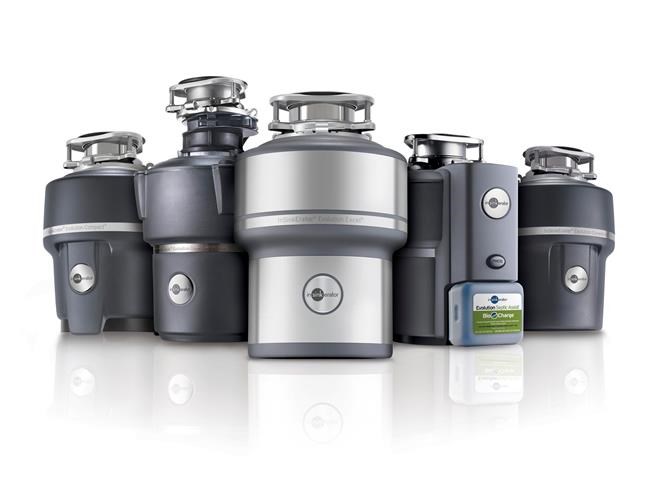
This photo provided by InSinkErator shows a variety of InSinkErator's food disposal systems. Wastewater and environment experts agree that the environmental value of kitchen disposal systems depends on the wastewater system of a given locality. Disposals make sense if your wastewater system is set up to convert food waste into energy, as is the case in a growing number of big cities. (InSinkErator via AP)

“If you’re in an area like ours, on the Long Island Sound, which has been trying to reduce nitrogen in the water for 25 years, using a kitchen disposal system and adding unnecessary nitrogen to the water waste system might not be a good idea.”

Disposals also might not be the best option in areas with water shortages: Conveying food waste through pipes and treating it at a plant can be energy- and water-intensive.

“Another consideration that should be given is whether there is methane capture at their municipality’s water treatment plant. Sending food scraps into wastewater streams will change their chemical composition, and whether a municipality would be able to handle this or not is a very specific question,” says Birnur Aral, a director at the Good Housekeeping Institute focusing on environmental issues.

Sauerhage, of the EPA, says that in determining how to dispose of food waste responsibly, consider these questions: Where is the effluent going? Does it go to a wastewater treatment plant or wastewater recovery facility? Has the treatment plant said it wants organic waste? Does it operate an anaerobic digestion facility? What does it do with solids? Is there concern over damaging your household or local piping systems?

The EPA has issued a “food recovery hierarchy” to help consumers. It’s a sort of upside-down pyramid ranking possible solutions for food waste. At the top — the most eco-friendly option — is reducing food waste, followed by distributing excess food to the hungry. The next best option is industrial uses for food waste, such as converting waste oil to fuel and food scraps to energy. Then comes composting, either by communities or in backyards. Landfills and incinerators are the least eco-friendly destination for food waste, according to the EPA.


Report Error Submit a Tip

More Stories

Letters, July 27

7 minute read Preview

Letters, July 27

7 minute read 2:00 AM CDT

It would appear to me that Tom Brodbeck and the Free Press suffer from some of the same symptoms of ignoring the trends and facts that inflicts Pierre Poilievre’s Conservatives.

Read
2:00 AM CDT

Ref ‘dominates’ game in Sea Bears loss to Honey Badgers, says coach

Joshua Frey-Sam 7 minute read Preview

Ref ‘dominates’ game in Sea Bears loss to Honey Badgers, says coach

Joshua Frey-Sam 7 minute read Saturday, Jul. 25, 2026

Following a festive Christmas-in-July-themed Saturday afternoon inside Canada Life Centre, Winnipeg Sea Bears head coach Mike Raimbault didn’t mince words about who he thought was the Grinch in a hard-fought 88-86 loss to the visiting Brampton Honey Badgers that ended in controversy.

As the Sea Bears owned a one-point lead in Target Score Time, Brampton guard Sean East II was awarded three free throws — all of which he converted — after a questionable foul called on Teddy Allen by official Perry Stothart.

Raimbault, who has been known to bite his tongue on such topics, left nothing to the imagination about where he stood on the game-deciding judgment made in a game that had major post-season implications.

“I just felt like it was a fitting ending to the game where Perry Stothart had dominated the flow of the game from the start,” he said. “For him to call a bit of a guess foul and end the game on the foul, I felt like it’s disappointing that he can come in and dictate how the game’s going to be played and flow, and (that) continues to be a bit of an M.O. for him. So I think we’re disappointed with the fact that the league continues to let that happen.”

Read
Saturday, Jul. 25, 2026

Automation reaches new heights on farm

Laura Rance-Unger 4 minute read Preview

Automation reaches new heights on farm

Laura Rance-Unger 4 minute read Saturday, Jul. 25, 2026

LANGHAM, Sask. — The thousands of farmers from across the Prairies who flock to the annual Ag in Motion show every July seem oblivious to the possibility the technology on display could one day replace many of them.

Families with children in tow, Hutterite colony workers, grandparents and young couples just starting out roamed through the 600 or more exhibitor displays, amazed at how everything about farming just keeps getting bigger, more efficient and increasingly more automated.

It’s now possible to seed using a 100-foot-wide drill — a 12-foot jump over the widest available a few years ago — provided the farmer can afford a tractor with enough horsepower to pull it. Those sell for around $850,000 and up.

Granted, the number of farms with enough acres to justify that kind of width and drawing power is still relatively small, but farms continue to grow. And it’s no secret the number of people who have the interest, skills and financial wherewithal to run them continues to shrink.

Read
Saturday, Jul. 25, 2026

Man, 20, faces charges in street-racing incident

1 minute read Updated: Yesterday at 11:37 PM CDT

Speeding drivers were racing through Elmwood at up to 200 km/h overnight, Winnipeg police say.

Around 2 a.m. July 26, police got reports of a Corvette and other vehicles racing along Disraeli Freeway. Using the Winnipeg Police Service's helicopter, officers monitored the vehicles and recorded speeds, including vehicles crossing the Nairn overpass at up to 200 km/hr.

Officers with the central traffic unit tried to pull over a Jeep and a Corvette at Lagimodiere Boulevard and Regent Avenue. The driver of the Corvette didn't stop and sped past police, eventually stopping in the 100 block of Johnson Avenue where the driver and passenger got out and ran.

The K9 unit tracked the suspects to the 100 block of Poplar Avenue. One of them was taken down by a police dog and received medical attention. Both were taken into custody.

An eroding Winnipeg neighbourhood looks to new foundations

Ian Bickis, The Canadian Press 5 minute read Preview

An eroding Winnipeg neighbourhood looks to new foundations

Ian Bickis, The Canadian Press 5 minute read Updated: Yesterday at 1:34 PM CDT

WINNIPEG - The lot Jesse Bettcher lives on in Winnipeg's north end used to be a pile of burnt rubble. Same with the one next door. And the one across the street.

But he's now the proud owner of a two-storey house with blue-grey siding and white trim, so new the orange construction fencing is still out front.

It's a dream home for Bettcher, and the latest hope for a city seeking to knock down, clean up and revitalize neighbourhoods that have seen hundreds of homes left vacant, leading to safety hazards and worries about the future.

He bought the house as part of a pilot project aimed at creating affordable home ownership. It let him and his family move out of a rental that he said was falling apart.

Read
Updated: Yesterday at 1:34 PM CDT

Conservatives call for emergency meeting on Trump threats, demand Carney explain plan

The Canadian Press 1 minute read Preview

Conservatives call for emergency meeting on Trump threats, demand Carney explain plan

The Canadian Press 1 minute read Updated: Yesterday at 9:16 AM CDT

OTTAWA - The Conservative shadow minister for Canada-U.S. relations is calling on Ottawa to provide its negotiation plan with U.S. President Donald Trump at an emergency meeting.

Shuv Majumdar says in a letter to Prime Minister Mark Carney that the Conservatives want an emergency meeting of the Standing Committee on International Trade next week, and Ottawa needs to table its written plans at the hearings.

Majumdar says Carney must explain how the government will address Trump's latest tariff threat.

Trump said Monday the U.S. government will hit an array of Canadian products with 50 per cent tariffs in 30 days.

Read
Updated: Yesterday at 9:16 AM CDT