CBD is getting buzz, but does it work? And is it legal?
Advertisement
Read this article for free:
or
Already have an account? Log in here »
To continue reading, please subscribe:

Digital Subscription
One year of digital access for only $205*
- Enjoy unlimited reading on winnipegfreepress.com
- Read the E-Edition, our digital replica newspaper
- Access News Break, our award-winning app
- Play interactive puzzles
*First annual payment billed as $205.00 + GST for one year. This annual subscription will automatically renew at $233.00 + GST every 52 weeks (10% off the regular annual price of $259.35). Offer available to new and qualified returning subscribers only. Cancel any time.
To continue reading, please subscribe:
Add Free Press access to your Brandon Sun subscription for only an additional
$1 for the first 4 weeks*
- Enjoy unlimited reading on winnipegfreepress.com
- Read the E-Edition, our digital replica newspaper
- Access News Break, our award-winning app
- Play interactive puzzles
*Your next Brandon Sun subscription payment will increase by $1.00 and you will be charged $17.95 plus GST for four weeks. After four weeks, your payment will increase to $24.95 plus GST every four weeks.
Read unlimited articles for free today:
or
Already have an account? Log in here »
Hey there, time traveller!
This article was published 02/04/2019 (2683 days ago), so information in it may no longer be current.
With CBD showing up everywhere, U.S. regulators announced Tuesday they are exploring ways the marijuana extract could be used legally in foods, dietary supplements and cosmetics.
The U.S. Food and Drug Administration said it will hold a public hearing May 31 to gather more information on the science, manufacturing and sale of cannabis compounds such as CBD.
In the meantime, it issued more warning letters to companies for making unapproved health claims about CBD products.
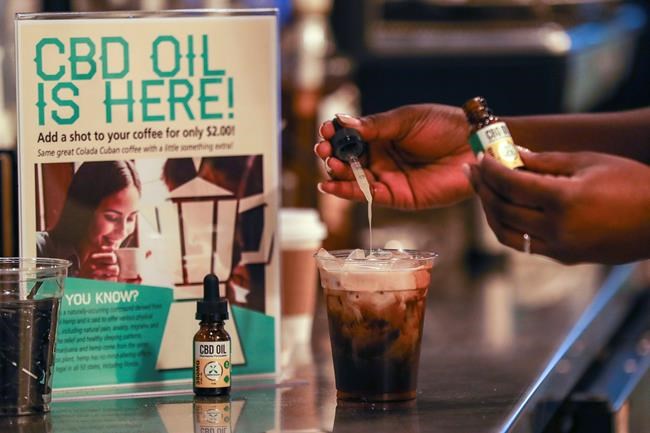
Products containing CBD are already in stores and sold online, so it’s easy to believe there must be something special about the ingredient. But the claims are largely unproven and quality control standards don’t exist.
A look at what we know as U.S. regulators work out what will and won’t be allowed:
WHAT IS CBD?
CBD is one of more than 100 compounds found in marijuana. It’s extracted using alcohol or carbon dioxide in factories. It’s added to oils, mixed into creams and lotions and sold in candies and liquid drops.
Widely sold online, CBD now is going mainstream with major retailers offering salves and balms for the skin. Prices range from $12 to $150 an ounce at high-end shops.
CBD often comes from a cannabis plant known as hemp, which is defined by the U.S. government as having less than 0.3% THC. That’s important because THC is what causes marijuana’s mind-altering effect.
CBD doesn’t get people high, although it may be calming. Keep in mind some CBD products may contain THC, whether or not the label says so.
People drug tested for work, addiction programs or because they take prescription opioids should take note: CBD products have caused people to fail urine drug screens.
IS IT A MIRACLE CURE?
If you believe the hype, CBD treats pain, relieves anxiety and both helps you sleep and keeps you focused.
Most claims are based on studies in rats, mice or in test tubes. Some human research has been done, but in small numbers of people.
One exception: For two rare seizure disorders, the evidence for CBD was strong enough to convince the FDA to approve GW Pharmaceutical’s drug Epidiolex, which contains a purified form.
The FDA announced Tuesday it has sent warning letters to three companies marketing products with what outgoing Commissioner Scott Gottlieb called “egregious, over-the-line claims” for CBD’s effects on cancer, Alzheimer’s disease, fibromyalgia and drug addiction. Among the cited examples: “CBD successfully stopped cancer cells” in cervical cancer.
Gottlieb said the agency “won’t tolerate this kind of deceptive marketing to vulnerable patients.”
Dr. Young Lee, CEO of Advanced Spine and Pain LLC (doing business as Relievus), said his company had taken down its website after receiving an FDA warning letter.
C.J. Montgomery of Nutra Pure LLC of Vancouver, Washington, said the company has revised some of wording on its website to try to address the FDA’s concerns.
PotNetwork Holdings Inc. of Fort Lauderdale, Florida, did not immediately return calls and emails seeking comment on the warning letters.
Only drugs that have been reviewed by the FDA as safe and effective can make claims that they treat or prevent diseases or medical conditions. Many CBD producers attempt to sidestep the issue by using only vague language about general health and well-being.
ANY SIDE EFFECTS?
Scant research means not much is known about side effects either. In epilepsy research, CBD changed the way the body processed other drugs. That suggests CBD could interact with medications in ways we still don’t know about.
The most common side effects of the CBD drug Epidiolex include sleepiness, decreased appetite, diarrhea, increases in liver enzymes, exhaustion, rash and infections. FDA’s Gottlieb noted Tuesday the potential for liver injury and other risks can be handled with medical supervision but less is known about how that would be managed without oversight. And there are questions about overlap if multiple CBD products are used.
IS IT LEGAL?
For now, the agency has said CBD is not allowed as an ingredient in food, drinks or dietary supplements.
In stating its position, the FDA cited a provision of the law prohibiting food makers from using active drug ingredients or those still undergoing substantial research. But the agency doesn’t have the resources to police all the CBD products that are already available, said Marc Scheineson, a former FDA official.
“They’re not going to pull a thousand products from the market,” he said.
The FDA’s authority is over interstate commerce, and local officials have taken differing approaches. In New York, Los Angeles and elsewhere, officials are warning eateries to stop selling it in food and drinks. Maine passed a law allowing it in foods and other products in the state.
Skin creams and cosmetics may be on safer footing with the FDA, but that too remains uncertain, said Camille Gourdet of RTI International, a non-profit research institute in Durham, North Carolina. Though cosmetics aren’t subject to premarket approval by the FDA, they could run afoul of regulations if they make specific health claims.
Marijuana itself is illegal under federal law; most states that have legalized it allow marijuana-infused foods and candies, called edibles.
ARE CBD LABELS ACCURATE?
What you buy may contain much less CBD than the label states — or much more. It may include more THC than you want and it may be contaminated with mould or pesticides. Ask to see testing reports.
A 2017 study in the Journal of the American Medical Association found 70% of CBD products were mislabeled. Researchers used an independent lab to test 84 products from 31 companies.
“You’re really flying by the seat of your pants when you buy this stuff,” said author Marcel Bonn-Miller of University of Pennsylvania.
A product labeled as containing 100 milligrams of CBD may only have 5 milligrams or it may have 200, said Bonn-Miller, now an adviser for a company that sells CBD and other cannabis products. He did not work in the industry when he did the research.
“I wouldn’t trust any of it until I knew independently it was safe,” Bonn-Miller said.
WHAT’S AHEAD?
CBD research is planned or underway for cancer, autism, diabetic neuropathy, fibromyalgia, chronic pain, alcoholism with PTSD and psychiatric conditions. Results will take years, but some people aren’t waiting.
“They are vulnerable and really hoping to feel better,” said Karen Hande, a nurse practitioner at Vanderbilt-Ingram Cancer Center in Nashville.
She became an expert in CBD because so many of her cancer patients were trying it. She tells them the evidence isn’t enough to back the claims, but “they want to believe something is going to work.”
___
Follow AP’s complete marijuana coverage: https://apnews.com/Marijuana
___
The Associated Press Health & Science Department receives support from the Howard Hughes Medical Institute’s Department of Science Education. The AP is solely responsible for all content.