Ghost of Toys R Us still haunts toy makers

Advertisement

Advertise with us

NEW YORK - Just last year, a kid in the market for an Uncle Milton ant farm could choose from a half dozen versions, including glow-in-the dark or an ant village. Now there are only three. Last year, there were 60 kinds of K'Nex construction sets on the market. This year there are 20.

Read this article for free:


or

Already have an account? Log in here »

To continue reading, please subscribe:

Subscribe and receive a limited-edition Free Press branded hat or tote.

Digital Subscription

One year of digital access for only $205*

  • Enjoy unlimited reading on winnipegfreepress.com
  • Read the E-Edition, our digital replica newspaper
  • Access News Break, our award-winning app
  • Play interactive puzzles

*First annual payment billed as $205.00 + GST for one year. This annual subscription will automatically renew at $233.00 + GST every 52 weeks (10% off the regular annual price of $259.35). Offer available to new and qualified returning subscribers only. Cancel any time.

To continue reading, please subscribe:

Add Free Press access to your Brandon Sun subscription for only an additional

$1 for the first 4 weeks*

  • Enjoy unlimited reading on winnipegfreepress.com
  • Read the E-Edition, our digital replica newspaper
  • Access News Break, our award-winning app
  • Play interactive puzzles
Start now

*Your next Brandon Sun subscription payment will increase by $1.00 and you will be charged $17.95 plus GST for four weeks. After four weeks, your payment will increase to $24.95 plus GST every four weeks.

Hey there, time traveller!
This article was published 09/04/2019 (2707 days ago), so information in it may no longer be current.

NEW YORK – Just last year, a kid in the market for an Uncle Milton ant farm could choose from a half dozen versions, including glow-in-the dark or an ant village. Now there are only three. Last year, there were 60 kinds of K’Nex construction sets on the market. This year there are 20.

A year after Toys R Us imploded, toy makers are still readjusting to the big loss of shelf space. That means slashing the number of styles they carry, re-evaluating how they sell large toys like playhouses and cars, and changing their packaging to squeeze into smaller retail spaces.

It’s a jolt for toy companies. They had already been trying to reinvent themselves amid an onslaught of changes, including kids’ evolving tastes toward gadgets, as well as the rise of Amazon and online shopping. They never expected the iconic chain to liquidate its 800 U.S. stores six months after it filed for Chapter 11 reorganization in 2017. Some companies depended on the chain for as much as 40 per cent of overall sales.
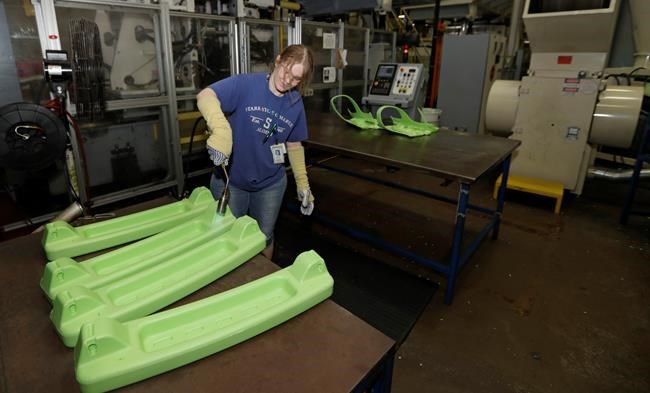
In this Thursday, March 28, 2019, photo Julie Smith prepares the Easy Store Picnic Table before packaging at the The Little Tikes Company in Hudson, Ohio. A year after Toys R Us imploded, toy makers, big and small, are still readjusting to smaller shelf space. That means slashing the number of styles they carry, re-evaluating how they sell big toys like playhouses and cars, and changing their packaging in order to squeeze into a smaller space at retailers. (AP Photo/Tony Dejak)

A slew of retailers like Walmart, Target and Party City rushed to expand their toy aisles to capitalize on Toys R Us’s demise, but toy companies say they aren’t able to fill the void. The stores devoted big sections to toys year round and served as incubators of new trends. They also say that Toys R Us’ massive orders of tens of thousands of units offset the cost of production.

All this has led to fewer options for kids.

“Maybe the world only needs one kind of ant farm, but in the day, you had a choice,” said Jay Foreman, president and CEO of Basic Fun. The Boca Raton, Florida-based company purchased the assets of Uncle Milton, which makes ant farms, along with K’Nex and Playhut, over the past year. He is now evaluating his overall lineup.

Many parents have taken note of the more limited options.

Stephen Desch of Keyport, N.J., said when his now 3-year-old daughter wanted a crab-shaped sandbox, he found it at Toys R Us. But he can’t find certain items now, like a plush toy inspired by the Jay character from the Netflix show “Beat Bugs.”

“It’s definitely annoying,” Desch said.

Vanessa Myers of Bristol, Virginia, cites too many choices in some categories, like light up toys for the tub. But she does worry about the dwindling selection of dolls and bikes.

“I really want dolls that are diverse,” in hair colour and ethnicity, she said.

Toys R Us collapsed after racking up nearly $3 billion in revenue last year, or 12 per cent of the U.S. toy market, according to market research group NPD Group Inc. Jim Silver, editor-in-chief of TTPM, an online toy review site, estimates that 40 per cent of Toys R Us business wasn’t scooped up. Even as the former investors of Toys R Us try to resurrect the business in the U.S. in time for the holidays, many expect it to be a shell of what it was.

The effort follows a 2 per cent drop to $21.6 billion in toy sales for last year, with demand weakening during the second half of the year with the loss of Toys R Us. That reversed four straight years of sales growth, NPD says.

Mattel’s annual sales last year fell 8 per cent, reflecting a negative 6 per cent impact from the toy retailer’s liquidation. At Hasbro, annual sales dropped 12 per cent, dragged down by the loss of Toys R Us. Mattel had been struggling for several years, but it had been starting to see a turnaround.
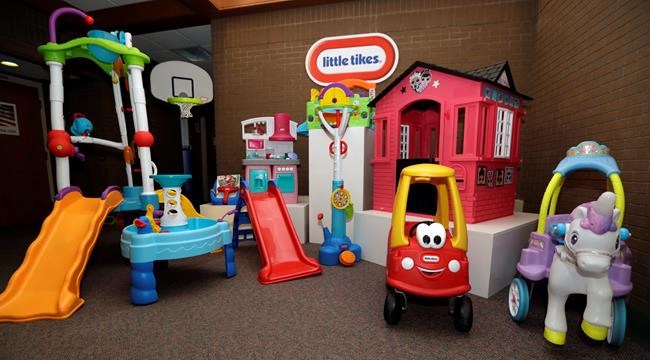
In this Thursday, March 28, 2019, photo Toys are on display at the The Little Tikes Company in Hudson, Ohio. A year after Toys R Us imploded, toy makers, big and small, are still readjusting to smaller shelf space. That means slashing the number of styles they carry, re-evaluating how they sell big toys like playhouses and cars, and changing their packaging in order to squeeze into a smaller space at retailers. (AP Photo/Tony Dejak)

Toy makers have been expanding online, but that isn’t the panacea, says Marc Rosenberg, the strategic marketing adviser who was behind the success of Hasbro’s furry hit Furby. Physical stores still drive the toy business and profitability since companies don’t incur shipping costs, Rosenberg says.

Foreman agrees, saying his new line of Cutetitos — beanie babies wrapped up in a burrito blanket and launched for the holidays — would have fared even better if Toys R Us was around. Typically, Toys R Us would have devoted a 3-feet-by-16-inch display in a highly visible spot to a hot item. Instead, stores gave Cutetitos an area that measured 18 inches wide by 5 inches deep.

Isaac Larian, CEO of privately held MGA Entertainment, has seen overall sales triple last year because of its popular LOL toys. But its Little Tikes division, which makes toy cars and playhouses that need big areas for display, suffered a 12 per cent sales drop because of the loss of Toys R Us even as his business with Amazon rose 50 per cent. Overall, 27 per cent of its overall business stemmed from Toys R Us, but at Little Tikes, that figure was 40 per cent.

Larian’s Little Tikes toy factory — the largest U.S. toy factory — based in Hudson, Ohio, is running at 25 per cent capacity. Larian says he’s cutting the number of Little Tikes toys it produces mainly because of the loss of Toys R Us. He’s now expanding into housewares to keep the factory busier.

“Every day we are reinventing ourselves,” he said.

___

Follow Anne D’Innocenzio: http://twitter.com/ADInnocenzio
Report Error Submit a Tip

More Stories

Smith’s pretzel logic confuses

Editorial 4 minute read Preview

Smith’s pretzel logic confuses

Editorial 4 minute read 2:01 AM CDT

Alberta Premier Danielle Smith had both sides of her mouth working overtime on Aug. 30, when she spoke at an event in Calgary to commemorate Alberta Day, the annual celebration of the province’s entry into Confederation in 1905 (officially Sept. 1, it was celebrated on the weekend).

Smith’s comments — and the things she did not say — revealed a lot about the political tightrope the premier is trying to walk over the challenges currently faced by her province. At the top of that list of challenges is a persistent campaign to separate Alberta from the aforementioned Confederation. A campaign that Smith appears to both support and oppose, depending on which day of the week it is.

Her Alberta Day remarks were an excellent case in point.

Smith has decided that on Oct. 19, Albertans will vote on a series of non-binding propositions in a province referendum. One of those questions will ask Albertans whether they want to hold a referendum on separation, thus making this fall’s vote a “referendum on whether to hold a referendum,” as some observers have dubbed it.

Read
2:01 AM CDT

Canada’s first drive-thru-only McDonald’s opens in Winnipeg

Aaron Epp 4 minute read Preview

Canada’s first drive-thru-only McDonald’s opens in Winnipeg

Aaron Epp 4 minute read Wednesday, Sep. 2, 2026

One Grimace and dozens of smiles were on display Wednesday as McDonald’s staff and supporters celebrated the grand opening of the fast-food chain’s first drive-thru-only restaurant in Canada.

Read
Wednesday, Sep. 2, 2026

Back to school means increased costs for parents, post-secondary students

Joel Schlesinger 6 minute read Preview

Back to school means increased costs for parents, post-secondary students

Joel Schlesinger 6 minute read 2:01 AM CDT

In the words of advice for students from Thornton Melon: “It’s rough out there. Move back in with your parents.”

As comedian Rodney Dangerfield’s character alluded to in the 1986 comedy Back to School, it is indeed a tough financial environment as students head back to the classroom in 2026.

A Capital One Canada survey found families are struggling with costs, with nearly six in 10 parents surveyed stating back-to-school expenses are higher than expected.

It’s not just tuition, new clothes and supplies. Extracurricular activities — like hockey, figure skating, ringette, soccer, dance, etc. — also ramp up, involving tuition-sized payments.

Read
2:01 AM CDT

‘Quite a journey’: dozens move into transitional housing downtown

Carol Sanders 4 minute read Preview

‘Quite a journey’: dozens move into transitional housing downtown

Carol Sanders 4 minute read Yesterday at 5:54 PM CDT

Dozens of residents have moved into transitional housing units in a former university building in downtown Winnipeg.

Housing, Addictions and Homelessness Minister Bernadette Smith said 42 residents have moved into suites on the third and fourth floors of a seven-storey building previously owned by Providence University College and Theological Seminary. There will be space for as many as 118 people who were in encampments or otherwise homeless.

The remaining units under renovation are expected to be ready and occupied in the coming weeks, Smith said.

“This has been two years in the making,” the minister said at a media event with residents, staff, neighbours and supporters. The building cost the province $24.4 million to purchase and renovate.

Read
Yesterday at 5:54 PM CDT

NDP minister needs lesson in political civility

Dan Lett 5 minute read Preview

NDP minister needs lesson in political civility

Dan Lett 5 minute read Yesterday at 2:40 PM CDT

Families Minister Nahanni Fontaine’s decision to intercede in Winnipeg’s mayoral election may be surprising to some political observers. To others, however, it is entirely on brand.

On Tuesday, Fontaine posted a video on social media in which she expressed concern that former city councillor and Progressive Conservative cabinet minister Kevin Klein was entering the race to challenge incumbent Mayor Scott Gillingham.

The caption on the video was blunt: “I mean, really, who chooses to work for Count Dracula?”

“Kevin Klein once worked for Peter Nygard. Peter Nygard is Canada’s equivalent to (American sex offender) Jeffrey Epstein — had his own little island, did unspeakable, disgusting things to women and girls … anyways, I just thought that Winnipeggers would want to know that Kevin Klein, at one point, worked for Peter Nygard,” she says in the video.

Read
Yesterday at 2:40 PM CDT

Controlling pace of response path to success

Tim Kist 5 minute read 2:01 AM CDT

WITH the recent collapse of Canada-U.S. trade talks, the economic, political and social changes are coming at business leaders on a daily basis.

While you cannot control the pace of these changes, you can control the pace of response and timing of actions your organization takes. This is a time for thoughtful analysis and careful action, not chasing the latest trends.

Artificial intelligence, for example, can write articles, create images, draft emails and perform seemingly countless other tasks. But is this new tool solving a current business problem?

Successful companies know they must develop a strategy before launching any tactics. Otherwise, the strategy is based on “hope” — and we all know hope is not a strategy.