Doctors use HIV in gene therapy to fix ‘bubble boy’ disease

Advertisement

Advertise with us

They were born without a working germ-fighting system, every infection a threat to their lives. Now eight babies with "bubble boy disease" have had it fixed by a gene therapy made from one of the immune system's worst enemies — HIV, the virus that causes AIDS.

Read this article for free:


or

Already have an account? Log in here »

To continue reading, please subscribe:

Subscribe and receive a limited-edition Free Press branded hat or tote.

Digital Subscription

One year of digital access for only $205*

  • Enjoy unlimited reading on winnipegfreepress.com
  • Read the E-Edition, our digital replica newspaper
  • Access News Break, our award-winning app
  • Play interactive puzzles

*First annual payment billed as $205.00 + GST for one year. This annual subscription will automatically renew at $233.00 + GST every 52 weeks (10% off the regular annual price of $259.35). Offer available to new and qualified returning subscribers only. Cancel any time.

To continue reading, please subscribe:

Add Free Press access to your Brandon Sun subscription for only an additional

$1 for the first 4 weeks*

  • Enjoy unlimited reading on winnipegfreepress.com
  • Read the E-Edition, our digital replica newspaper
  • Access News Break, our award-winning app
  • Play interactive puzzles
Start now

*Your next Brandon Sun subscription payment will increase by $1.00 and you will be charged $17.95 plus GST for four weeks. After four weeks, your payment will increase to $24.95 plus GST every four weeks.

Hey there, time traveller!
This article was published 17/04/2019 (2680 days ago), so information in it may no longer be current.

They were born without a working germ-fighting system, every infection a threat to their lives. Now eight babies with “bubble boy disease” have had it fixed by a gene therapy made from one of the immune system’s worst enemies — HIV, the virus that causes AIDS.

A study out Wednesday details how scientists turned this enemy virus into a saviour, altering it so it couldn’t cause disease and then using it to deliver a gene the boys lacked.

“This therapy has cured the patients,” although it will take more time to see if it’s a permanent fix, said Dr. Ewelina Mamcarz, one of the study leaders at St. Jude Children’s Research Hospital in Memphis.
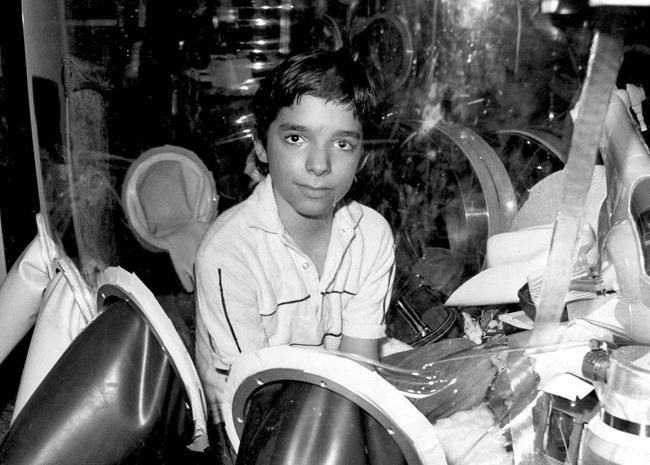
FILE - This Sept. 11, 1982 file photo shows David Vetter, born with an inherited disorder which leaves him no natural immunities against disease, in his protective enclosure in Texas. In 1984, Vetter died from complications from an experimental bone marrow transplant, thought to be his only chance at survival outside the
FILE - This Sept. 11, 1982 file photo shows David Vetter, born with an inherited disorder which leaves him no natural immunities against disease, in his protective enclosure in Texas. In 1984, Vetter died from complications from an experimental bone marrow transplant, thought to be his only chance at survival outside the "bubble." (AP Photo)

Omarion Jordan, who turns 1 later this month, had the therapy in December to treat severe combined immunodeficiency syndrome, or SCID.

“For a long time we didn’t know what was wrong with him. He just kept getting these infections,” said his mother, Kristin Simpson. Learning that he had SCID “was just heartbreaking … I didn’t know what was going to happen to him.”

Omarion now has a normal immune system. “He’s like a normal, healthy baby,” Simpson said. “I think it’s amazing.”

Study results were published by the New England Journal of Medicine. The treatment was pioneered by a St. Jude doctor who recently died, Brian Sorrentino.

SCID is caused by a genetic flaw that keeps the bone marrow from making effective versions of blood cells that comprise the immune system. It affects 1 in 200,000 newborns, almost exclusively males. Without treatment, it often kills in the first year or two of life.

“A simple infection like the common cold could be fatal,” Mamcarz said.

The nickname “bubble boy disease” comes from a famous case in the 1970s — a Texas boy who lived for 12 years in a protective plastic bubble to isolate him from germs. A bone marrow transplant from a genetically matched sibling can cure SCID, but most people lack a suitable donor. Transplants also are medically risky — the Texas boy died after one.

Doctors think gene therapy could be a solution. It involves removing some of a patient’s blood cells, using the modified HIV to insert the missing gene, and returning the cells through an IV. Before getting their cells back, patients are given a drug to destroy some of their marrow so the modified cells have more room to grow.

When doctors first tried it 20 years ago, the treatment had unintended effects on other genes, and some patients later developed leukemia. The new therapy has safeguards to lower that risk.

A small study of older children suggested it was safe. The new study tried it in infants, and doctors are reporting on the first eight who were treated at St. Jude and at UCSF Benioff Children’s Hospital San Francisco.

Within a few months, normal levels of healthy immune system cells developed in seven boys. The eighth needed a second dose of gene therapy but now is well, too. Six to 24 months after treatment, all eight are making all the cell types needed to fight infections, and some have successfully received vaccines to further boost their immunity to disease.
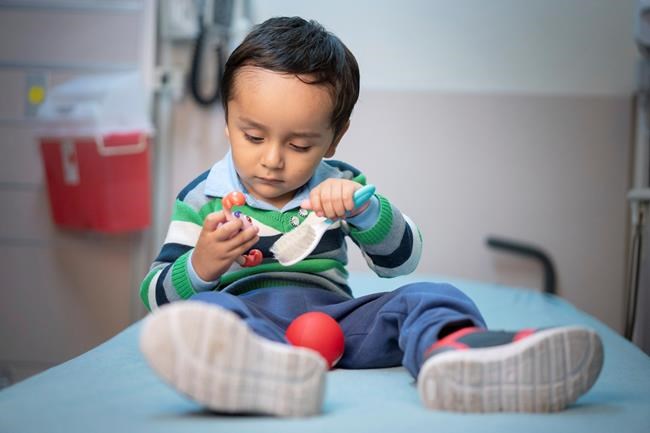
In this April 2019 photo provided by the St. Jude Children's Research Hospital, 2-year old Gael Jesus Pino Alva plays with toys at the hospital in Memphis. Gael was one of eight babies with
In this April 2019 photo provided by the St. Jude Children's Research Hospital, 2-year old Gael Jesus Pino Alva plays with toys at the hospital in Memphis. Gael was one of eight babies with "bubble boy disease" who have had it corrected by gene therapy that ironically was made from one of the immune system's worst enemies _ HIV, the virus that causes AIDS. (Peter Barta/St. Jude Children's Research Hospital via AP)

No serious or lasting side effects occurred.

Omarion is the 10th boy treated in the study, which is ongoing. It’s sponsored by the American Lebanese Syrian Associated Charities, the California Institute of Regenerative Medicine, the Assisi Foundation of Memphis and the federal government.

“So far it really looks good,” but patients will have to be studied to see if the results last, said Dr. Anthony Fauci, head of the National Institute of Allergy and Infectious Diseases, which helped develop the treatment. “To me, this looks promising.”

Rights to it have been licensed by St. Jude to Mustang Bio. Doctors say they have no estimate on what it might cost if it does become an approved treatment. They say they also hope to try it for more common problems such as sickle cell disease.

___

Marilynn Marchione can be followed at http://twitter.com/MMarchioneAP

___

The Associated Press Health and Science Department receives support from the Howard Hughes Medical Institute’s Department of Science Education. The AP is solely responsible for all content.

Report Error Submit a Tip

More Stories

Bombers need all three phases to step up in second half: O’Shea

Taylor Allen 6 minute read Preview

Bombers need all three phases to step up in second half: O’Shea

Taylor Allen 6 minute read Yesterday at 6:44 PM CDT

Highlight-reel catches are a daily occurrence for Ontaria Wilson at practice.

The Winnipeg Blue Bombers receiver also makes jaw-dropping grabs on game days — just go back to last October in Edmonton when Wilson made arguably the most impressive play of the 2025 campaign.

For those that need a reminder, quarterback Zach Collaros underthrew a pass to the end zone that ricocheted off a pair of defenders. Wilson reached out with his right hand and batted the ball up twice while falling to the turf before securing it for an incredible 35-yard score.

That was likely the hardest touchdown of his career, and he should’ve had his easiest in last Friday’s 33-21 win over the Ottawa Redblacks at home — but he dropped it.

Read
Yesterday at 6:44 PM CDT

Hometown hero hits CEBL championship clinching shot

Taylor Allen 5 minute read Preview

Hometown hero hits CEBL championship clinching shot

Taylor Allen 5 minute read Sunday, Aug. 16, 2026

Chapter 1 of Winnipeg Sea Bears basketball was capped by hometown hero Chad Posthumus.

It was May 27, 2023, and the late, great centre out of River East Collegiate had a put-back basket off a Teddy Allen miss to give the Sea Bears a 90-85 victory over the Vancouver Bandits in Winnipeg’s inaugural game, in front of what was then a record crowd of 7,303.

So, on Saturday, it was rather poetic that Simon Hildebrandt — another Winnipegger and a player Posthumus used to mentor — was the one to put an exclamation mark on the franchise’s latest and greatest chapter.

Hildebrandt drilled a wide-open three in Target Score Time to crown the Sea Bears as the 2026 CEBL champions.

Read
Sunday, Aug. 16, 2026

City crews cleaning up drug paraphernalia, weapons having some impact on inner-city life

Malak Abas 7 minute read Preview

City crews cleaning up drug paraphernalia, weapons having some impact on inner-city life

Malak Abas 7 minute read Yesterday at 5:49 PM CDT

A three-person crew, employed by the city as part of its recently expanded proactive cleanup program, allowed the Free Press to follow along last week while they worked to make the Freight House Recreation Centre's property safe to play in.

Read
Yesterday at 5:49 PM CDT

‘You vote with your bike’: cyclists celebrate freedoms, call for increased safety

Maggie Macintosh 6 minute read Preview

‘You vote with your bike’: cyclists celebrate freedoms, call for increased safety

Maggie Macintosh 6 minute read Updated: Yesterday at 9:24 AM CDT

Patty Wiens got dressed up in her sparkly, hot pink cowboy boots to pedal and talk politics with more than 100 other people on Sunday.

The founder of Winnipeg’s Fancy Women Bike Ride called on attendees of the 2026 event to ask candidates in the upcoming civic election — a half-dozen of whom were in attendance — about their active transportation platforms.

“We’re here today, in an election year, to remind you that you vote with your bike,” Wiens told a crowd of nearly 120 cyclists gathered on the legislature grounds for the group ride.

“When (city council) candidates come to your door and ask what’s important to you, you’re going to say, ‘I want to ride my bike safely in the city. What are you going to do about it?’”

Read
Updated: Yesterday at 9:24 AM CDT

Brush up on your Winnipeg knowledge with this summertime quiz

0 minute read Updated: Yesterday at 6:50 PM CDT

How well do you know your city? Put your knowledge to the test with our 10-question quiz.

Trial project lauded in the fight against pollution

Joyanne Pursaga 5 minute read Preview

Trial project lauded in the fight against pollution

Joyanne Pursaga 5 minute read Updated: Yesterday at 6:45 PM CDT

A city project aimed at reducing water pollution is being deemed a success, despite some challenges in adding it to an aging sewage treatment plant.

The city used strategically placed doses of ferric chloride to reduce the amount of phosphorous, a key algae-promoting nutrient, in effluent leaving the North End sewage treatment plant between June 2024 and September 2025.

The chemical additives increased the removal of phosphorous through the plant’s treatment process. It went from 61 per cent of the nutrient being removed pre-trial, to reach 74 per cent in 2024 and 67 per cent in 2025.

“It’s a success, because we’re removing more phosphorous than we were before … Any improvement in phosphorous removal will help Lake Winnipeg,” said Michelle Paetkau, a senior planning engineer for Winnipeg water and waste.

Read
Updated: Yesterday at 6:45 PM CDT