WEATHER ALERT

Blankets, bed-sharing common in accidental baby suffocations

Advertisement

Advertise with us

CHICAGO - Accidental suffocation is a leading cause of injury deaths in U.S. infants and common scenarios involve blankets, bed-sharing with parents and other unsafe sleep practices, an analysis of government data found.

Read this article for free:

or

Already have an account? Log in here »

To continue reading, please subscribe:

Subscribe and receive a limited-edition Free Press branded hat or tote.

Digital Subscription

One year of digital access for only $205*

  • Enjoy unlimited reading on winnipegfreepress.com
  • Read the E-Edition, our digital replica newspaper
  • Access News Break, our award-winning app
  • Play interactive puzzles

*First annual payment billed as $205.00 + GST for one year. This annual subscription will automatically renew at $233.00 + GST every 52 weeks (10% off the regular annual price of $259.35). Offer available to new and qualified returning subscribers only. Cancel any time.

To continue reading, please subscribe:

Add Free Press access to your Brandon Sun subscription for only an additional

$1 for the first 4 weeks*

  • Enjoy unlimited reading on winnipegfreepress.com
  • Read the E-Edition, our digital replica newspaper
  • Access News Break, our award-winning app
  • Play interactive puzzles
Start now

*Your next Brandon Sun subscription payment will increase by $1.00 and you will be charged $17.95 plus GST for four weeks. After four weeks, your payment will increase to $24.95 plus GST every four weeks.

Hey there, time traveller!
This article was published 21/04/2019 (2656 days ago), so information in it may no longer be current.

CHICAGO – Accidental suffocation is a leading cause of injury deaths in U.S. infants and common scenarios involve blankets, bed-sharing with parents and other unsafe sleep practices, an analysis of government data found.

These deaths “are entirely preventable. That’s the most important point,” said Dr. Fern Hauck, a co-author and University of Virginia expert in infant deaths.

Among 250 suffocation deaths, roughly 70 per cent involved blankets, pillows or other soft bedding that blocked infants’ airways. Half of these soft bedding-related deaths occurred in an adult bed where most babies were sleeping on their stomachs.
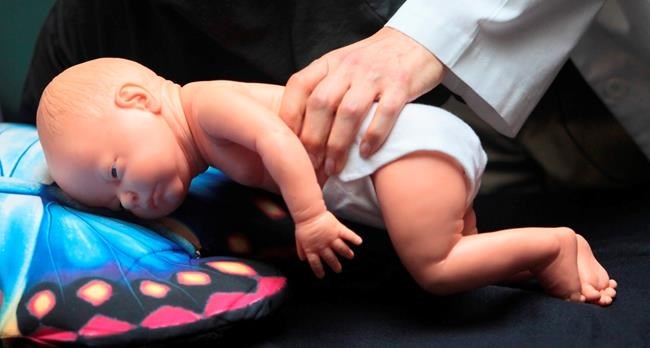
FILE - In this March 22, 2012 file photo, a doctor demonstrates how an infant can die due to unsafe sleeping practices using a scene re-enactment doll in Norfolk, Va. Released on Monday, April 22, 2019, an analysis of five years of CDC data found most accidental suffocation deaths in U.S. infants occur when babies are sleeping on their stomachs in adult beds with blankets and pillows. (AP Photo/The Virginian-Pilot, Steve Earley, File)

Almost 20 per cent suffocated when someone in the bed accidentally moved against or on top of them, and about 12 per cent died when their faces were wedged against a wall or mattress.

The authors studied 2011-2014 data from a Centers for Disease Control and Prevention registry of deaths in 10 states. The results offer a more detailed look at death circumstances than previous studies using vital records, said lead author Alexa Erck Lambert, a CDC researcher.

The authors said anecdotal reports suggest there’s been little change in unsafe sleep practices in more recent years.

“It is very, very distressing that in the U.S. we’re just seeing this resistance, or persistence of these high numbers,” Hauck said.

The study was published Monday in Pediatrics.

For years, the U.S. government and the American Academy of Pediatrics have waged safe-sleep campaigns aimed at preventing accidental infant suffocations and strangulations and sudden infant death syndrome. These include “back to sleep” advice promoting having babies sleep on their backs, which experts believe contributed to a decline in SIDS deaths over nearly 30 years. But bed-sharing has increased, along with bed-related accidental suffocations — from 6 deaths per 100,000 infants in 1999 to 23 per 100,000 in 2015, the researchers note.

Dr. Rachel Moon, a University of Virginia pediatrics professor not involved in the study, said the results are not surprising.

“Every day I talk to parents who have lost babies. They thought they were doing the right thing, and it seems safe and it seems OK, until you lose a baby,” Moon said.

Some studies have found bed-sharing increases breastfeeding and it’s common in some families because of cultural traditions. Others simply can’t afford a crib.

Erika Moulton, a stay-at-home mom in suburban New York, said bed-sharing was the only way her son, Hugo, would sleep as a newborn. Moulton struggled with getting enough sleep herself for months, and while she knew doctors advise against it, bed-sharing seemed like the only option.

Now 14 months old, “he’s still in our bed,” she said. “Trying to transition him out is a little difficult.”

The pediatricians group recommends that infants sleep on firm mattresses in their own cribs or bassinets but in their parents’ room for the first year. A tight-fitting top sheet is the only crib bedding recommended, to avoid suffocation or strangulation.

Young babies can’t easily move away from bedding or a sleeping parent; all of the study deaths were in infants younger than 8 months old.

___

Follow AP Medical Writer Lindsey Tanner at @LindseyTanner.

___

The Associated Press Health and Science Department receives support from the Howard Hughes Medical Institute’s Department of Science Education. The AP is solely responsible for all content.

Report Error Submit a Tip

More Stories

Province announces review of child welfare funding, governance

Carol Sanders 5 minute read Preview

Province announces review of child welfare funding, governance

Carol Sanders 5 minute read Updated: Yesterday at 5:34 PM CDT

An independent external review of provincial Child and Family Services funding and its governance model, which is expected to begin this fall, is long overdue, says one Indigenous leader who described a system in crisis.

Read
Updated: Yesterday at 5:34 PM CDT

Bombers receiver’s lateral recovery still talk of the town

Ken Wiebe 7 minute read Preview

Bombers receiver’s lateral recovery still talk of the town

Ken Wiebe 7 minute read Yesterday at 5:08 PM CDT

Ontaria Wilson has made a habit of ending up on highlight reels for his brilliant play-making ability.

But the Winnipeg Blue Bombers receiver added an exclamation point to all of that jaw-dropping footage last Friday, quickly changing gears into the role of a defender after a Dru Brown interception ended up in the hands of Calgary Stampeders defensive back Ben Labrosse.

Wilson has been seen flying through the air with the greatest of ease to haul in passes during his time with the Bombers, but this was a thing of beauty, turning a potential turnover into a new set of downs when he snatched the ball that was heading for the hands of Marquel Lee.

“I’ve never seen anything like that in my life,” said Bombers offensive lineman Patrick Neufeld, a 15-year CFL veteran. “It’s one of those crazy CFL action plays. Thank God (Wilson) had the wherewithal to do that. He’s made some unbelievable plays for us and that’s going up there on the top for sure.”

Read
Yesterday at 5:08 PM CDT

$129-M segregation-lawsuit deal good for Manitoba: judge

Erik Pindera 4 minute read Preview

$129-M segregation-lawsuit deal good for Manitoba: judge

Erik Pindera 4 minute read Yesterday at 5:48 PM CDT

A judge has said the $129-million class-action settlement that must be paid by the Manitoba government over the use of segregation in provincial jails is a good deal for taxpayers.

Court of King’s Bench Justice Theodor Bock approved the settlement — in which the province didn’t admit liability — in June, before issuing his full written decision July 22.

“Although Manitoba is responsible to fund a significant settlement, it benefits considerably from the certainty created by capping its total liability to the class, the release of all claims, costs saved or avoided altogether as a result of the appointment of Proactio as the claims administrator and the development of the agreed-upon claims process, and the discontinuance of all litigation concerning this matter,” he wrote.

The judge said class members “comprise a group of vulnerable and marginalized people who endured significant periods of segregation, some under very severe conditions.”

Read
Yesterday at 5:48 PM CDT

Pilot project targets defence contract tracking

Gabrielle Piché 4 minute read Preview

Pilot project targets defence contract tracking

Gabrielle Piché 4 minute read Yesterday at 7:16 PM CDT

As Manitoba businesses cast eyes on national defence contracts, a local firm is piloting technology to ease regulatory headaches.

Mode40 announced its project — and a $2.6 million injection from the feds — earlier this month.

Defence contracts require stringent tracking of parts manufacturing and data may come from hundreds of different systems, said Cameron Bergen, Mode40’s chief executive.

There are raw material conversions, inspections and standards to track. Parts might go to several plants before landing in a finished product.

Read
Yesterday at 7:16 PM CDT

Temporary foreign workers rally to stay

Carol Sanders 4 minute read Preview

Temporary foreign workers rally to stay

Carol Sanders 4 minute read Yesterday at 6:09 PM CDT

Close to 100 temporary foreign workers, mainly from China, whose time in Canada is running out, rallied on the steps of the Manitoba legislature Tuesday to raise awareness of their situation.

They arrived in Manitoba before the federal government cut immigration levels — when international students and temporary foreign workers had a shot at becoming permanent residents if they met the requirements to stay, said Ruby Lu.

“We come here for a few years and we work for a few years, pay taxes. Some of us are already bought a house,” said Lu, whose work permit expires at the end of the year.

“So if our (permit) expires, we don’t know what to do,” she said in front of demonstrators holding signs with messages including “we love Manitoba” and “bring back TPP” — the temporary public policy used by the Manitoba provincial nominee program to support open work permits and prioritize permanent residency for select candidates.

Read
Yesterday at 6:09 PM CDT

Fences to be installed at Whiteshell park site where brothers drowned

Tyler Searle 4 minute read Preview

Fences to be installed at Whiteshell park site where brothers drowned

Tyler Searle 4 minute read Yesterday at 6:13 PM CDT

The Manitoba government will install fences and signs to restrict access to a popular natural attraction in Whiteshell Provincial Park, where two brothers drowned this month and others have died in recent years.

“My heart goes out to the family. We recognize the hardship and the tragedies that are taking place, and so we’re responding as quickly as we can to secure the site,” Environment Minister Mike Moyes said Tuesday, referring to Sturgeon Falls.

“People will still be able to view the falls. They’re still going to be able to enjoy the beauty of that area of Manitoba, but they’re going to be able to do it in a way that ensures that they’re going to remain safe.”

The falls are located between Nutimik and Numao lakes on the Winnipeg River system. Visitors can reach them by hiking a 1.9-kilometre trail that begins at the Nutimik Lake campground.

Read
Yesterday at 6:13 PM CDT