How birdwatchers can help threatened bird populations

Advertisement

Advertise with us

The types of birds coming through your neighbourhood are probably changing, and so is the timing of their migrations. Birdwatchers noticing these differences are on the front line in figuring out how climate change and more severe weather events are putting stress on bird populations.

Read this article for free:

or

Already have an account? Log in here »

To continue reading, please subscribe:

Subscribe and receive a limited-edition Free Press branded hat or tote.

Digital Subscription

One year of digital access for only $205*

  • Enjoy unlimited reading on winnipegfreepress.com
  • Read the E-Edition, our digital replica newspaper
  • Access News Break, our award-winning app
  • Play interactive puzzles

*First annual payment billed as $205.00 + GST for one year. This annual subscription will automatically renew at $233.00 + GST every 52 weeks (10% off the regular annual price of $259.35). Offer available to new and qualified returning subscribers only. Cancel any time.

To continue reading, please subscribe:

Add Free Press access to your Brandon Sun subscription for only an additional

$1 for the first 4 weeks*

  • Enjoy unlimited reading on winnipegfreepress.com
  • Read the E-Edition, our digital replica newspaper
  • Access News Break, our award-winning app
  • Play interactive puzzles
Start now

*Your next Brandon Sun subscription payment will increase by $1.00 and you will be charged $17.95 plus GST for four weeks. After four weeks, your payment will increase to $24.95 plus GST every four weeks.

Hey there, time traveller!
This article was published 07/05/2019 (2642 days ago), so information in it may no longer be current.

The types of birds coming through your neighbourhood are probably changing, and so is the timing of their migrations. Birdwatchers noticing these differences are on the front line in figuring out how climate change and more severe weather events are putting stress on bird populations.

“Birders have to be much more alert to when birds are coming through than they used to be, since birds may be coming through much earlier or later than they used to,” says John Rowden, director of community conservation at the National Audubon Society.

Birdwatchers are increasingly noticing unfamiliar birds normally found elsewhere, he says, and are seeing fewer of the birds they’d taken for granted.
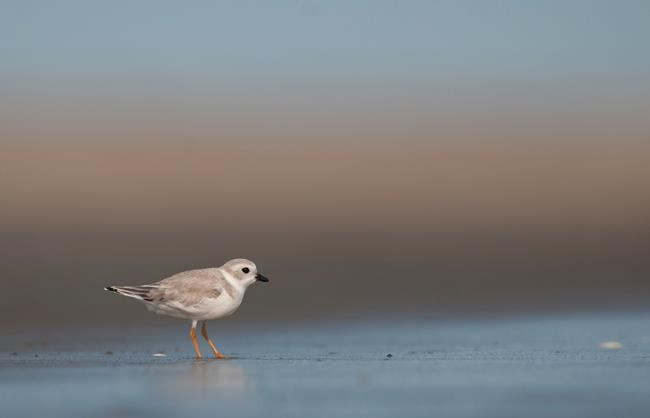
This 2012 photo provided by Audubon shows a Piping Plover on the coast of Maine. (Walker Golder/Augubon via AP)

“People are shocked when I say it. But just because we’ve seen these birds (year after year) doesn’t mean they’ll always be there. They are declining in numbers because we’re throwing so many things at them, so we need to do what we can to help them,” says Rowden.

At least 314 species of American birds are expected to lose 50 per cent or more of their range by the end of the century, and have been listed by the Audubon Society as climate-threatened or endangered, Rowden says.

A United Nations science report issued Monday says 1 million species of plants and animals are at risk of going extinct. Scientists issuing the report in Paris blamed development that has led to loss of habitat, climate change, overfishing, pollution and invasive species.

Conservationists say there are a few easy steps people can take to help struggling bird populations, like planting native species, even in window boxes or patio containers, to encourage the native insects upon which birds depend, particularly for feeding their young.

The Audubon Society’s Plants for Birds program encourages people to plant native plants; there’s a website where you can type in your zip code to find out which plants will help birds in your area, and where to find those native plants and seeds locally.

During spring and fall migration seasons, people are encouraged to help migrating birds by minimizing outdoor lighting and covering reflective surfaces like large windows. Make indoor plants less visible to passing birds.

Birdwatchers can also help efforts to save the birds by tracking what they see on ebird.org, a national online data base run by The Cornell Lab of Ornithology.

“We also have a community science program called Climate Watch , which tries to collect data on how bird ranges are changing. It asks people to go out and do point counts of certain species, and runs from May 15 to June 15. That’s something very helpful that birders can participate in,” says Rowden.

“Birders love to see the same birds year after year, and keep track of when they are they going to come back each year during migration. Now, the timing may change and the windows may shift. You’ve got to be on the ball to spot them,” he says.

“It’s helpful if communities can pitch in to help,” he adds.

Geoff LeBaron, director of the Christmas Bird Count at the National Audubon Society, says he has seen the effects of climate change firsthand.

“I’ve been a birder since I was a little kid,” he says. “It’s clear that climate change is affecting and will continue to affect birds on a global scale, and it’s a question of whether or not they can adapt to what the climate is throwing at them.”

Record droughts, floods, hurricanes and more are having a dramatic impact, he says.

“Hurricanes tend to happen during migration season and they happen initially over water, so they have a big effect on sea birds and can send them thousands of miles off track. Birdwatchers spot them when they get displaced over land.”

Most at risk from climate catastrophes are sea birds and grasslands birds, experts say. Birds known as aerial insectivores, like swifts and nighthawks, are also at risk because the insects they depend on are getting harder to find.

One bird, the rufous hummingbird, is expected to lose all of its range in the United States within this century. And the yellow warbler, which is found across the country and is considered one of the more common birds, has declined by 25 per cent since the 1960s, Rowden says.

Report Error Submit a Tip

More Stories

Granite housing project passes final council hurdle after appeal rejected

Malak Abas 4 minute read Preview

Granite housing project passes final council hurdle after appeal rejected

Malak Abas 4 minute read 5:34 PM CDT

Critics of the proposed 12-storey housing project set for the parking lot of the Granite Curling Club were shut down at a city meeting Thursday as councillors allowed the development to proceed.

The 110-unit building at 30 Granite Way originally meant the loss of 45 of the 80 parking spots, which the long-running club said would ruin its financial viability.

In June, the city produced a plan to add parking spots around the club by removing a boulevard and adjusting spots at another parking lot, but the club’s management called the plan inadequate.

City council’s property and development committee discussed a number of proposed variances to the building plan Thursday, including allowing the building height to reach 126 feet even though regulations stipulate a maximum 100 feet, and shifts in the width of some parking spots allotted to the residential building and the curling club. Appeals against those changes, including those by management at the Granite Curling Club, were unanimously denied by the committee.

Read
5:34 PM CDT

Rested Sea Bears ready for post-season press

Joshua Frey-Sam 7 minute read Preview

Rested Sea Bears ready for post-season press

Joshua Frey-Sam 7 minute read 5:17 PM CDT

Isiah Osborne acknowledged that the effort — and the results — have been disappointing at times recently.

He also knows it’s not too late to change that.

The Winnipeg Sea Bears were afforded some time this week to reflect on the recent shortcomings as a group. With six days separating the last game and the next game, members of the club took a couple of days away from basketball before returning to the court for their last full week of practice, which was appreciated for a tired group that finished its busiest stretch of the Canadian Elite Basketball League campaign last weekend.

“We think we’re the best team in the league, obviously,” said Osborne. “A couple bad games, but that’s just off some mistakes. On some plays, if we’re not on that 100 per cent effort, little things happen, and we’ve lost a couple games by two, by four, and that happens. Just a couple mishaps on defence, stuff like that, and I mean, you just gotta lock in on those.”

Read
5:17 PM CDT

Good Samaritan stabbed attempting to help with suspected overdose

1 minute read Updated: Yesterday at 2:07 PM CDT

A Good Samaritan who was trying to help a woman who appeared to be suffering from a drug overdose on Tuesday night was instead stabbed by her companion, police say.

The victim, a 51-year-old man, came across the woman near Jubilee Avenue and Osborne Street at about 9:15 p.m. on Tuesday and tried to assist her, before a suspect came up and stabbed him in the upper body. Police say the suspect knows the woman.

The 51-year-old was rushed to hospital in unstable condition, where he was given medical treatment. The woman, too, was taken to hospital for medical attention. Winnipeg Fire Paramedic Service personnel alerted police to the incident.

Patrol officers, along with a police dog unit, found the suspect on the 400 block of Brandon Avenue just before 11 p.m. He tried to run, but officers made the arrest and seized two knives, police said.

Body of 11-year-old Calgary boy missing for two weeks found in water pipe

Dayne Patterson and Bill Graveland, The Canadian Press 5 minute read Preview

Body of 11-year-old Calgary boy missing for two weeks found in water pipe

Dayne Patterson and Bill Graveland, The Canadian Press 5 minute read Updated: 6:24 AM CDT

CALGARY - An 11-year-old Calgary boy who disappeared two weeks ago has been found dead in a labyrinth of pipes under the city, police announced Wednesday.

Chief Katie McLellan said the boy, named Parker, was discovered in a small water pipe underneath Deerfoot Trail, the city's major north-south expressway.

"For nearly two weeks, so many people woke up hoping it would be the day Parker came home," McLellan told reporters.

"Instead, we are here sharing news that is heartbreaking for his family and for everyone who has been carrying that hope."

Read
Updated: 6:24 AM CDT

MPI donates auto repair gear to RRC Polytech

Gabrielle Piché 3 minute read Preview

MPI donates auto repair gear to RRC Polytech

Gabrielle Piché 3 minute read 7:22 PM CDT

Manitoba Public Insurance’s donation Thursday came without an oversized cheque or physical money.

Instead, the Crown corporation announced $1.2-million worth of collision repair equipment for Red River College Polytechnic.

“We knew that the equipment wasn’t being used to its full value,” Carmen Nedohin, MPI’s board chair, said outside the Winnipeg post-secondary’s auto repair shop at its Notre Dame Avenue campus.

Inside, students assembled golf carts. More than 200 pieces of equipment — frame racks, dent pulling systems — have been added to the facility. “It was just a perfect fit,” Nedohin added.

Read
7:22 PM CDT

Province orders mosquito fogging owing to increased risk of West Nile virus

Malak Abas 3 minute read Preview

Province orders mosquito fogging owing to increased risk of West Nile virus

Malak Abas 3 minute read 6:01 PM CDT

Parts of Winnipeg and several rural communities will be sprayed for mosquitoes in the coming days as the heat wave across southern Manitoba has created a higher risk of exposure to West Nile virus.

The province has issued a fogging order under the Environment Act in response to a high number of Culex tarsalis mosquitoes — the primary transmitter of West Nile virus — in Manitoba.

Surveillance data from last week showed evidence of the West Nile virus.

“High temperatures across southern Manitoba have shortened the time required for West Nile virus to develop within infected Culex tarsalis mosquitoes and be transmitted to humans,” the province’s first bulletin on West Nile virus this summer, published Thursday afternoon, reads.

Read
6:01 PM CDT