For Gaza grooms, crippling debt overshadows marital bliss
Advertisement
Read this article for free:
or
Already have an account? Log in here »
To continue reading, please subscribe:

Digital Subscription
One year of digital access for only $205*
- Enjoy unlimited reading on winnipegfreepress.com
- Read the E-Edition, our digital replica newspaper
- Access News Break, our award-winning app
- Play interactive puzzles
*First annual payment billed as $205.00 + GST for one year. This annual subscription will automatically renew at $233.00 + GST every 52 weeks (10% off the regular annual price of $259.35). Offer available to new and qualified returning subscribers only. Cancel any time.
To continue reading, please subscribe:
Add Free Press access to your Brandon Sun subscription for only an additional
$1 for the first 4 weeks*
- Enjoy unlimited reading on winnipegfreepress.com
- Read the E-Edition, our digital replica newspaper
- Access News Break, our award-winning app
- Play interactive puzzles
*Your next Brandon Sun subscription payment will increase by $1.00 and you will be charged $17.95 plus GST for four weeks. After four weeks, your payment will increase to $24.95 plus GST every four weeks.
Read unlimited articles for free today:
or
Already have an account? Log in here »
Hey there, time traveller!
This article was published 23/05/2019 (2685 days ago), so information in it may no longer be current.
GAZA, Palestinian Territory – Two years ago, Gaza resident Saleh Abu Serdanah took out a small loan in order to get married and start a family. These days, the 31-year-old construction worker is on the run, hiding from police in a tiny rental apartment and unable to repay the money he borrowed.
Abu Serdanah is among hundreds of young men who have turned to Gaza’s small industry of wedding lenders for help, only to fall onto hard times because of crushing debt and lack of jobs in the impoverished Palestinian territory. Many have been forced to renegotiate their debts, and others have gone into hiding. Some have even ended up in jail.
“I have never been into a police station and have never made troubles. Now I’m like a fugitive crook,” Abu Serdanah said.
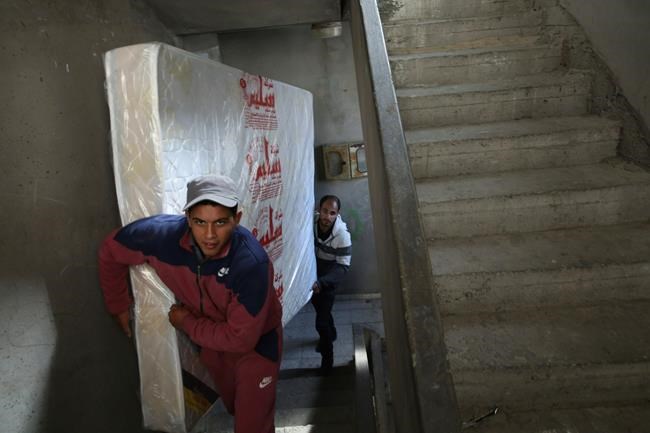
Wedding lenders have filled an important need in Gaza’s conservative society, where young men and women are typically expected to marry in their late teens or early 20s. Facing a nearly 60% unemployment rate, many young Gazan men have been forced to put off their dreams of marriage because they cannot afford it.
Over a decade ago, a number of wealthy people launched charities to help young couples to pay for their weddings and settle post-marriage debts. The initiative was promoted through ceremonial mass weddings that thrived after Israel and Egypt imposed a blockade on Gaza after the Hamas militant group took power in 2007.
These charitable efforts, which still continue, paved the way for a profitable private industry to emerge, offering more substantial packages that included things like bridal dresses, invitations, bedroom furniture and meals for guests.
Allured by the idea, Abu Serdanah signed up for an offer of $2,500 through Farha Project, one of those companies, in 2017. He acknowledges that he would never have been able to marry without Farha. The November 2017 wedding included a bachelor’s party with a live band and a separate women’s ceremony the following day. The company threw in invitations, catering for 60 people and a suit and dress for the couple.
Abu Serdanah agreed to repay the money in monthly payments over two years, but managed to pay only for five months. Today, he regrets his decision.
“I was committed to paying on time for a while, but things have changed and made me unable to,” said Abu Serdanah, sitting on a mat outside the apartment he shares with his wife as a candle faintly lit the dark stairway. “There is no work, so where should I get money from?”
The blockade, aimed at weakening Hamas, has ravaged the economy. The skyrocketing unemployment rates, combined with foreign aid cuts and Hamas’ mismanagement, has left thousands of families dependent on food aid and social welfare.
Economic sanctions by the West Bank-based Palestinian Authority, ousted by Hamas in 2007, have worsened the situation. The internationally recognized Palestinian Authority says its measures, which include salary cuts to tens of thousands of former public servants, are aimed at pressuring the militant Hamas group into ceding control.
Hamas, however, remains in firm control, even as the World Bank says Gaza’s economy is in “free fall.”
A plasterer who earns 50 shekels, or about $15, a day, Abu Serdanah was certain that he would be able to manage the payments to Farha.
But due to the weak economy, there have been few workdays and he was unable to pay back his debt. Trying to save himself from prison, he asked the company to reduce his monthly installment by 50%, but its lawyer refused. Eventually, a police summons was delivered to his family’s home. He decided not to respond.
“I don’t want to stall for time, but I really can’t pay for now,” he said.
The Hamas-run Economy Ministry says at their peak, 20 such companies were registered in Gaza. But their number has dropped to five as business has withered up. The Hamas-run prosecutor’s office, the judiciary council and the police refused requests to interview people jailed for failing to pay their marriage debts, or even reveal their number.
But an official at Gaza’s general prosecution department, speaking in condition of anonymity because he was not authorized to talk to the media, said that as of last year, courts have investigated 3,000 such cases.
This explains why the business is no longer thriving. Salama al-Awadi, manager of Farha Project, says only 7% of his clients managed to pay the monthly installments fully this year and 40% could not pay back at all. The others pay less than the agreed amount.
“We see with our eyes that the situation is hard, so we try all possible ways before resorting to the courts,” al-Awadi said, noting that his company has fallen into debt because of its customers’ struggles. Unable to collect payments, Farha owes money to service providers like carpenters and caterers.
With economic recession in Gaza, the number of clients is also dwindling. In 2018, the average monthly number of grooms signing up for contracts at Farha was 20. The year before, it was 35.

“This year would be way less,” al-Awadi said. “I cancelled many contracts and our plan for 2019 is to get by with the minimum. If it remains like this, I will have no choice but to shut down.”
One of al-Awadi’s clients is 29-year-old Yehiya Taleb, whose four brothers, all married, believed it was problematic by Gaza’s standards to reach that age and still be single.
Taleb got a job working as a waiter at a cafe earning about $180 a month but that amount is not enough to cover wedding expenses. Anxious to fulfil the wish of their ailing mother, the brothers resorted to Farha Project and took out a $2,000 package.
After getting married early in May, Taleb and his wife now share a rental house in the Shati refugee camp with another brother’s family. Afraid of “failure,” he is already stressed out over how to repay the loan. He hopes to make ends meet with some help from his brothers.
“My salary can’t cover my demands. With installments, you can cover a little part of them,” he said.