Electronic tool effective in reducing overmedication in seniors, study finds

Advertisement

Advertise with us

MONTREAL - Many of Canada's seniors ingest a worrying, and perhaps unnecessary, amount of medication, according to the lead author of a new study that found a Canadian-made electronic tool is effective in safely reducing the medication overload.

Read this article for free:

or

Already have an account? Log in here »

To continue reading, please subscribe:

Subscribe and receive a limited-edition Free Press branded hat or tote.

Digital Subscription

One year of digital access for only $205*

  • Enjoy unlimited reading on winnipegfreepress.com
  • Read the E-Edition, our digital replica newspaper
  • Access News Break, our award-winning app
  • Play interactive puzzles

*First annual payment billed as $205.00 + GST for one year. This annual subscription will automatically renew at $233.00 + GST every 52 weeks (10% off the regular annual price of $259.35). Offer available to new and qualified returning subscribers only. Cancel any time.

To continue reading, please subscribe:

Add Free Press access to your Brandon Sun subscription for only an additional

$1 for the first 4 weeks*

  • Enjoy unlimited reading on winnipegfreepress.com
  • Read the E-Edition, our digital replica newspaper
  • Access News Break, our award-winning app
  • Play interactive puzzles
Start now

*Your next Brandon Sun subscription payment will increase by $1.00 and you will be charged $17.95 plus GST for four weeks. After four weeks, your payment will increase to $24.95 plus GST every four weeks.

Hey there, time traveller!
This article was published 08/10/2019 (2487 days ago), so information in it may no longer be current.

MONTREAL – Many of Canada’s seniors ingest a worrying, and perhaps unnecessary, amount of medication, according to the lead author of a new study that found a Canadian-made electronic tool is effective in safely reducing the medication overload.

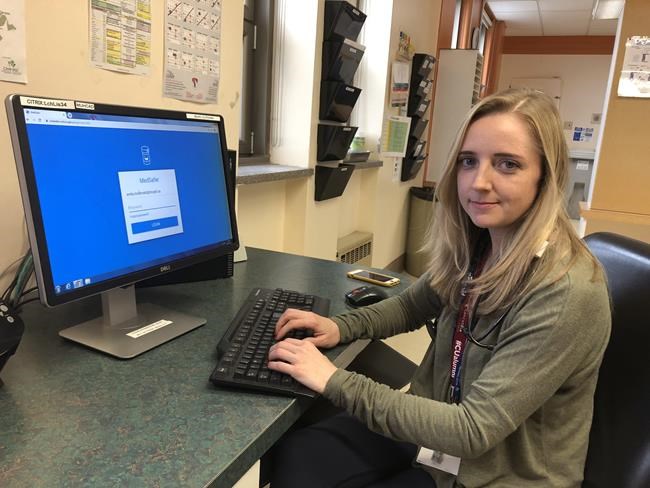
The study by the Research Institute of the McGill University Health Centre was conducted with patients 65 and over who took five or more medications a day. It found doctors could safely reduce the number of medications given to their patients by using MedSafer, an electronic tool that helps monitor the different medications and flag potentially inappropriate ones.

Lead author Emily McDonald, a researcher and internal medicine physician at the McGill University Health Centre in Montreal, said taking multiple medications can be dangerous to people 65 and up, who are vulnerable to side effects.
Dr. Emily McDonald, co-creator of MedSafer, first author of the study, and scientist at the RI-MUHC and physician in the Division of General Internal Medicine at the MUHC, is shown in a handout photo. THE CANADIAN PRESS/HO-Research Institute of the McGill University Health Centre MANDATORY CREDIT

Currently, some 40 per cent of older adults take five or more medications per day. In addition to the risk of side effects or complications, McDonald says some medications may not be appropriate for certain health problems, which can make seniors vulnerable to additional hospitalizations, memory problems, dizziness, and balance problems that lead to falls and fractures.

“It’s one of the most common causes of hospital visits,” she said in a phone interview.

“In seniors, polypharmacy — taking multiple medications — has increased enormously in recent years. We’re talking about taking five, 10, even 15 medications.”

While lists of potentially harmful medication combinations exist already, it can be complicated and time-consuming for doctors to research them, especially when several people are involved in a patient’s care.

“Performing a prescription checkup is a complex process for interprofessional teams, and often involves complicated decision-making,” she explained.

A desire to address the problem led McDonald and study co-author Todd Lee to create MedSafer. It checks the different combinations of medications prescribed to a patient and offers a recommendation of whether any can be safely stopped or reduced. Designed specifically for seniors, the tool can be used by doctors, pharmacists and nurse practitioners.

The goal of the study, published in September in the Journal of the American Geriatrics Society, was to see if the tool was useful in tapering off medications, and if it was safe to do so.

“Often, clinicians don’t want to stop a medication because they’re afraid of causing secondary reactions for the patient in withdrawing the medication,” McDonald said.

The study took place between Sept 2016 and May 2017 with 1,066 hospital patients at four research centres in Montreal, Ottawa and Toronto.

An initial report by MedSafer showed that 82 per cent of the subjects were receiving a potentially inappropriate medication. That triggered a review by a doctor, who made the final decision on whether the medication was necessary.

Later, the researchers compared the results of patients whose doctors had used MedSafer to those who had received the usual care. It found that 54.7 per cent of patients in the MedSafer group had had a medication de-prescribed by the time they were discharged, compared with 46.9 per cent for the second group.

The researchers believe the difference may be even greater in other clinical settings where there are fewer drug experts on site, such as long-term care homes.

Following the results of the study, MedSafer will be deployed in long-term care units in New Brunswick and Ontario. In Quebec, McDonald is hoping to start a pilot project at Lachine Hospital, part of the McGill University Health Centre.

McDonald said the researchers interviewed the patients and their families a month after leaving hospital and found the health of the MedSafer group was no worse as a result of the reduction in medication.

“There was no increase in no adverse effects,” McDonald said. “It’s safe.”

This report by The Canadian Press was first published Oct. 8, 2019.

Report Error Submit a Tip

More Stories

Gaps in homecare leave Winnipeg man in perilous situation

Nicole Buffie 4 minute read Preview

Gaps in homecare leave Winnipeg man in perilous situation

Nicole Buffie 4 minute read Yesterday at 6:00 AM CDT

Tom Landy fears he won’t live long enough to receive adequate homecare.

The 49-year-old Winnipegger has spinal muscular atrophy, a degenerative disease, and requires 24-7 homecare, but gaps in his care leave him sitting in one spot for hours and lately he’s developed bed sores.

Landy was approved for around-the-clock care in June 2025, but staffing issues and an investigation into a homecare worker’s workplace injury have left him without help for periods of time throughout the day and forced his 76-year-old father to fill in.

“This is what they’re here for, to take care of me, and now it feels like I’m a burden,” he said from his home in the Maples.

Read
Yesterday at 6:00 AM CDT

It isn’t ‘just the weather’

Erna Buffie 5 minute read 2:00 AM CDT

I was reading The Guardian the other day, which is one of the best, if not the best, newspaper for climate change coverage. I say this, despite the fact that it still silos the subject into a special section called “Climate Crisis and Environment.”

And it continues to publish front page headlines like “May and June heatwave kills about 2,700 in England and Wales, data suggests,” with no reference to climate change, until you hit the body of the story.

Which, quite frankly, is better than most newspapers do.

Indeed, in a recent issue of The Guardian, there’s an article about just that — the fact that an analysis of British newspapers revealed that 72 per cent of articles covering the U.K.’s June heatwave failed to even mention the climate crisis.

Woman, 23, charged with fatal stabbing outside Portage Place

Tyler Searle 3 minute read Preview

Woman, 23, charged with fatal stabbing outside Portage Place

Tyler Searle 3 minute read 2:03 PM CDT

A 58-year-old woman is dead after being stabbed outside the entrance of Portage Place Tuesday afternoon when an argument escalated into violence.

Winnipeg Police Service Const. Claude Chancy said officers responded to the area near the mall’s front entrance on the 300 block of Portage Avenue around 2:45 p.m. where they found Helen Annie Spence suffering from severe and life-threatening injuries.

“There was a verbal dispute that led to a physical altercation, at which point the suspect armed herself with an edged weapon and then proceeded to stab the victim,” Chancy said, adding the alleged killer and victim knew each other.

Spence, a member of Grand Rapids First Nation who had been living in Winnipeg, was taken to the hospital in critical condition and later died.

Read
2:03 PM CDT

Saying goodbye to a friend I never met

Pam Frampton 5 minute read Preview

Saying goodbye to a friend I never met

Pam Frampton 5 minute read Yesterday at 2:00 AM CDT

Hedie Epp and I first connected over a column I wrote in October 2023 about my mother’s dementia. Now I find myself awash in sadness for the loss of this person I will never get to meet.

Read
Yesterday at 2:00 AM CDT

Preserving past, pondering future of 142-year-old downtown church

Chris Kitching 6 minute read Preview

Preserving past, pondering future of 142-year-old downtown church

Chris Kitching 6 minute read Yesterday at 6:55 PM CDT

A 142-year-old church in downtown Winnipeg needs about $7.7 million for upgrades and related costs, while an ongoing heritage renewal project aims to create a blueprint for its future.

Potential options include selling Holy Trinity Anglican Church and leasing it back for a decades-long term, or building an apartment or office tower on an existing surface parking lot to generate revenue, officials said Wednesday.

“I think that is part of the negotiation and ensuring we have the right partners, but it is hard to put down on paper precisely every aspect of the future of a place of worship,” project manager Stephen Borys said of the potential duration of a sale and leaseback agreement to ensure the church still exists generations from now.

Similar agreements with 50- or 100-year leases exist elsewhere in Canada, he said, noting the option has been on the table for Holy Trinity for a year.

Read
Yesterday at 6:55 PM CDT

Report draws link between missing Indigenous women and trafficking across Canada

Marsha McLeod 6 minute read Preview

Report draws link between missing Indigenous women and trafficking across Canada

Marsha McLeod 6 minute read Tuesday, Jul. 28, 2026

A new analysis of online sex advertisements featuring Indigenous women has identified cross-country corridors that are highly indicative of sex trafficking, while revealing insight into how women and girls are exploited in Winnipeg.

Read
Tuesday, Jul. 28, 2026