A Poet’s statue and river nymphs
Markian Shashkevich Park features row of old stone monuments
Advertisement
Read this article for free:
or
Already have an account? Log in here »
To continue reading, please subscribe:

Digital Subscription
One year of digital access for only $205*
- Enjoy unlimited reading on winnipegfreepress.com
- Read the E-Edition, our digital replica newspaper
- Access News Break, our award-winning app
- Play interactive puzzles
*First annual payment billed as $205.00 + GST for one year. This annual subscription will automatically renew at $233.00 + GST every 52 weeks (10% off the regular annual price of $259.35). Offer available to new and qualified returning subscribers only. Cancel any time.
To continue reading, please subscribe:
Add Free Press access to your Brandon Sun subscription for only an additional
$1 for the first 4 weeks*
- Enjoy unlimited reading on winnipegfreepress.com
- Read the E-Edition, our digital replica newspaper
- Access News Break, our award-winning app
- Play interactive puzzles
*Your next Brandon Sun subscription payment will increase by $1.00 and you will be charged $17.95 plus GST for four weeks. After four weeks, your payment will increase to $24.95 plus GST every four weeks.
Read unlimited articles for free today:
or
Already have an account? Log in here »
Hey there, time traveller!
This article was published 26/10/2019 (2459 days ago), so information in it may no longer be current.
One of the many lovable aspects of North Point Douglas, the oldest neighbourhood of Winnipeg, is its quirky, unexpected angles and corners. Some of the streets and sidewalks run east and west, north and south. Some of them run at a 45-degree angle to the city’s main grid. Some of them curve to the contours of the Red River, with steep little sidewalks to the raised street on the river dike, built long after the quirky little wooden houses themselves (some of which still bear pre-dike flood marks on their walls.)
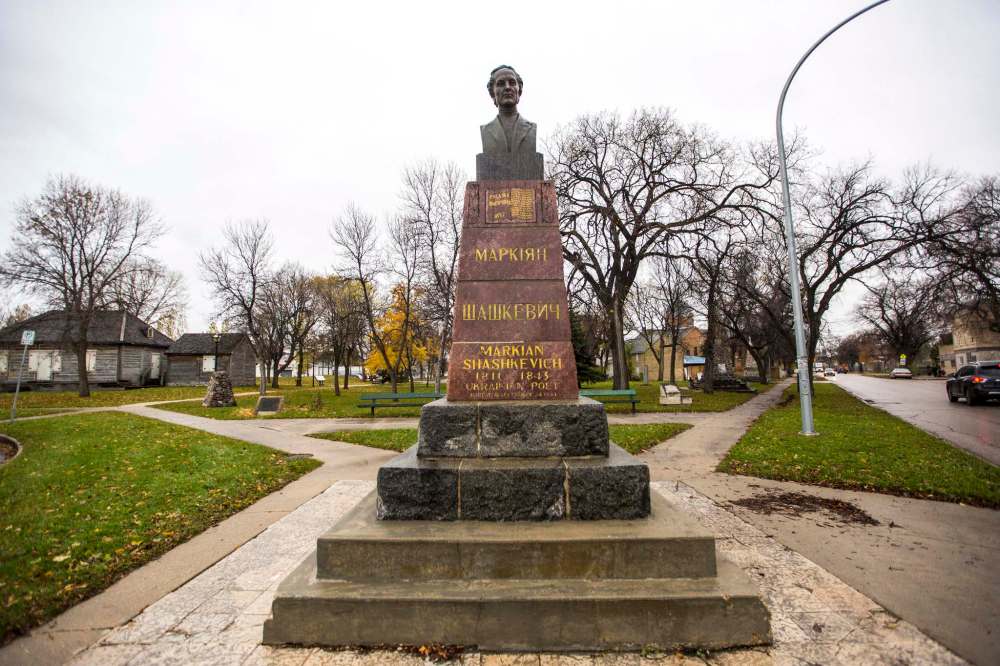
Did we say the sweet little park in North Point Douglas, next to Ross House Museum, is called Joe Zuken Park? Umm, that’s only on the south side. On the north side, we’re in Markian Shashkevich Park, according to the marble plinth proudly planted there.
Markian Shashkevich Park is clearly much older than Joe Zuken Park. No rolling hills or flowering bushes here. The ground is flat grass, overlooked by a few wind-bent old trees. The attraction of this unique little triangle park is its row of old stone monuments, erected in the 1940s by Ukrainian Canadian organizations, along the Euclid Avenue side.
A third area of the park, running down the middle between these two, looks to be the oldest of the three, with monuments to earlier events and people: the arrival of the Selkirk Settlers in 1812; the establishment of Western Canada’s first agricultural settlement; and the commemoration of one of the most famous Icelandic Canadian citizens of Point Douglas, Sir William Samuel Stephenson, nicknamed “Intrepid.” Stephenson was trained as an engineer, and became an early electronic communications expert, distinguishing himself with exceptional service during the two world wars. He became so renowned and useful to the war effort that at one point he was sent to be an emissary between Churchill and Roosevelt.
The various areas of the park with their different commemorations are skilfully melded together, so you might not notice how different they are, unless you stop to take a closer look. And isn’t that a lovely metaphor for Winnipeg in general? So many different areas and people, with so many different cultural histories and languages and customs, combined into a shining, shimmering, singing (and sometimes moaning, and crying, and dying) whole.
My favourite monument is the corner cairn on the northeast side, with its funky bronze bust of Markian Shashkevich himself (sporting a bright white cotton ribbon around his hair when I visited). Who was he? A Ukrainian poet and priest honoured around the world for publishing the first poetry collection in the vernacular western Ukrainian dialect, Russalka Dniestro, or The Dniester River Nymph, in 1837.
The statue was erected in 1944 by Winnipeg’s immigrant Ukrainian population, through the Markian Shashkevich Literary Society. The plaque below the bust quotes a few lines from the anthology. It took me awhile to find someone fluent enough in what is now considered an archaic dialect to furnish a modern English version. This is an approximate translation, with help from Yuliana Bagan of Winnipeg:
Slavic peoples will rise up. Maybe not now, but soon,
They will see the full bright Sun. The Ukrainian language
And the Ukrainian soul
Have always lived
In these Slavic lands,
Held close like the crystal
Tears of young women
In the palm of
The Seraphim’s hand.
A poet’s statue with Ukrainian river nymphs and divine Seraphim right here in the middle of Point Douglas? What a touching way to memorialize the traumatic relocation of half-starved Ukrainian immigrants to Winnipeg in the city’s early days, bringing along their mythical and spiritual treasures, if not their beloved lands.
It makes me long for many more poets’ statues in our city, to honour also our homegrown Winnipeg poets, and the poetic and spiritual icons they held dear. Louis Riel’s dancing La Métisse and Charles Mair’s spooky Last Bison. Dorothy Livesay’s beautiful Green Rain and Miriam Waddington’s Advice to the Young and its restorative asparagus garden.
Robert Kroetsch’s prairie epic Seed Catalogue, Roger Léveillé’s dreamy Festivals of the Infinite, Katherena Vermette’s bittersweet River Songs, Rosanna Deerchild’s dancing ancestral Aurora Borealis. And so many others. People of Winnipeg, let’s do it!
I digress. Begin by visiting this little park, this scenic little innovative multicultural parks collective, in the heart of Point Douglas. Admire the carefully handcrafted Métis artifacts and lively old stories of Ross House Museum. Check out the many simple stone and bronze monuments to Winnipeg’s early settlers, poignantly scattered in the grass. Wander across Euclid Avenue to the famous little corner store Metro Meats, for “Hot Kulbassa on a Bun.” Yum!
And while you’re munching on your delicious sample of Winnipeg’s most famous sausage, thankfully still being made here long after the Markian Shashkevich Literary Society has gone, guess which cairn holds a time capsule, with little messages in glass bottles, some written by local children.
Di Brandt is Winnipeg’s inaugural poet laureate (2018-19).
dibrandt@shaw.ca