

Magical moments
The tricks are among thousands of Christmas treats for kids of all ages at Toad Hall, Winnipeg's Exchange District 'toy story' for nearly a half-century
Advertisement
Read this article for free:
or
Already have an account? Log in here »
To continue reading, please subscribe:
Digital Subscription
One year of digital access for only $1.44 a week*
- Enjoy unlimited reading on winnipegfreepress.com
- Read the E-Edition, our digital replica newspaper
- Access News Break, our award-winning app
- Play interactive puzzles
*Billed as $5.77 plus GST every four weeks. After 52 weeks, price increases to the regular rate of $19.95 plus GST every four weeks. Offer available to new and qualified returning subscribers only. Cancel any time.
To continue reading, please subscribe:
Add Free Press access to your Brandon Sun subscription for only an additional
$1 for the first 4 weeks*
- Enjoy unlimited reading on winnipegfreepress.com
- Read the E-Edition, our digital replica newspaper
- Access News Break, our award-winning app
- Play interactive puzzles
*Your next Brandon Sun subscription payment will increase by $1.00 and you will be charged $17.95 plus GST for four weeks. After four weeks, your payment will increase to $24.95 plus GST every four weeks.
Read unlimited articles for free today:
or
Already have an account? Log in here »
Hey there, time traveller!
This article was published 21/12/2019 (2352 days ago), so information in it may no longer be current.
Most children, and the child in most adults, are drawn to magic, a truism easily confirmed any Saturday at Toad Hall in Winnipeg’s Exchange district.
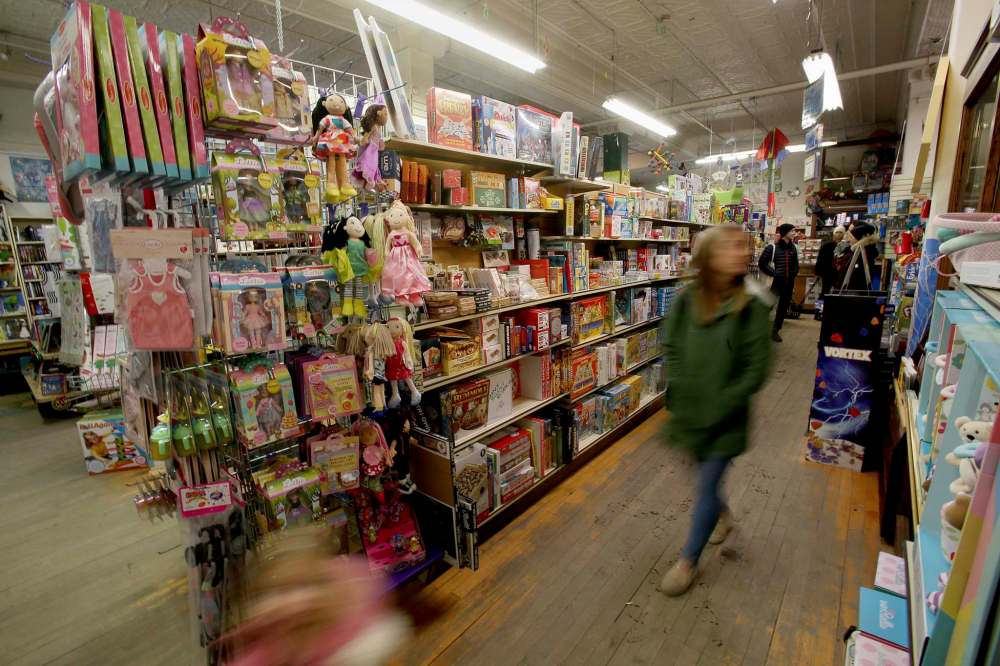
The toy store has 50,000 different items to inflame any child’s yearnings — games, puzzles, crafts, books, puppets, models, kites, tricks, gags, dolls and dinos, cars and trucks and trains… and on and on and on. There’s even a real cricket chirping in a mini-environment in the science zone.
But amidst all of that endless temptation, most kids eventually gravitate to the “magic counter” where they pick cards — any cards — from a magician’s deck, even if they don’t know a spade from a club and think suits are what Mom wears to work.
Take Teia Silva, age nine.
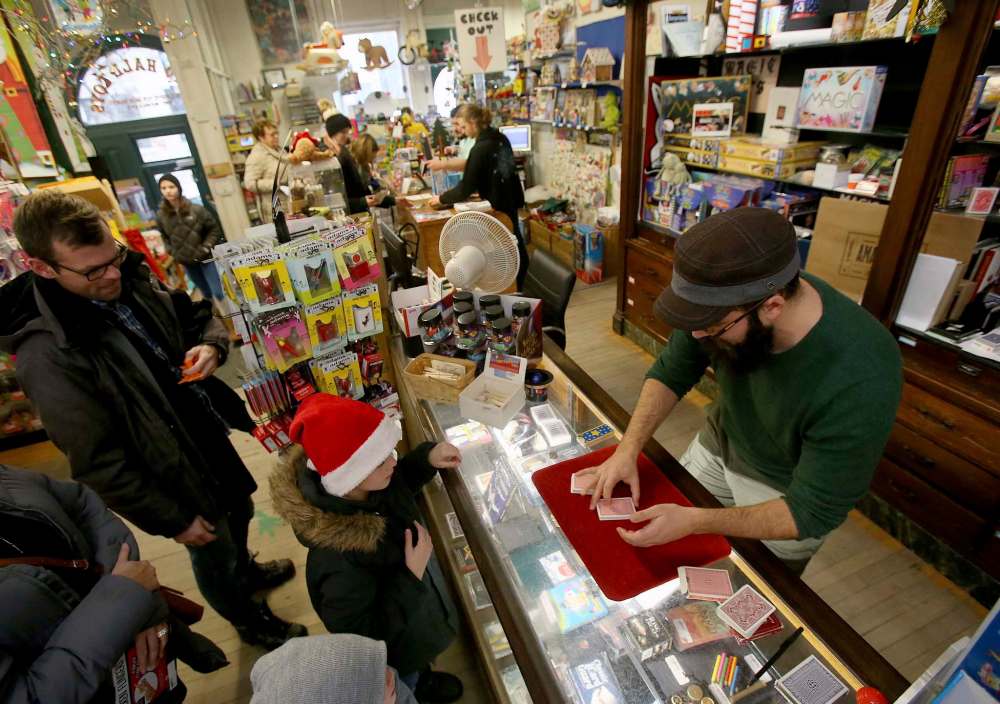
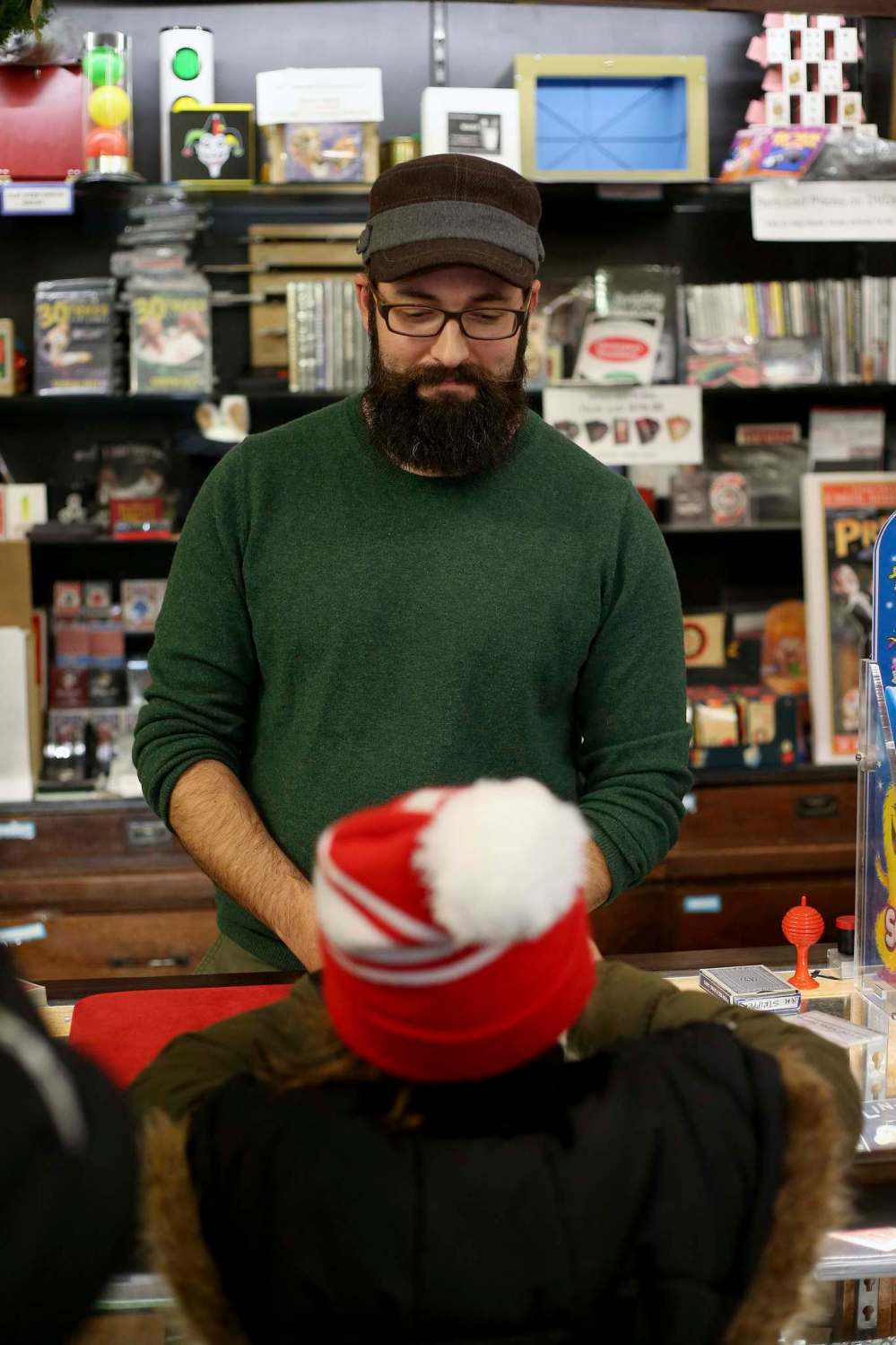
With her green parka thrown open and her long red and white toque slouching on her head, Teia marched up to the century-old magic counter, the glass top level with her chin, its surface so worn that it appears to be frosted, and stared straight at Brad Micholson on the other side.
“Show me a trick,” she said, sweetly to be sure, but a command all the same.
Micholson, a computer programer by day, a talented magician with a twirled up handlebar moustache by night, dramatically sized her up, his head cocked, eyebrow slightly raised, as if weighing Teia’s impertinence.
Then, with a smile, he obeyed by flaring a deck of cards and had Teia choose one, memorize it and return it to the deck. Before you could say “abracadabra,” he found her card and returned it. Ta-da!
“Again!” she squealed.
She picked another card, and another and another, always somehow her cards returned, maybe from the deck, maybe from atop a nearby box, maybe from inside the box, maybe from under a mat or behind a display.
She ooohed when Micholson turned four quarters into a dollar, and again when he took two cards, a three and a five, and turned them into one card, an eight.
This time, however, Teia wasn’t fooled.
“I know how you did that,” she cried, taking the cards, which she pinned to the counter as Micholson had done, but to no avail — the magic proved elusive.
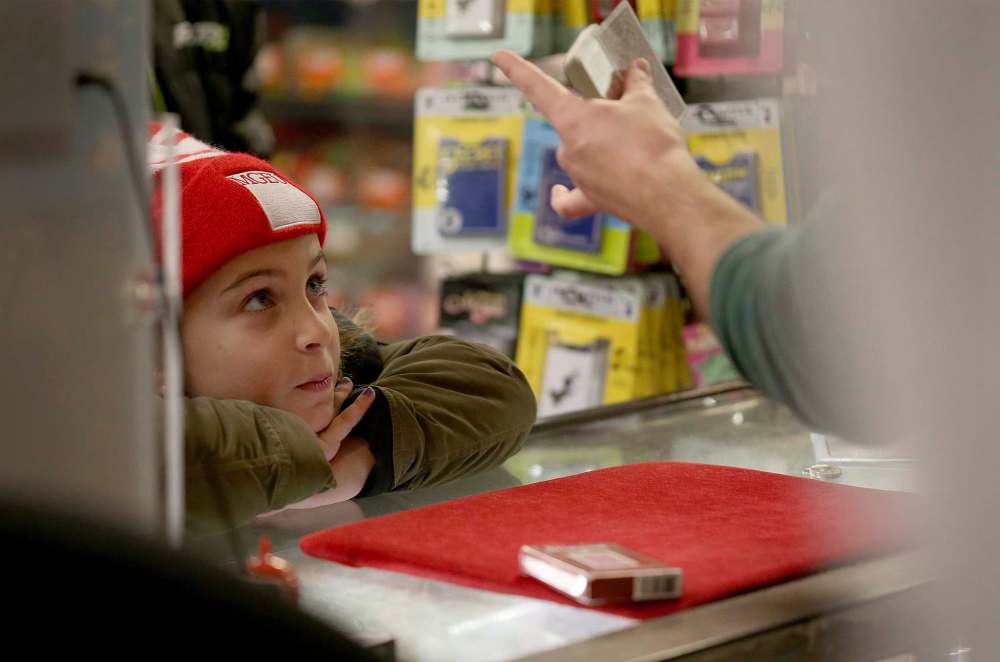
“Show me how,” she implored. “Show me.”
● ● ●
The wonder Teia clearly felt and her desire to know how to do it for others is the first, fundamental building block of magic.
Ask any Winnipeg magician — and there are a great many, including famed illusionists Dean Gunnarson and Darcy Oake — and they’ll tell you about a magic moment when they were children that ignited lifelong desires to cast spells and make wonder.
Gunnarson had his magic moment at age 10 when his mom gave him a book about Harry Houdini, the greatest magician of all time, according to most top-10 lists.
“He could do the impossible,” Gunnarson said. “It’s what a magician does, and I knew I wanted to do the impossible, too.”
Gunnarson, hailed as the greatest escape artist since Houdini, started dropping in at Toad Hall, talking with the magicians who work or frequent the magic counter, soaking up the lore, buying and learning tricks, attending magic club meetings.
At age 18, he launched a professional career that has taken him all over the world by escaping from a straitjacket while hanging from the old Free Press building on Carlton Street, just as Houdini had done in 1923.
“Every parent should take their kids to Toad Hall. It’s a magic place. You can’t know where it might lead,” he said.

It was a fluke that Oake found magic.
He was a boy, 10 or 11, in the kitchen at home in St. James. His dad, who was fooling with a deck of cards, asked him the proverbial question. Darcy picked and returned a card. His father, broadcaster Scott Oake, shuffled the cards and then pulled Darcy’s card from the pile.
“I have no magic,” Scott said recently. “I had a one-in-52 chance of finding his card and I did. It was dumb luck.”
But Scott, seeing the magical effect the fluke had on his son, refused to reveal his secret.
“Dad saw that I was blown away and wouldn’t tell me for a month,” Darcy recalled in an interview from London, where he is preparing for an 11-city tour of Britain in the new year.
“I was dumbfounded by that and had to know. I knew I had to be able to do it, to have that effect on other people.”
Overnight, he started learning tricks. Within weeks, his parents were driving him to Toad Hall, where the resident magician, Gord Gilbey, encouraged Darcy and gave him an application to join the Winnipeg Society of Young Magicians, which he did, faithfully attending monthly meetings and regular competitions for the next four years.
Carey Lauder was one of Darcy’s magic club instructors.
“You could tell he was special,” Lauder said. “He was so far ahead of the other kids, doing things we couldn’t do. You knew he would go places.”

Which, of course, Darcy did.
In 2014, nine years after his 16th birthday aged him out of magic club, Darcy became the first magician to reach the finals of Britain’s Got Talent. His televised act, in which white doves appear in a flash from his hand, went viral and has been watched more than 67 million times on YouTube.
● ● ●
Oake and Gunnarson, however, are not the only luminaries in the world of magic from Winnipeg.
Brian Glow started doing magic tricks at age seven, achieved local celebrity status in his teens and went on to perform in more than 40 countries, on television and at casinos. Today, he specializes in custom magic shows for such Fortune 500 companies as Ford, Apple, IBM and Coca-Cola.
The late Doug Henning was a Winnipegger who went on to revolutionize the presentation of magic — transforming tricks into spectacles and taking magic to Broadway and a weekly TV show, both for the first time.
On June 9, 1986, it was Henning who brought attention to the rich history of magic in Winnipeg when, in a flash of powder and a puff of smoke, he unveiled a plaque on a wall of the Union Bank Building (the present-day Patterson Globalfoods Institute) on Main Street.
The plaque, which is still there, pays tribute to Ken McMullen, a magician and ventriloquist who, in 1922, from his office on the seventh floor, established the world’s first magic society, the International Brotherhood of Magicians (IBM). It subsequently opened chapters called “magic rings” in countries around the world.
The plaque also is a reminder that McMullen, whose stage name was Len Ventis, launched Linking Rings, the first magic magazine — “the voice of magic” — which became the most-read magic magazine ever. Both the magazine and the IBM are still going.

● ● ●
Of course, not all Winnipeg magicians are famous, nor do they aspire to be.
Micholson carries a deck of cards with him everywhere, practising sleight of hand but rarely performing outside of Toad Hall.
Lauder came to magic later in life, when he was too old for the magic club, and pursued magic as a hobby with the idea of teaching it to a younger generation, which, as it turned out, led to mentoring young Darcy Oake.
He was instrumental in keeping the magic club alive and well for years while working variously as a professional photographer and teacher of photography at Tec Voc High School.
Youth club members range in age from seven to 16. The younger magicians are the Mini Wands, the older kids the Top Hats. Members meet monthly and compete in annual competitions.
Many perform in public.
“A kid could work a birthday party and earn 50 bucks,” Lauder said. “That’s quite a bit of money for a 10-year-old.”
In June, Lauder joined the staff at Toad Hall, working at online promotion and acting as resident magician.
A teacher of a different sort, Joe Kaufert, is a professor of community health at the University of Manitoba medical school. He has served several times as IBM president.
Kaufert was a boy when he got the bug from an uncle who had performed magic in theatres during the vaudeville era.
“For someone like me who could not tell a joke to establish rapport with strangers, magic was a way of getting their attention,” he said.
Magic did more than that. It paid his way through graduate school and remains part of most everything he does, from entertaining friends or lecturing medical school students.
Once in medical school, to drive home the importance of clean water, he filled two cups with dirty river water, one more with clean water, and invited his students to “play Russian roulette” and drink from one of the cups.
To the astonishment of the students, all the cups were empty, which saved them from some unpleasantness but made an indelible point.
● ● ●
I discovered magic at Christmas more than 30 years ago when I was reporter walking between city hall and the old Free Press building.
My walks sometimes took me up two-block-long Arthur Street (surely one of shortest streets in town) past the R.J. Whitla and Company Building, which was built in stages between 1899 and 1911.
An imposing brick-and-stone structure in the “romanesque revival” style, it made little impression on me. But I was drawn to a carved-wood sign hanging like some “olde shingle” over a green door at the south end of the building. It says TOAD HALL in large gold letters under a silhouette of a toad in suit jacket.
Over several walks I started to notice other features, window displays of toys, artful scripts and a fanciful scene in which a court jester is raising a curtain. Close inspection reveals the jester’s face is that of Winnipeg children’s entertainer Al Simmons, a Toad Hall devotee.
At some point I climbed the steps and entered Toad Hall.
It’s an experience that is variously described as magical, unforgettable, enchanted, charming.
Many say it’s like something out of a novel by Charles Dickens.
Kaufert was more specific.
“Toad Hall is a little like Dickens’ The Old Curiosity Shop. It’s mystical because the shop is filled with things that you don’t know what they do.”
Dickens himself described the Curiosity Shop in 1842 as “one of those receptacles for old and curious things which seem to crouch in odd corners of this town.”
Yes, very much like that.
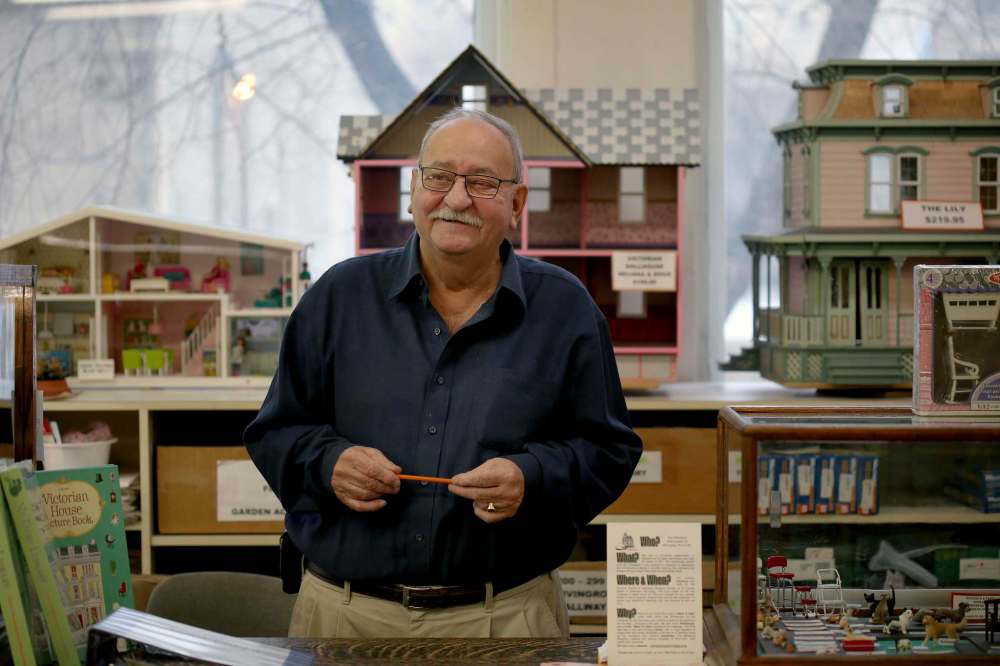
In fact, the 5,000 square feet Toad Hall occupies almost qualify on age alone. It opened as warehouse space in 1904 — 115 years ago. The pressed-tin ceiling is unchanged, the wood floors are worn grey and creak and groan like a tall ship in bad weather. Display cases are wood and glass antiques. The shelving units behind the magic counter, and those displaying tin toys, came from the original Hudson Bay Co., store built on Main Street and opened in 1891. The shelving became surplus when the “new” Bay store opened on Portage Avenue in 1926.
But of all descriptions of Toad Hall, I think Adrian Raven put it best.
On a recent Saturday, I watched as the 10-year-old pushed through the door at the entrance and looked up a short stairwell lined with toy displays and posters to the vast space beyond, all crowded with toys and drenched in a kaleidoscope of colours almost to the rafters five metres above.
“Holy cow,” he said. “Holy, holy cow.”
● ● ●
Toad Hall is a fantasy that Ray and Ann England have been imagining and re-imagining for more than 42 years.
It wasn’t something they planned. Ann, born in Winnipeg, and Ray, in St. Catharines, Ont., met at the University of Toronto. After Ann graduated, she taught high school English while Ray completed a PhD in regional planning and resource development.
His first job with the province brought the couple to Winnipeg, where they bought an 850-square-foot bungalow, where they remain to this day.
After a decade of planning and consulting in the private and public sectors, Ray and Ann were fed up with Ray’s “travel, travel, travel.” They hit on the idea of opening a toy store that would blend Ray’s love of good toys with Ann’s progressive ideas about childhood learning.
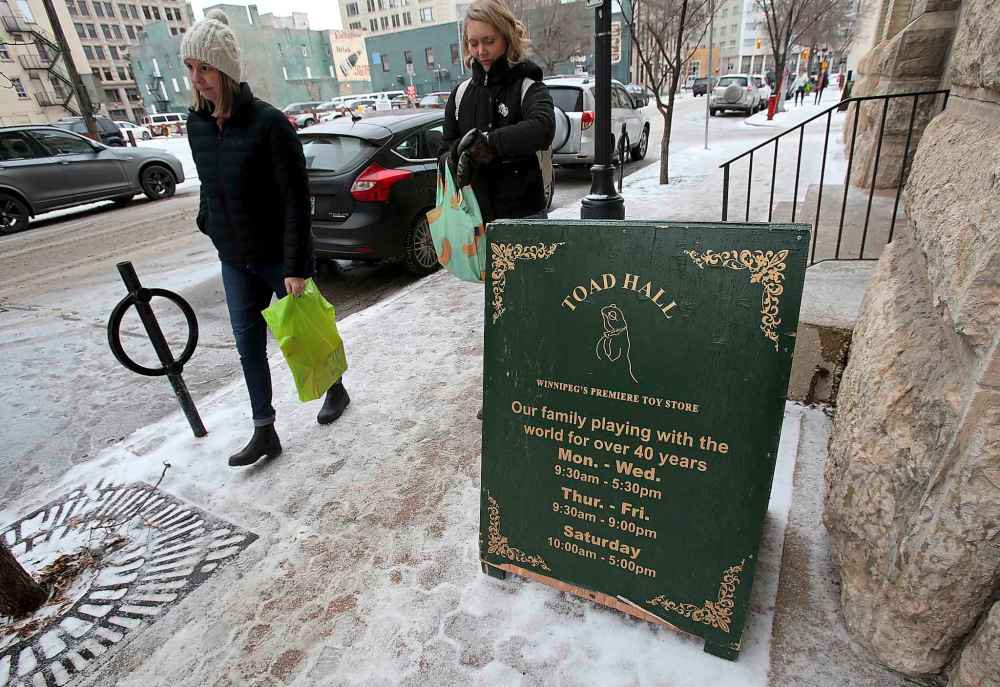
Named after Toad’s home in the British children’s classic The Wind in the Willows, Toad Hall opened on McDermot Avenue in 1977. Four years later, it moved to its present location at 54 Arthur St.
The choice of location perplexed some. But Ray guessed that the area would gentrify and become Winnipeg’s version of Gastown or Yorkville. Besides, the store was only two blocks from thousands of people working in the towers and office buildings clustered at Portage and Main.
Magic was not part of the store, at first. And when the first tricks were put on sale, they took up little more than a metre of shelf space. But that they were offered at all caught the attention of local magicians, who encouraged the Englands to do more, a process through which supply drove demand, which drove supply — what business consultants refer to as a “virtuous circle.”
While magic is a big part of the mystique of Toad Hall, it’s a small part of the store’s inventory. Ray estimates that he offers four times the variety of a typical big-box store, which skews toward toys made in America under licence — think of the endless variations of Toy Story, Frozen or Star Wars characters.
Ray, Ann and now their daughter Kari scour the world for toys that are more creative than endless copies of Disney characters.
Europe, and increasingly eastern Europe, are major sources of quality toys. The reason? Europe bans advertising to children younger than 14. The ban forces toymakers to innovate. The licensing racket so prevalent in North America does not dominate EU toy markets.
● ● ●
The first things I bought at Toad Hall were gags for my children’s Christmas stockings — joy buzzers, whoopee cushions, clattering dentures and, a favourite, replica bricks made of Styrofoam that caused panic when “accidentally” dropped on grandma’s toes.
Exposure to magicians at the magic counter, however, quickly turned my attention to tricks, many of which I still have — the Cheating Gambler, the Ball and Cup, the Floating Matchstick and Nickels to Dimes.
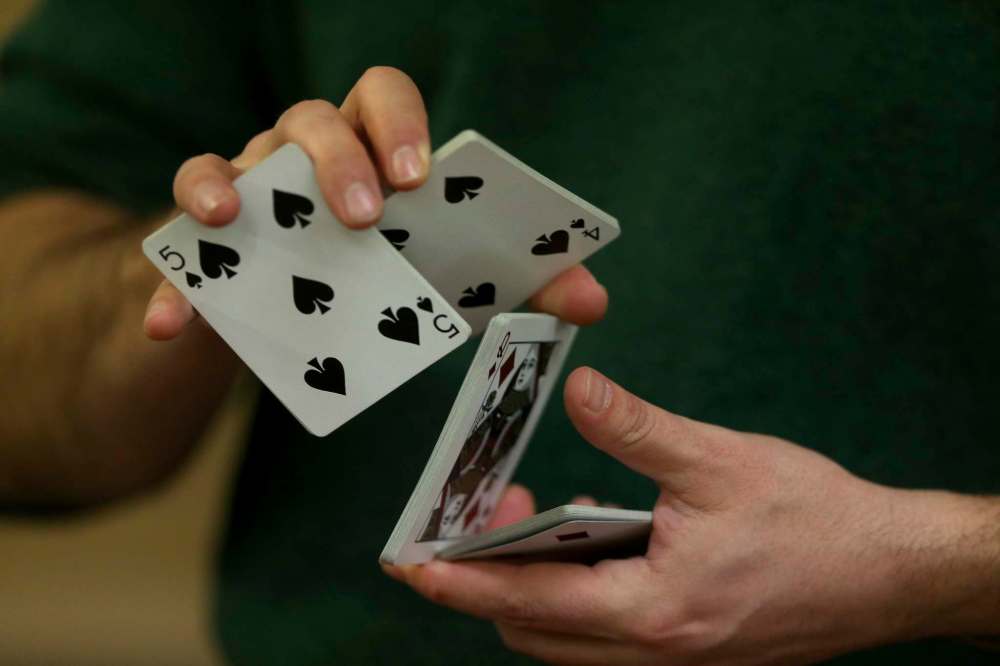
I have an assortment of card tricks like The Sucker Club and card decks like Short ’n Long cards, a “tapered” deck and the versatile Svengali Deck.

A couple of weeks ago, I picked up a some little charmers called Magic Fireflys and took them with me to a Christmas party.
After a time, I started to “discover” glowing fireflies clinging to clothing, hopping from left to my right hand, flying up my nose and out of my mouth.
A kitchen filled with adults morphed into a playroom of excited children.
The spell lasted no more than a few minutes.
But then, it was just a bit of magic at Christmas.