

Charlie Brown still matters
Two decades after his death, Charles Schulz continues to set a high bar for comics -- and life
Advertisement
Read this article for free:
or
Already have an account? Log in here »
To continue reading, please subscribe:
Monthly Digital Subscription
$1 per week for 24 weeks*
- Enjoy unlimited reading on winnipegfreepress.com
- Read the E-Edition, our digital replica newspaper
- Access News Break, our award-winning app
- Play interactive puzzles
*Billed as $4.00 plus GST every four weeks. After 24 weeks, price increases to the regular rate of $19.95 plus GST every four weeks. Offer available to new and qualified returning subscribers only. Cancel any time.
Monthly Digital Subscription
$4.99/week*
- Enjoy unlimited reading on winnipegfreepress.com
- Read the E-Edition, our digital replica newspaper
- Access News Break, our award-winning app
- Play interactive puzzles
*Billed as $19.95 plus GST every four weeks. Cancel any time.
To continue reading, please subscribe:
Add Free Press access to your Brandon Sun subscription for only an additional
$1 for the first 4 weeks*
*Your next subscription payment will increase by $1.00 and you will be charged $16.99 plus GST for four weeks. After four weeks, your payment will increase to $23.99 plus GST every four weeks.
Read unlimited articles for free today:
or
Already have an account? Log in here »
Hey there, time traveller!
This article was published 12/02/2020 (2265 days ago), so information in it may no longer be current.
I have the same routine every morning — when I sit down at the computer, before I consider writing a single word, I take a moment to read the daily Peanuts calendar resting on my desktop.
Without fail, the little four-panel comic strips, featuring the exploits of Charlie Brown, Snoopy and the rest of the Peanuts gang, make me laugh, or smile or unleash some other human emotion that starts my day more effectively than a hot cup of coffee.
One recent morning, I found myself getting all misty-eyed over a heartfelt strip in which Peppermint Patty is tearful because the school says she can no longer wear her trademark sandals because they violate the dress code.
Which is when — “SMAK!” — a tuque-clad Snoopy loudly plants a kiss on her cheek and the thought balloon over the legendary fictional beagle’s head declares: “We all need someone to kiss away our tears.”
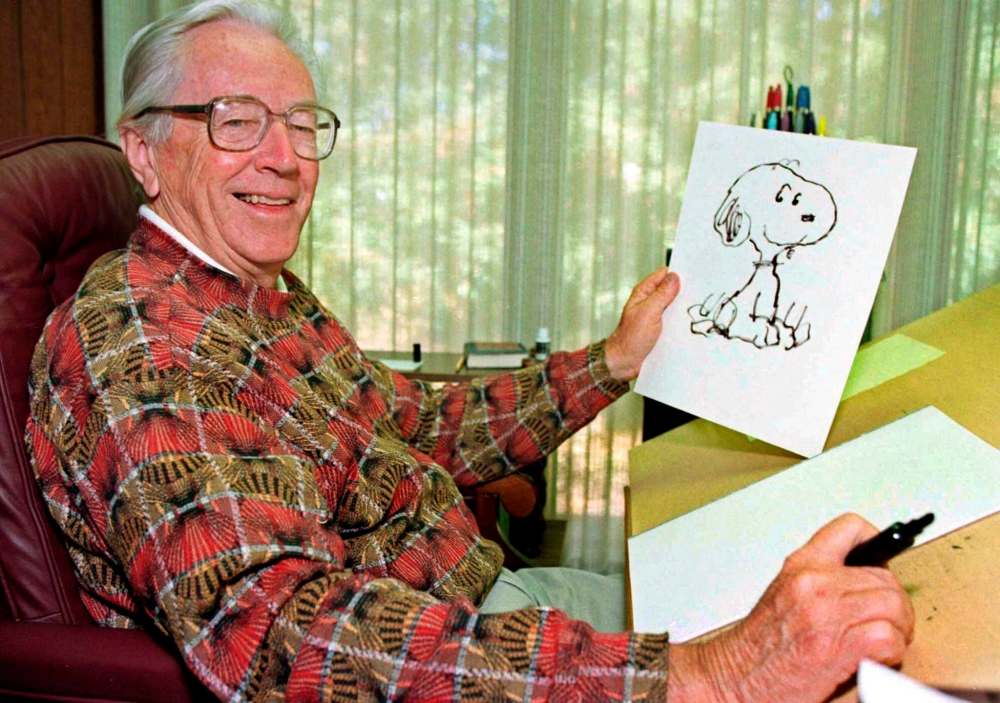
Gripped by a strangely warm and fuzzy feeling, I was moved to look up Peanuts creator Charles Schulz online, which is when I discovered that today, Feb. 12, marks the 20th anniversary of the death of the man who became the world’s most popular and beloved cartoonist.
On Feb. 12, 2000, almost 50 years after his first Peanuts strips were published, Charles (Sparky) Schulz, 77, died peacefully in his sleep, succumbing to the complications of colon cancer.
The next day, mere hours after his passing, the final original Peanuts comic strip landed on readers’ doorsteps in the Sunday papers. In it, Schulz announced his retirement and thanked fans for their support and love throughout his remarkable career.
“Charlie Brown, Snoopy, Linus, Lucy… how can I ever forget them…” Schulz concluded. He had rightly predicted Peanuts would outlive him because the strips were typically drawn weeks before they were published.
And he would no doubt be pleased to know that, 20 years after his death, no one has forgotten Charlie Brown, Snoopy and the rest of the cast, especially the devoted fans in my house. According to Forbes magazine, he remains the fourth top-earning deceased celebrity, trailing only Michael Jackson, Elvis Presley and Arnold Palmer.
In our house, along with Peanuts calendars, we boast two clocks featuring the Peanuts crew, a Peanuts welcome mat at the front door, countless figurines of Charlie Brown and the gang, as well as books, a shower curtain, bath towels, boxes of collectible Peanuts jewelry and — this may seem hard to believe, but it’s true — a waffle maker that churns out breakfast in the easily recognizable shapes of Charlie Brown, Snoopy, and his doghouse.
My wife, She Who Must Not Be Named, not only wears her passion for all things Peanuts on her sleeve, she also sports it on her ankle in the form of a tattoo of Snoopy and his beloved bird buddy, Woodstock.
“Snoopy has the best outlook on life. He is happy, loyal, always looks on the bright side, he is comical, daring (first beagle in space!), creative, imaginative and he loves his boy and his best friend, Woodstock. He is always open for new adventures. We should all be more like him,” is what my spouse chirped when asked about her Peanuts obsession.
In our house, we are nuts for Peanuts. And we are not alone.

The Peanuts phenomenon began in 1950 after Schulz signed with United Features Syndicate. At the time of his retirement and subsequent death, Peanuts was featured in 2,600 newspapers, reaching 335 million readers in 75 countries. Over nearly 50 years, Schulz drew an astounding 17,897 published Peanuts strips.
In an effort to understand why so many of us continue to love Schulz’s creations in 2020, I contacted the kind folks who run the Charles M. Schulz Museum, which is located in Santa Rosa, Calif.
It houses the largest collection of Peanuts strips in the world, and is visited every year by more than 100,000 fans, including a smattering of devoted Winnipeggers.
In a thoughtful email, museum curator Benjamin L. Clark explained why Schulz’s artwork remains so enduring.
“Charles Schulz drew from life in just about every way an artist can,” Clark wrote. “He needed to in order to single-handedly produce nearly 18,000 comic strips in his career. Schulz took on some big questions like ‘Why am I lonely,’ ‘What is friendship,’ and ‘What if someone I love doesn’t love me back?’ These questions have been with humanity from the beginning and will no doubt endure forever. These questions are also very personal. We don’t think about every other person around us feeling the way we do, but they do. That’s why Peanuts feels so personal but proves to be universal. It’s also very funny.”
There’s no question Schulz was passionate about delivering the funny. One of his more famous quotes states: “All I’m literally doing is sitting at a drawing board drawing a funny picture. I just want to draw something that’s funny. I would draw comic strips even if I weren’t getting paid for it… I’m obsessed with thinking of funny things. It’s my hobby. It’s just the way I was born and I’m lucky it works.”
His work was undeniably hilarious, but his humour wasn’t about cheap laughs. He could say more about the human condition in four small panels than long-winded novelists could in 2,000 pages. Without him, the phrases “Good grief!” and “security blanket” would not be a part of our popular vocabulary.
“His humour was at times observational, wry, sarcastic, nostalgic, bittersweet, silly and melancholy, with occasional flights of fancy and suspension of reality thrown in from time to time,” the museum notes on its website.
My wife and I were able to see ourselves — and our friends and family — in Schulz’s collection of characters.
All of us could identify with Charlie Brown, the world’s most famous lovable loser, a round-headed kid in a zig-zag shirt who kept the flickering flame of hope alive even when he was battered on the pitcher’s mound or, once again, Lucy pulled the football away when he tried to kick it, landing our hero flat on his back.

We all understood Linus’s need for a security blanket, Schroeder’s obsession with Beethoven and, most of all, the off-the-wall antics of Snoopy, the world’s most famous canine who transformed over the years from a traditional dog into the root beer-loving, sunglasses-wearing, bird-befriending First World War flying ace who, when he was not battling the Red Baron, sat atop his doghouse composing novels that always begin with: “It was a dark and stormy night.”

What you might not know is that, when he wasn’t drawing, Schulz was frequently feeding his lifelong passion for hockey. According to Schulz Museum curator Clark: “Charles Schulz loved hockey. He played as a kid on the frozen, iced-over streets of St. Paul, Minn., where he grew up, and later built a world-class ice arena in sunny Sonoma County, Calif., where he lived from 1958 until his passing in 2000.”
Stephanie King, the museum’s marketing director, told me the museum, where Schulz’s widow, Jean, remains active, is dedicated to celebrating the legacy of the man and his fictional friends.
“One thing that makes the Schulz Museum so special is that nearly all our visitors arrive with a very personal connection to the artwork on view,” King told me. “Every day we hear stories from visitors around the world about family traditions and vivid memories directly tied to Peanuts, whether it was watching A Charlie Brown Christmas every year huddled up in the living room or growing up with a nickname taken from one of the characters in the Peanuts gang. But for every memory shared, we also hear, ‘I never knew that!’ It is one of the greatest rewards for our staff — to see visitors of all ages leave with a new, deeper love of Peanuts because of a connection made during their visit.”
It’s too late now, but I have figured out what I would have said to Charles Schulz if we’d met during his lifetime. I would have said “Thank you!” And just maybe I’d have asked him to let Charlie Brown kick that (bad word) football, if only once.
doug.speirs@freepress.mb.ca