Animal interlopers
From gators to hippos and penguins, Winnipeg's wayward swine not the only critter to show up in odd places
Advertisement
Read this article for free:
or
Already have an account? Log in here »
To continue reading, please subscribe:
Digital Subscription
One year of digital access for only $75*
- Enjoy unlimited reading on winnipegfreepress.com
- Read the E-Edition, our digital replica newspaper
- Access News Break, our award-winning app
- Play interactive puzzles
*Billed as $5.77 plus GST every four weeks. After 52 weeks, price increases to the regular rate of $19.95 plus GST every four weeks. Offer available to new and qualified returning subscribers only. Cancel any time.
Monthly Digital Subscription
$4.99/week*
- Enjoy unlimited reading on winnipegfreepress.com
- Read the E-Edition, our digital replica newspaper
- Access News Break, our award-winning app
- Play interactive puzzles
*Billed as $19.95 plus GST every four weeks. Cancel any time.
To continue reading, please subscribe:
Add Free Press access to your Brandon Sun subscription for only an additional
$1 for the first 4 weeks*
- Enjoy unlimited reading on winnipegfreepress.com
- Read the E-Edition, our digital replica newspaper
- Access News Break, our award-winning app
- Play interactive puzzles
*Your next Brandon Sun subscription payment will increase by $1.00 and you will be charged $17.95 plus GST for four weeks. After four weeks, your payment will increase to $24.95 plus GST every four weeks.
Read unlimited articles for free today:
or
Already have an account? Log in here »
Hey there, time traveller!
This article was published 18/04/2020 (2226 days ago), so information in it may no longer be current.
This little pig went to market, this little pig stayed home — and this little pig was found wandering the streets of Winnipeg.
For the record, those aren’t the lyrics to a silly childhood song, because the truth is a lost piglet was found running wild in the northwest part of Winnipeg last weekend.
Last Saturday, Winnipeg Animal Services received a report about the runaway critter and picked up the piglet on Leila Avenue in Garden City.
The roaming porker, believed to be about eight to 12 weeks old, posed a bit of a mystery because it is illegal to keep pigs as domesticated pets in the city, and there are no farms in the area where it was found.
“It’s incredibly rare,” Leland Gordon, chief operating officer of animal services, said when asked how often animal services comes across a lost pig. That kind of encounter may occur two or three times a year.
Believed to be a breed that can grow to be between 100 and 400 pounds, the piglet found a temporary home at the animal services facility. “The pig has a blanket, she has a nice kennel and we’re all hoping of course for a nice, positive outcome for this pig,” Gordon said.
Fortunately, there was a happy ending — Reba the pig was claimed by her owner and surrendered to Kismet Creek Farm, a rescue farm located near Steinbach.
It’s not the first time odd critters have been found roaming city streets, as we see from today’s beastly list of Five Wild Creatures Famously Spotted in Urban Locations:
5) The exotic creature: Sacred sika deer
The urban location: Nara, Japan

The wild story: As the saying goes, nature abhors a vacuum. What that means in the age of coronavirus is that when humanity is away, the animals will play. With much of the world’s human population hunkered down at home to ride out the global pandemic, critters not normally seen on city streets have been playing the role of urban tourist. Photographs and videos of the wild animals’ antics have been going viral on assorted social-media platforms.
In New Delhi, a monkey was spotted searching for food in an alley of shuttered shops. Puma have been spotted walking the streets of Santiago, Chile, and wild boar have been seen strolling through the deserted streets of Barcelona. But nowhere have wild critters filled the void as much as they have in the ancient Japanese city of Nara, a 45-minute train ride south of Kyoto and home to the famous Nara Park. The city, one of Japan’s top tourist destinations, has been all but emptied of human life in the face of the novel coronavirus.
Nara Park’s sika deer, officially designated as a national natural treasure, have grown accustomed to being fed by tourists, many of whom come to watch as the deer bow for treats in the form of rice crackers purchased from local vendors. Without tourists, however, the deer have been forced to wander out of the park and into the city in search of food. Photos have emerged showing the deer wandering en masse though the city’s streets and subway stations and strolling through shopping areas. “Images of the deer feasting on the grass in the city centre and in the train station have been shared by locals on social media, who admit they have never seen the creatures act like this before,” Britain’s The Independent newspaper reported.
“News reports also show distressed deer wandering the streets of the city while concerned drivers slow down and try to avoid hitting them.”
4) Exotic creature(s): A pair of penguins
The urban location(s): Dublin, Ireland, and Sydney, Australia
The wild story: You may find some unusual things wandering around the storied streets of Dublin, but a penguin isn’t usually one of them. That changed in July 2010, however, when Dublin police bagged a female Humboldt penguin on a street in the north end of the city.
It turns out the penguin had been kidnapped in a suspected prank by a gang of men from the Phoenix Park Zoo in the capital of the Irish Republic. It was believed the men broke into the zoo and smuggled the penguin out in a bag before fleeing in a taxi. The penguin at the centre of the kidnap ordeal was a 10-year-old female peguin called Kelli, who was tracked through a microchip, fitted to all animals in the zoo. “Dublin Zoo confirms that a penguin which had been missing has been returned,” a zoo official said at the time.
“The penguin went missing this morning at 8 a.m. but due to the security measures that are in place at Dublin Zoo and the rapid response of (police), the penguin was soon recovered and returned.” Penguins are a little more common in Australia, but you don’t typically find them hanging out in the sewer system. In 2016, however, two young boys were out for a walk when they stumbled on a young penguin — from a small species known as a little or fairy penguin — trapped in a stormwater drain. The bird, stuck inside a smaller pipe within the drain, was reportedly distressed and made “wild noises” when they attempted to pick him up.
“They called the (Royal Society for the Prevention of Cruelty to Animals) for assistance but as we were en route, a gush of water actually went through a smaller drain and pushed it back down into the larger stormwater drain,” RSPCA Inspector Tyson Hohlein said. “We then took it off their hands and I transported it to the Taronga Zoo Wildlife Clinic where it was assessed by one of the veterinarians there.” Hohlein said he had never found a penguin that far inland. It might have come from a small colony near the Sydney Harbour.
3) Exotic creature(s): A camel, a cow and a spotted donkey
The urban location: Goddard, Kansas
The wild story: A camel, a cow and a donkey walk into a bar … OK, they didn’t actually walk into a bar, because this is a true story as opposed to the setup for a corny old joke. What happened was, in a scene straight out of Jesus’ manger, a camel, a cow and a small spotted donkey were discovered travelling together — not in Bethlehem, but in small-town Kansas.
According to a gaggle of online news reports, the trio was spotted just outside the city limits of Goddard, located about 24 kilometres west of Wichita. The friendly critters escaped their enclosures outside Goddard, Capt. Lance Beagley of Goddard Police told CNN at the time. Rather than stay put in their pens, it seemed the only road to take was the open one, and the three pals took off down a street together. They didn’t end up in a bar, but they were a strange enough sight roaming the roadside to prompt a 911 call to police, who took a photograph of the scene, complete with a beam of ethereal-looking light beating down on the four-legged fugitives.
The photo was posted to the police Facebook page along with a plea for the owners to step forward. “Does anyone know the owners of these three friends travelling together (towards a Northern star) just east of Goddard?” the police department posted along with the photo of the animals. “If we cannot locate the owner, we may be halfway towards a live nativity this Christmas season.” Sedgwick County Sheriff’s Lt. Tim Meyers said the animals belonged to an employee of the nearby Tanganyika Wildlife Park. They were quickly reunited, but not before the Facebook posting went viral and prompted some seasonal riffs from online wisecrackers impressed by the biblical implications. “Are there three wise-looking men near?” queried one writer.
“Let them keep walking and follow them,” quipped another. “Who knows, they may lead you to the second coming. IT’S A CHRISTMAS MIRACLE. Happy Holidays everyone!”
2) The exotic creature: Rogue alligators
The urban location: Milwaukee, Wis.
The wild story: Parked on the shores of Lake Michigan, Wisconsin’s largest city, Milwaukee, is famous for its breweries and Major League Baseball’s Brewers. But there is more to this city than beer and baseball. There are also (dramatic pause) alligators.
We say that because in November, 2003, postal workers in Milwaukee got the shock of their lives when a four-foot alligator chewed its way out of a shipping carton. Employees were sorting mail when they noticed the alligator chewing its way out of an Express Mail box, JoAnne Blackburn, a Postal Service spokeswoman, told the Associated Press. Workers tried to tape the box closed, but the alligator bit it open. “The nose . . . was sticking out with its teeth hanging out,” said postal employee Jennifer Hejdak. She said a co-worker picked it up by its tail and threw it in a hamper before they called local animal control officers. Officials said someone had put the alligator in a carton to ship it from Milwaukee to Colorado.
A Milwaukee radio station later reported that a Marquette University student was the one responsible. He told a reporter he had the creature at his residence for about a week before deciding it had to go. The alligator remained at a shelter for a week before being shipped to a northern Illinois sanctuary, said Len Selkurt, executive director of the Milwaukee Area Domestic Animal Control. The sanctuary owner would take it to Florida, he said. If that’s not enough, the body of an ex-alligator was discovered in a Milwaukee alley on Halloween night in 2019. The five-foot American alligator was found frozen inside a plastic storage bin in a back alley beside some trash cans.
“It’s very weird,” said Blake Campbell, a resident who found the dead alligator. “Noticed a strange smell. I thought it was a joke. I thought somebody was playing a trick on me.” It was disposed of by the Department of Public Works, and police said they were baffled. “MPD was not able to discover where the animal came from,” said Sgt. Sheronda Grant, the public information officer for the Milwaukee Police Department.
1) The exotic creature: Hippos
The urban location: Doradal, Colombia

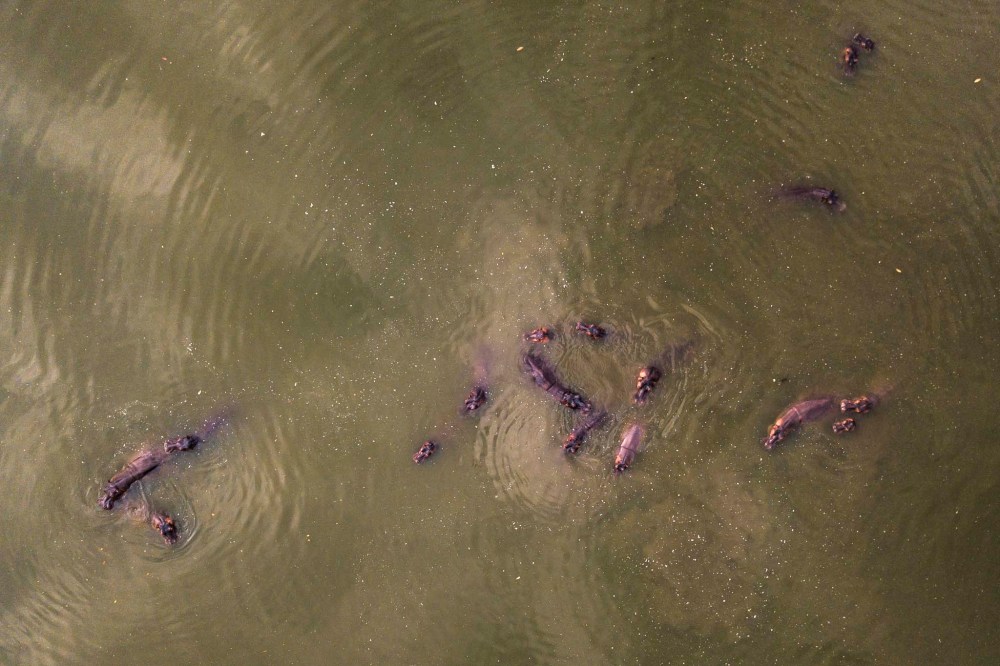
The wild story: Maria Jaramilla will never forget the night in 2018 when she looked out across her small yard and saw something shocking — a hippopotamus had wandered down her driveway and was inspecting her house. “It was a big fright for all of us,” Jaramilla, 41, told the Associated Press in February. Since that night, the hippos have kept coming, wandering down the back streets of Doradal, a small Colombian town a four-hour drive from Medellin.
An estimated 80 hippos live in the area around the Rio Magdalena, Colombia’s principal river. They’re descendants of four hippos that were illegally brought to the country by infamous drug lord Pablo Escobar for his personal collection. In the 1980s, during the height of his power, Escobar kept the hippos in a private zoo on his 2,225-hectare estate, Hacienda Napoles.
When Escobar was shot dead in 1993, the hippos were deemed too difficult to move and were abandoned on the estate. They may resemble bathtubs on legs, but hippos are considered one of the most aggressive animals on the planet, especially in their native home of Africa, where there are an average of 50 hippo-related deaths reported per year. Now the animals are thriving and authorities are worried about the threat posed by the so-called “Cocaine Hippos”.
“Students at a small primary school behind Escobar’s former estate arrive for class each day by passing a sign that reads ‘danger — hippopotamus present’,” AP reported. It may come as a surprise that some residents in Doradal welcome the hippo visits and the tourism boost they provide. Notes the Associated Press: “Each afternoon in the town’s main park, children hang and play from statues of the hippos while shops throughout the town sell key rings and souvenirs of the animals.”
Not to mention the gas station in the South African city of St. Lucia that had a viral hit when it posted a video to Facebook showing a hippopotamus casually strolling through the station’s parking lot before heading back to a nearby lake.
doug.speirs@freepress.mb.ca