Science summary: A look at novel coronavirus research around the globe

Advertisement

Advertise with us

Thousands of scientists around the world are working on problems raised by the COVID-19 pandemic. Here is a summary of some recent research from peer-reviewed academic journals and scientific agencies:

Read this article for free:


or

Already have an account? Log in here »

To continue reading, please subscribe:

Subscribe and receive a limited-edition Free Press branded hat or tote.

Digital Subscription

One year of digital access for only $205*

  • Enjoy unlimited reading on winnipegfreepress.com
  • Read the E-Edition, our digital replica newspaper
  • Access News Break, our award-winning app
  • Play interactive puzzles

*First annual payment billed as $205.00 + GST for one year. This annual subscription will automatically renew at $233.00 + GST every 52 weeks (10% off the regular annual price of $259.35). Offer available to new and qualified returning subscribers only. Cancel any time.

To continue reading, please subscribe:

Add Free Press access to your Brandon Sun subscription for only an additional

$1 for the first 4 weeks*

  • Enjoy unlimited reading on winnipegfreepress.com
  • Read the E-Edition, our digital replica newspaper
  • Access News Break, our award-winning app
  • Play interactive puzzles
Start now

*Your next Brandon Sun subscription payment will increase by $1.00 and you will be charged $17.95 plus GST for four weeks. After four weeks, your payment will increase to $24.95 plus GST every four weeks.

Hey there, time traveller!
This article was published 25/05/2020 (2271 days ago), so information in it may no longer be current.

Thousands of scientists around the world are working on problems raised by the COVID-19 pandemic. Here is a summary of some recent research from peer-reviewed academic journals and scientific agencies:

The International Journal of Infectious Disease has tracked the source of Canada’s first 118 cases of COVID-19. It found that despite nearly two-thirds of the world’s cases originating in China, and despite Canada’s large human and trade links with that country, only nine (7.6 per cent ) of Canada’s earliest cases originated there. Researchers say the most commonly reported travel among the 118 cases involved the Middle East, the United States and Europe. Nearly one-third — 30 cases — were from Iran. Researchers say the results suggest that future travel bans shouldn’t necessarily be restricted to only countries with high levels of infection.
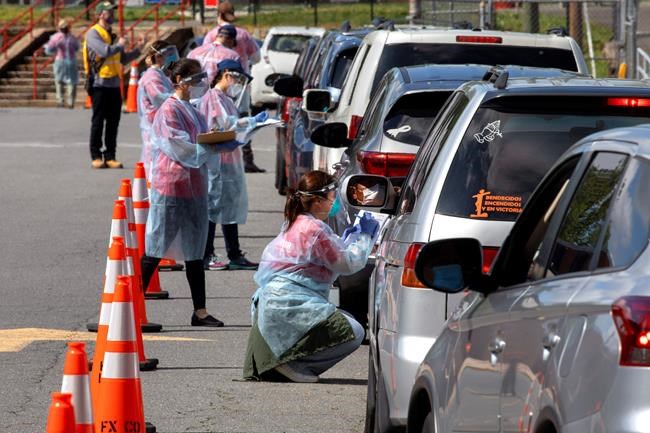
A man wearing a facemask waits inside his car to be tested for COVID-19 as volunteers take registration information in Annandale, Va., Saturday, May 23, 2020. COVID-19 testing was available from Fairfax County at no cost and without a doctor's order. Hundreds of people had lined up in cars and on foot by 10am. Officials planned on testing about 1000 people from 10 a.m. to 6 p.m. Testing will be available at Bailey's Elementary on Sunday. (AP Photo/Jacquelyn Martin)

The novel coronavirus has mutated thousands of times, but a large study from University College London suggests none of those mutations has made it more transmissible. The paper, which hasn’t been peer-reviewed, looked at more than 15,000 COVID-19 patients from 75 countries. It found 6,822 mutations. Of those, 31 mutations have occurred at least 10 times independently during the course of the pandemic. Researchers found no evidence those common mutations increased the virus’s transmissibility — including one mutation which has been widely credited with being more infectious. In fact, they found most mutations were mildly detrimental to the virus.

An unreviewed study from the Universite de Paris found cases of Kawasaki disease in children, which causes swelling blood vessels, seem to be associated with COVID-19. It found 17 children were admitted to the university hospital between late April and early May this year, when the average number of cases is one. Fourteen youngsters showed evidence of recent infection by the novel coronavirus. They also suffered gastrointestinal distress. All were treated and successfully recovered.

The journal The Lancet has published one of the largest studies yet on the value of hydroxycholoroquine as a COVID-19 treatment. The study looked at 96,032 patients from 671 hospitals on six continents. The paper reports no benefit from the antimalarial drug, either on its own or with anything else. It says hydroxychloroquine, which has known side effects on the heart, may cause more problems than its solves — although the paper cautions that conclusion isn’t definitive.

Studies in macaque monkeys suggest that developing immunity against COVID-19 is possible for humans, either through exposure to the virus causing it or through a vaccine, reports the journal Science. Researchers are still trying to determine if being infected with the virus creates immunity against future exposures. In this study, nine adult macaques who had recovered from an infection were exposed again 35 days later. All showed little to no symptoms and exhibited immune responses that protected against the second infection. The same researchers then inoculated 35 macaques with prototypes of six different COVID-19 vaccines and exposed the animals to the novel coronavirus. Antibodies showed up in all the monkeys’ bloodstreams.

A paper in the journal Science Immunology warns that testing for COVID-19 antibodies may be a good way to assess the immunity of large groups, but not of individuals. The authors suggest such tests could help with public-health questions such as when to relax stay-at-home orders or school closures. But they add such tests aren’t accurate or specific enough to determine if any one person is immune to infection, throwing into question the value of so-called immunity passports. Using currents tests for that purpose is insufficient and potentially harmful, they say.

This report by The Canadian Press was first published May 25, 2020

Report Error Submit a Tip

More Stories

Manitoba-made technology earns faith of investors across Canada

Gabrielle Piché 4 minute read Preview

Manitoba-made technology earns faith of investors across Canada

Gabrielle Piché 4 minute read Yesterday at 2:00 AM CDT

Blue light flashed as a robotic arm welded the metal in front of it.

Unlike other robots of its kind, this one uses artificial intelligence. It’s supposed to see and adjust its movements if a part it’s working on doesn’t match the standard piece.

It’s Manitoba-made technology that investors across Canada are betting on. TetraGen Robotics, the technology’s creator, announced it had raised $1.8 million in an oversubscribed seed funding round.

It announced the funding Monday afternoon. Jim Richardson, from the family behind Richardson International, is among the investors listed online.

Read
Yesterday at 2:00 AM CDT

Moving rail lines outside city would make Winnipeg ‘major transportation hub’

Carol Sanders 6 minute read Preview

Moving rail lines outside city would make Winnipeg ‘major transportation hub’

Carol Sanders 6 minute read Updated: 7:33 PM CDT

After decades of calls to move rail traffic to the outskirts of Winnipeg, a plan that would benefit residents, railways and taxpayers is now on track, says the former Winnipegger leading the way.

A rail line bypass south of the city, using Crown-owned land and the Manitoba Hydro corridor, would take 20 years to complete, remove 120 railway crossings that are a safety risk and free up about 250 acres of Winnipeg land over time for development, Lloyd Axworthy said Wednesday.

“The visions that we have have to be implemented,” Axworthy said at a news conference announcing the launch of a 90-day feasibility study to move freight rail traffic out of Winnipeg’s urban core along Manitoba Hydro’s southern transmission corridor, connecting east to west along the Perimeter Highway.

The former federal transport minister and Manitoba MP was tasked by Premier Wab Kinew in October 2024 to lead a two-year rail relocation feasibility study.

Read
Updated: 7:33 PM CDT

Long-awaited supervised drug consumption site opens quietly after months of loud opposition

Malak Abas 11 minute read Preview

Long-awaited supervised drug consumption site opens quietly after months of loud opposition

Malak Abas 11 minute read Updated: Yesterday at 5:57 PM CDT

After three years of planning, delays and constant controversy, Manitoba’s first supervised drug consumption site quietly opened its doors Tuesday morning.

Read
Updated: Yesterday at 5:57 PM CDT

‘No CUSMA, no booze-ma’: Kinew

Malak Abas 4 minute read Preview

‘No CUSMA, no booze-ma’: Kinew

Malak Abas 4 minute read Updated: 6:20 PM CDT

With the next round of tariffs set to hit Canadian goods next week, and a new report suggesting Manitobans could be severely impacted if the Canada-U.S.-Mexico agreement on trade breaks down, Premier Wab Kinew pledged Wednesday to keep working with the U.S. ambassador — and keep American booze off Manitoba shelves, for now.

Read
Updated: 6:20 PM CDT

Student union coalition scrutinized, accused of providing minimal benefit for fees paid

Maggie Macintosh 5 minute read Preview

Student union coalition scrutinized, accused of providing minimal benefit for fees paid

Maggie Macintosh 5 minute read Updated: Yesterday at 8:36 AM CDT

Despite being labelled as “permanently closed” online and maintaining a website filled with outdated information, a coalition of student unions is defending itself as an active entity deserving of fees in spite of its low profile.

The Canadian Federation of Students and its local chapter, better known as CFS-MB, collect annual membership dues from campuses across the province to support their advocacy work.

Alan Saji Koshy’s advice to new and returning students to the University of Winnipeg? “Start asking questions.”

“We pay hundreds of thousands of dollars for practically no benefit and students don’t even know (CFS-MB resources) exist,” the recent graduate and former student association president said.

Read
Updated: Yesterday at 8:36 AM CDT

A Winnipeg home with a mountain view? You won’t find a real one, but AI-generated visual suggests otherwise

Gabrielle Piché 6 minute read Preview

A Winnipeg home with a mountain view? You won’t find a real one, but AI-generated visual suggests otherwise

Gabrielle Piché 6 minute read Yesterday at 6:03 PM CDT

Manitoba’s mountain range peeked out behind a Scotia Street home.

At least, it did in a photo attached to a real estate listing for 232 Scotia St. in Winnipeg’s (flat) Seven Oaks neighbourhood.

Another picture — now removed — showed a cartoon cityscape viewable from the bungalow’s front porch.

Both photos had tags in their bottom left corners: “AI-generated content.”

Read
Yesterday at 6:03 PM CDT