Comet contenders
The arrival, and departure, of Neowise prompts look at five others that have left their marks
Advertisement
Read this article for free:
or
Already have an account? Log in here »
To continue reading, please subscribe:
Monthly Digital Subscription
$1 per week for 24 weeks*
- Enjoy unlimited reading on winnipegfreepress.com
- Read the E-Edition, our digital replica newspaper
- Access News Break, our award-winning app
- Play interactive puzzles
*Billed as $4.00 plus GST every four weeks. After 24 weeks, price increases to the regular rate of $19.95 plus GST every four weeks. Offer available to new and qualified returning subscribers only. Cancel any time.
Monthly Digital Subscription
$4.99/week*
- Enjoy unlimited reading on winnipegfreepress.com
- Read the E-Edition, our digital replica newspaper
- Access News Break, our award-winning app
- Play interactive puzzles
*Billed as $19.95 plus GST every four weeks. Cancel any time.
To continue reading, please subscribe:
Add Free Press access to your Brandon Sun subscription for only an additional
$1 for the first 4 weeks*
*Your next subscription payment will increase by $1.00 and you will be charged $16.99 plus GST for four weeks. After four weeks, your payment will increase to $23.99 plus GST every four weeks.
Read unlimited articles for free today:
or
Already have an account? Log in here »
Hey there, time traveller!
This article was published 01/08/2020 (2082 days ago), so information in it may no longer be current.
It’s been a spectacular show, but the curtain is about to drop.
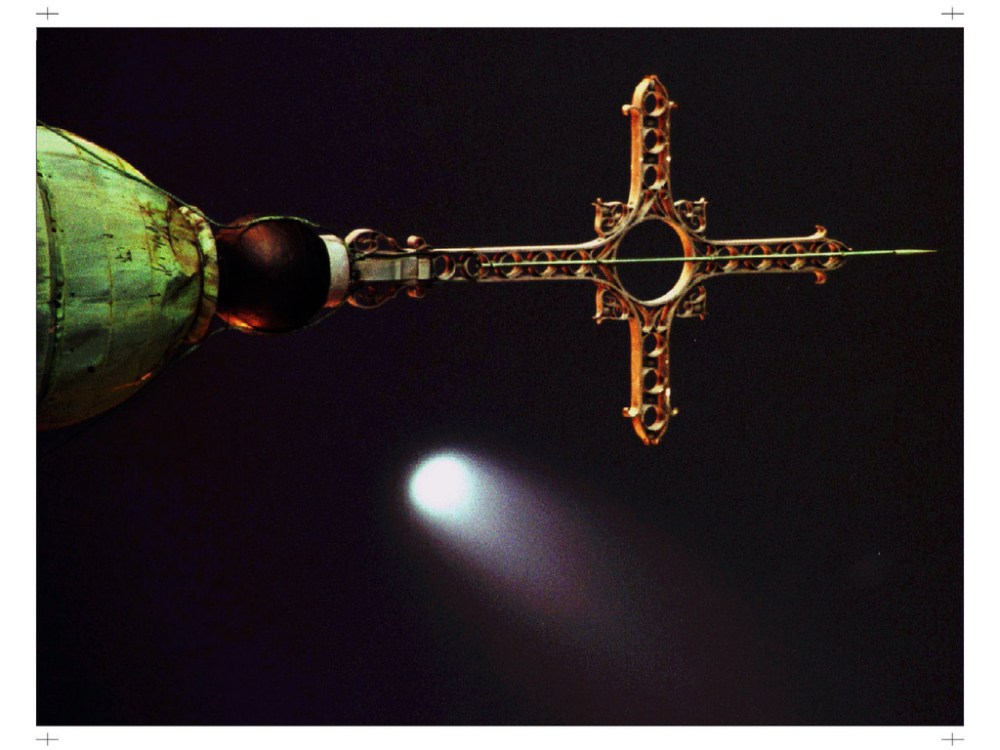
Astronomers say the newly discovered comet Neowise — the brightest comet to appear in Northern Hemisphere skies in nearly a quarter of a century — is poised to end its run as an object that can be seen with the naked eye.
It didn’t attain the status of a so-called “great comet” (exceptionally brilliant comets with bright, long tails), but it has been thrilling skywatchers and generating headlines around the globe.
It was first spotted on March 27 by NASA’s Near-Earth Object Wide-field Infrared Survey Explorer (NEOWISE) mission. According to NASA, the comet’s nucleus is about 4.8 kilometres across and composed of dust, rock and frozen gases left over from the birth of our solar system around 4.6 billion years ago.
Now making its way back toward the outer reaches of our solar system, the comet has come as close as 64 million miles (103 million kilometres) to Earth. It emits a tail of dust and possibly two tails of gas as it moves through space at around 144,000 mph (232,000 km/h).
Not expected to return for about 6,800 years, Neowise was fading from view in late July, but there should still be a little time to catch a quick glimpse before it vanishes. Grab binoculars and look to the northwestern sky below and just a bit west of the Big Dipper.
This cosmic snowball is far from the first celebrity celestial visitor to grace Earth’s skies, as we see from today’s starry-eyed list of Five of the Most Famous Comets in History:
5) The famous comet: Comet Hyakutake
The comet’s tale: Amateur comet-hunter Yuji Hyakutake (pronounced “hyah-koo-tah-kay”) quit his newspaper job in 1994 specifically to move to an area of Japan with less light pollution and dedicate more time to searching the skies. It proved to be a pretty shrewd move.
His first comet discovery came on Christmas Day 1995, when he spotted what was later designated C/1995 Y1, but a much more famous discovery came just weeks later on Jan. 30, 1996. While re-observing his first comet — which never became visible to the naked eye — he was shocked to look through his binoculars and find another comet in almost the same position as the first.
Comet Hyakutake became visible to the naked eye in early March 1996. It remained visible for three months and was the brightest comet seen in 20 years. Also dubbed The Great Comet of 1996, it made one of the closest approaches to Earth of the previous 200 years. According to NASA, its long, long tail was perhaps its most spectacular feature, stretching out more than 100 degrees as seen from Earth.
“By mid-March, the first signs of a tail were visible by amateurs. In the coming days, to everyone’s delight, the tail kept growing and glowed in green as it got larger. As it reached its closest approach to Earth, the tail began to extend far across the sky,” says space.com.
In May 1996, an instrument on the Ulysses spacecraft went “haywire” for several hours, according to Physics World. It turned out that the instrument, which was supposed to measure particles in the solar wind, had stumbled across Hyakutake’s tail at a distance of 311 million miles (500 million kilometres) from the comet’s nucleus.
“The length of the comet’s tail was therefore twice that of the previous record holder — the ‘Great March Comet’ of 1843,” Physics World noted. Astronomers believe the comet was here about 8,000 years ago, and its orbit will not bring it near the sun again for 14,000 years.
4) The famous comet: Comet Hale-Bopp
The comet’s tale: If you like your comets big and bright — and with a tragic twist — then Hale-Bopp is the space rock of your dreams. On July 23, 1995, an unusually large and bright comet was seen outside of Jupiter’s orbit by two amateur astronomers — Alan Hale of New Mexico and Thomas Bopp of Arizona. At the time of its discovery, Hale-Bopp was the farthest comet ever to be discovered by amateurs, according to NASA.
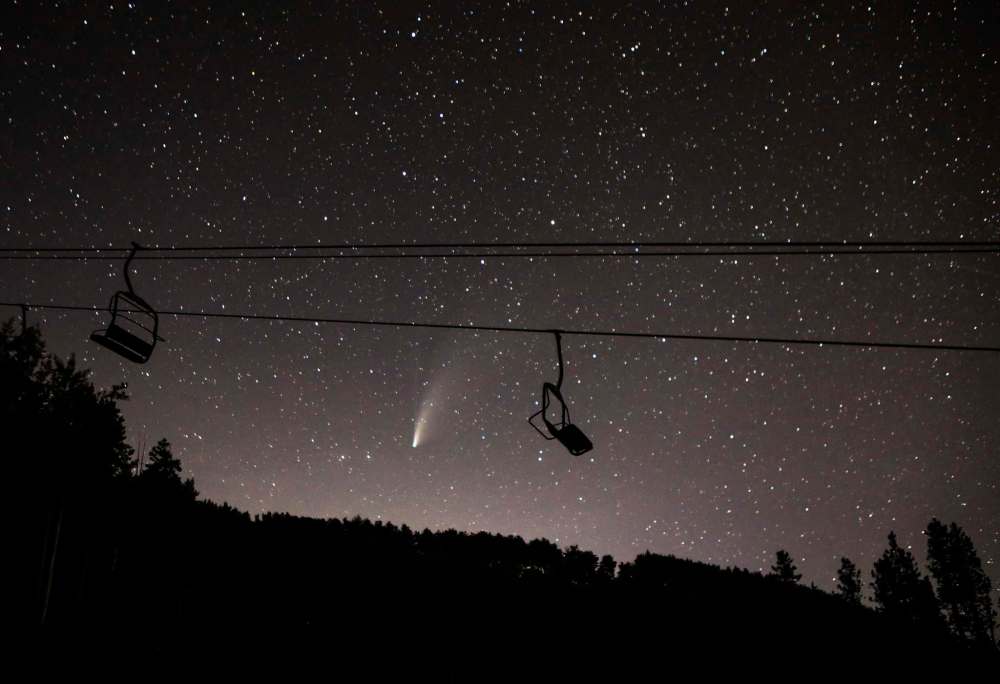
What really astounded astronomers was how bright Hale-Bopp appeared, even from a great distance away. Analysis of Hubble Space Telescope images suggested that its intense brightness was due to its exceptionally large size.
“While the nuclei of most comets are about 1.6 to 3.2 kilometres across, Hale-Bopp’s was estimated to be 40 km across. It was visible even through bright city skies, and may have been the most viewed comet in recorded history.” According to amazingspace.org. “Comet Hale-Bopp holds the record for the longest period of naked-eye visibility: an astonishing 18 months. It will not appear again for another 2,400 years.”
It provided a spectacular light show, being 1,000 times brighter than Halley’s Comet at the time of its discovery, NASA said at the time. It was visible to the naked eye twice as long as the Great Comet of 1811, the previous record holder.
“Its twin blue-and-white tails were clearly visible even from light-polluted areas such as Chicago,” space.com noted. The comet’s closest approach to Earth was about 120 million miles (193 kilometres). It was one of the first things to blow up on the internet, which was in its infancy.
In a tragic footnote, about 40 people who were part of the “Heaven’s Gate” cult in San Diego committed mass suicide as the comet came close to Earth. “In late March 1997, (leader Marshall) Applewhite and 38 followers drank a lethal cocktail of Phenobarbital and vodka and lay down to die, convinced that they would leave their physical bodies, enter the alien spacecraft they believed was behind Hale-Bopp, and pass through Heaven’s Gate into a higher existence,” according to Space.com.
3) The famous comet: Comet Swift-Tuttle
The comet’s tale: Every year in July and August, people on this planet are treated to a spectacular celestial fireworks display, better known as the Perseid meteor shower. That remarkable display happens every summer as Earth passes through the trail of dust and debris left by Comet Swift-Tuttle, a miles-wide behemoth that swings by our planet every 133 years. As comets go, Swift-Tuttle is a big one, with a nucleus 16 miles (26 kilometres) across, which makes it more than twice the size of the space body hypothesized to have led to the demise of the dinosaurs.
“And even though the comet only passes by Earth every 133 years, the meteor shower occurs every year when Earth moves through the trail of its orbit,” Space.com notes. “For viewers in the Northern Hemisphere, the Perseids are one of the best meteor showers of the year, and NASA has called it the “fireball champion” of annual meteor showers for its record-breaking number of extra-bright meteors, called fireballs. Those fireballs are visible even in light-polluted areas such as cities (still, there are many more faint meteors that are only visible if you go to a darker area).”
This husky comet was first seen independently in July 1862 by American astronomers Lewis Swift and Horace Tuttle. It is by far the biggest space object to cross Earth’s orbit and make repeated approaches to our planet.
“Its orbit passes very close to the Earth’s orbit, so that it has been viewed as a hazardous object over the years,” Paul Chodas, NASA’s manager for the centre of near-Earth object studies, told Space.com. “Now, we know its orbit very well, well enough to say that we are safe from an impact for many thousands of years.”
It will pass about 22.9-million kilometres from Earth on Aug. 5, 2125. A close encounter with Earth (about 1.6-million kilometres) is predicted for the comet’s return in 3044. We don’t expect to be around then.
2) The famous comet: Comet Shoemaker-Levy 9
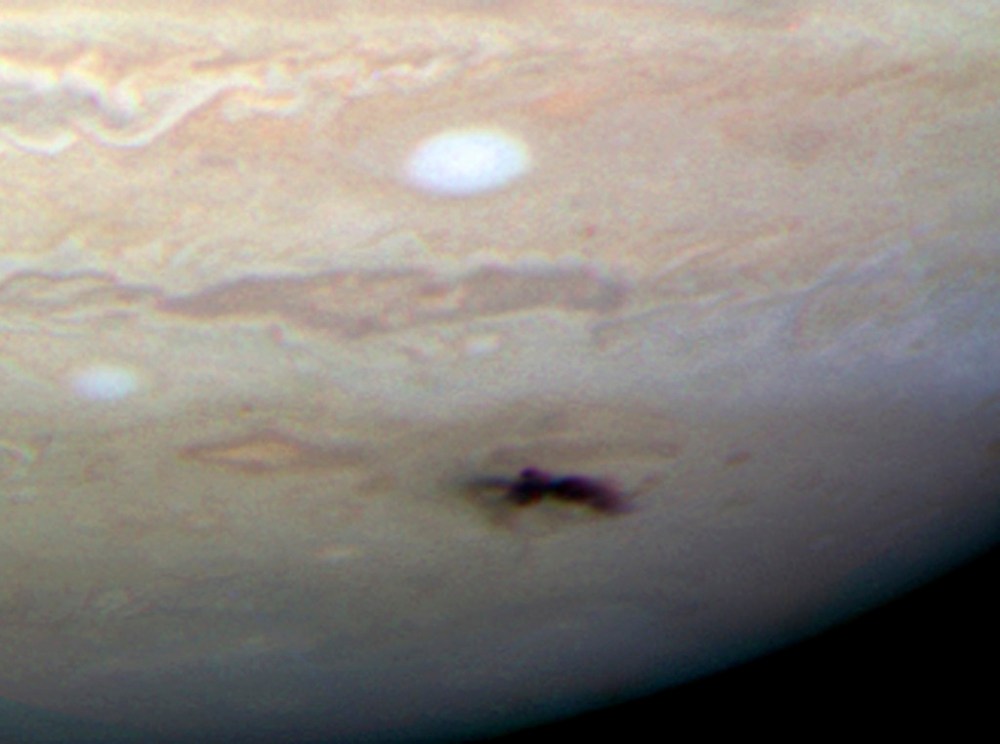
The comet’s tale: It was easily the most spectacular demise humankind has ever witnessed. Several months after its discovery in 1994, more than 20 fragments of Shoemaker-Levy 9 smashed into the planet Jupiter, producing scars that were visible from Earth.
“This is the first collision of two solar system bodies ever to be observed, and the effects of the comet impacts on Jupiter’s atmosphere have been simply spectacular and beyond expectations,” NASA wrote on a website describing the comet.
Shoemaker-Levy 9 was first spotted in March 1993 by three veteran comet discoverers: Eugene and Carolyn Shoemaker, and David Levy. The trio had collaborated several times before and discovered several other comets, which is why this comet was dubbed Shoemaker-Levy 9. When the comet was first discovered, it was believed to be a single body, but further observation revealed it had made a close approach to Jupiter in 1992 and been torn apart by tidal forces resulting from the planet’s powerful gravity. It became obvious the comet fragments were going to collide with Jupiter.
Fortunately, NASA had a spacecraft (the Galileo orbiter) in position to watch for the first time in history as two bodies in the solar system collided in space. “The ‘freight train’ of fragments smashed into Jupiter with the force of 300 million atomic bombs. The fragments created huge plumes that were 2,000 to 3,000 kilometres (1,200 to 1,900 miles) high, and heated the atmosphere to temperatures as hot as 30,000 to 40,000 degrees Celsius (53,000 to 71,000 degrees Fahrenheit). Shoemaker-Levy 9 left dark, ringed scars that were eventually erased by Jupiter’s winds,” NASA says on its solar system exploration website. “Scientists have calculated that the comet was originally about 1.5 to 2 kilometres (0.9 to 1.2 miles) wide. If a similar-sized object were to hit Earth, it would be devastating.”
It brought the dangers of comet collisions to the fore, and Hollywood unveiled two films (Armageddon and Deep Impact) on the theme of Earth being menaced by rogue celestial bodies. The U.S. Congress authorized NASA to monitor for objects cruising uncomfortably close to our planet.
1) The famous comet: Halley’s Comet
The comet’s tale: If you have never heard of Halley’s comet, then you have probably spent the majority of your life hiding in a drain pipe. This is easily the best-known comet in the history of people living on this planet. Its fame hinges on the fact it marked the first time astronomers realized comets could be repeat visitors to our night skies.
“Until the time of English astronomer Edmond Halley (1656-1742), comets were believed to make only one pass through the solar system. But in 1705, Halley used Isaac Newton’s theories of gravitation and planetary motions to compute the orbits of several comets. Halley found the similarities in the orbits of bright comets reported in 1531, 1607 and 1682 and he suggested that the trio were actually a single comet making return trips,” according to NASA’s website. Halley correctly predicted the comet’s return in 1758-1759 — 16 years after his death — and history’s first known “periodic’ comet was later named in his honour.
The comet has since been connected to ancient observations going back more than 2,000 years. For example, it is featured in the famous Bayeux tapestry, which chronicles the Battle of Hastings in 1066. Halley was last seen in Earth’s skies in 1986 and was met in space by an international fleet of spacecraft. It will return in 2061 on its regular 76-year journey around the sun. It was fortunate humans could send spacecraft to eyeball Halley in 1986 because, as NASA reports, “the comet ended up being underwhelming in observations from Earth. When the comet made its closest approach to the sun, it was on the opposite side of that star from the Earth — making it a faint and distant object, some 39 million miles away from Earth.”
Like Swift-Tuttle, Halley’s comet leaves a visually pleasing gift in its wake. “Each time Halley returns to the inner solar system its nucleus sprays ice and rock into space. This debris stream results in two weak meteor showers each year: the Eta Aquarids in May and the Orionids in October,” NASA’s website states. Halley has been in its current orbit for at least 16,000 years, but shows no signs of retiring soon.
doug.speirs@freepress.mb.ca