How COVID-19 is changing back-to-school shopping and budgets

Advertisement

Advertise with us

TORONTO - Vonny Sweetland has yet to decide if he will be sending his 12-year-old sister Josephine back to class in September, but just in case he does, he's been stocking up on supplies for months.

Read this article for free:


or

Already have an account? Log in here »

To continue reading, please subscribe:

Subscribe and receive a limited-edition Free Press branded hat or tote.

Digital Subscription

One year of digital access for only $205*

  • Enjoy unlimited reading on winnipegfreepress.com
  • Read the E-Edition, our digital replica newspaper
  • Access News Break, our award-winning app
  • Play interactive puzzles

*First annual payment billed as $205.00 + GST for one year. This annual subscription will automatically renew at $233.00 + GST every 52 weeks (10% off the regular annual price of $259.35). Offer available to new and qualified returning subscribers only. Cancel any time.

To continue reading, please subscribe:

Add Free Press access to your Brandon Sun subscription for only an additional

$1 for the first 4 weeks*

  • Enjoy unlimited reading on winnipegfreepress.com
  • Read the E-Edition, our digital replica newspaper
  • Access News Break, our award-winning app
  • Play interactive puzzles
Start now

*Your next Brandon Sun subscription payment will increase by $1.00 and you will be charged $17.95 plus GST for four weeks. After four weeks, your payment will increase to $24.95 plus GST every four weeks.

Hey there, time traveller!
This article was published 18/08/2020 (2206 days ago), so information in it may no longer be current.

TORONTO – Vonny Sweetland has yet to decide if he will be sending his 12-year-old sister Josephine back to class in September, but just in case he does, he’s been stocking up on supplies for months.

He picks up hand sanitizer when he sees it in stores, grabbed new masks last month, bought a fresh uniform and has been testing out Josephine’s muscle power with some new lunch containers.

The new additions to her backpack and are all part of a wave of changes families — and their wallets — are being confronted with as they prepare for back to school, whether it’s sourcing protective equipment or choosing a thermos their child can open unassisted.
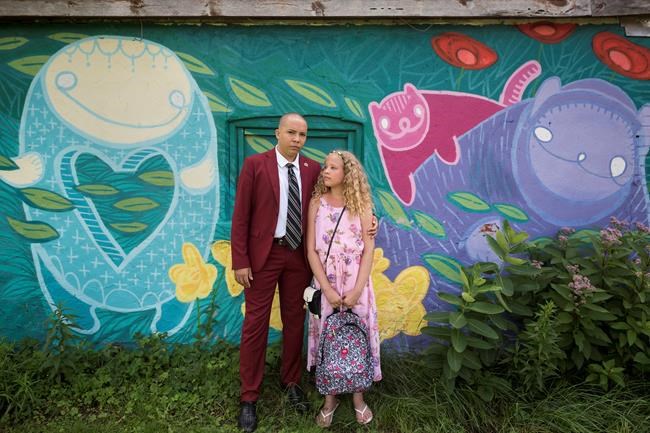
Vonny Sweetland and his sister, who he is a guardian for, Josephine Price, 12, pose for a photograph at Wychwood Barns Park in Toronto, on Saturday, August 15, 2020. Vonny Sweetland has yet to decide if he will be sending his 12-year-old sister Josephine back to class in September, but just in case he does, he's been stocking up on supplies for months. THE CANADIAN PRESS/ Tijana Martin

“In a COVID-era, all of these things we take for granted or think are minuscule are actually really important,” said Sweetland, who is his sister’s guardian.

“These are things as simple as a teacher helping you unpack your lunch or zipping a zipper. To prevent potential spread, I don’t think teachers are really going to be doing these things.”

The cost of so many new supplies can easily add up.

A Deloitte survey of 1,200 parents who have at least one child attending school in grades K-12 this fall found the average family will spend $102 on school supplies, $216 on clothing and accessories, $395 on computers and hardware, $316 on electronic gadgets and digital subscriptions.

The survey, which was conducted between May and July, found those families will allocate $61 on a new category: home or health supplies.

Even so, back-to-school shopping doesn’t have to be more expensive than any other year, said Seung Hwan (Mark) Lee, an associate professor of retail management at Ryerson University.

He recommends shoppers compare prices and take advantage of sales.

Anne Marie Taber said she’s noticed plenty of sales, though she hasn’t sought them out when shopping with seven-year-old daughter Avery because she tries to minimize her time in stores and instead use online options with delivery to lessen her exposure to the virus.

She stocked up as soon as she could on Old Navy’s uniform-style clothing because several sizes were out of stock and also grabbed Avery a new backpack.

On top of masks and hand sanitizers, they bought a wide-mouth water bottle without a straw to make cleaning easy, plastic Duo-Tangs that can be wiped down and a set of art supplies that Avery has been reminded not to share.

“This is extra stuff we haven’t had to buy in the past but it’s a small dollar to pay to make sure that that is just hers exclusively,” Taber said.

Parents may also want to consider disposable cutlery, if they have children that bring lunches to school and are worried about germs spreading through anything reuseable, Lee said.

If your child is doing virtual classes, he suggests ensuring you have a reliable laptop or tablet with a webcam.

Those who want to go all out or are older and have specific needs for programs they are enrolled in, may need to think about microphones and speakers too.

Those supplies don’t come cheap. However, the cost of those high-ticket items could be partially offset by a change he sees happening across universities and colleges during the pandemic.

“It’s no longer really about carrying around the heavy textbooks,” he said.

“Many professors aren’t holding lengthy exams because the exams are becoming very difficult to monitor and you can’t really get a proctor to look at how students are conducting their exams… so using test banks or textbooks no longer apply.”

If you’re feeling anxious or stressed about back to school shopping and advertisements are making you feel you better get to a store soon, Lee says not worry.

“I would advise parents right now not to rush into getting supplies,” he said.

“Find out more about what your school district is doing, and then adjust according to that. A deal can always be had.”

This report by The Canadian Press was first published Aug. 18, 2020

Report Error Submit a Tip

More Stories

New businesses start to creep up in former Winnipeg Slurpee shops

Tiago Resko 5 minute read Preview

New businesses start to creep up in former Winnipeg Slurpee shops

Tiago Resko 5 minute read Thursday, Aug. 27, 2026

The remnants of 7-Eleven can still be seen as new businesses move into spaces where Slurpee machines and taquitos once ruled.

As fresh paint dries on several new ventures — such as a pizza place and a convenience store with a name that might make a customer do a double-take — holes across Winnipeg once occupied by the international convenience chain are slowly being filled.

Business at a Domino’s Pizza in Elmwood, formerly a 7-Eleven, has been booming since it opened June 1, the store manager said.

“The issues that 7-Eleven would have had might be different than what we would have. They were dealing with a lot of theft where people can just walk in and out, but Domino’s isn’t set up that way,” said Paul Hemmerling.

Read
Thursday, Aug. 27, 2026

Social problems cannot be simply swept away

Editorial 4 minute read Preview

Social problems cannot be simply swept away

Editorial 4 minute read 2:00 AM CDT

In the battle to alleviate homelessness, mental health issues and drug addiction, we just can’t seem to get the order of our response right.

The city dismantles homeless encampments before there are enough safe, permanent places for people to live.

The Winnipeg Police Service conducts an intensive sweep to combat open drug use on Main Street, without arranging support from social service agencies to help the people they are rousting.

Is it any surprise that the acute problems being experienced by residents, businesses and workers on Main Street are beginning to manifest in adjacent neighbourhoods? That’s what happens when you try to solve a problem by moving it, not addressing it head-on.

Read
2:00 AM CDT

Long-term care best when public

Noah Schulz 4 minute read Preview

Long-term care best when public

Noah Schulz 4 minute read 2:00 AM CDT

Long-term care remains in crisis in Manitoba. As a result, too many Manitobans fear what will happen to them and their relatives as they age and develop more complex health needs.

While some public support does exist, too much of the labour of caring for our relatives as we age is privatized onto individual family members, most often women in these families. This adds additional stress and workload onto these individuals, who must essentially act as unpaid caregivers for their loved ones as they age.

For those without such family support, the circumstances are even more challenging.

In Manitoba, personal care homes (PCH) are a mix of private for-profit, public and private not-for-profit operations. Recently, private for-profit care homes have been back in the news for all the wrong reasons.

Read
2:00 AM CDT

Filtering the worst of our behaviour

Gwynne Dyer 5 minute read 2:00 AM CDT

On Sunday, Aug. 30, a Falcon Heavy rocket delivered the Nancy Grace Roman space telescope onto a direct transfer trajectory to its permanent home at the Lagrange Two Point (L2), 1.5-million km from Earth. In 100 days it will reach its station, power up, and start observing the universe.

Astronomers will use it to try to understand the nature of dark matter, which makes up most of the mass in the universe (but some say may not even exist).

It is expected to find up to 100,000 new exoplanets circling other stars, and may be able to spot ones even smaller than Mars. Current methods can only see much bigger ones.

It will test a new technology called a coronagraph, which may one day be able to detect life on some of those planets by analyzing the light reflected from them. It would be nice to have a better answer to scientist Enrico Fermi’s famous question: “Where is everybody?”

Kevin Klein to run for mayor

1 minute read Updated: Yesterday at 2:18 PM CDT

A former city councillor and provincial cabinet minister says he will enter the race to become Winnipeg’s next mayor.

“I have decided, after some consideration, that I will be throwing my name into the election for mayor. I'm going to go up against Scott Gillingham and we're going to make a race of it,” said Kevin Klein, in a video posted to the Winnipeg Sun website. Klein is the president and CEO of Klein Media Group, which publishes the Winnipeg Sun.

Klein, a former Charleswood-Tuxedo-Westwood councillor and Manitoba Progressive Conservative environment minister, finished third in the 2022 mayoral race with 28,806 votes. Gillingham claimed a narrow victory with 53,663, followed by Glen Murray with 49,272.

In the video, Klein said he had decided not to enter the race weeks ago due to an unspecified health scare that required surgery. After recovering, he said he decided to run.

Autumn need not be melancholy forever

Maureen Scurfield 5 minute read Yesterday at 2:00 AM CDT

DEAR MISS LONELYHEARTS: Autumn is almost here (the most beautiful time of the year) but it always puts me in mind of my dearest love — a young man from my university days who died tragically in the fall, a couple decades ago. I lost him forever!

How can I get through this time, when it feels like I’ve been punched in the gut every September, and I have to stay home in bed pretending to have flu for a week or more?

— Numbing Out Again, Headingley

Dear Numb: See your physician and confess that you haven’t been able to heal this serious emotional wound. You should really book a visit to a psychiatrist, sooner rather than later, as this tragic loss from the past incapacitates you every fall. A professional therapist can help you to carefully undo these painful “knots,” and a psychiatrist would also be able to prescribe medication that could help you with the process of getting into an improved state of mind. That way, you won’t fall back into a serious state of mourning every autumn.