Canada approves Pfizer’s COVID-19 vaccine; here’s what we know about it
Advertisement
Read this article for free:
or
Already have an account? Log in here »
To continue reading, please subscribe:

Digital Subscription
One year of digital access for only $205*
- Enjoy unlimited reading on winnipegfreepress.com
- Read the E-Edition, our digital replica newspaper
- Access News Break, our award-winning app
- Play interactive puzzles
*First annual payment billed as $205.00 + GST for one year. This annual subscription will automatically renew at $233.00 + GST every 52 weeks (10% off the regular annual price of $259.35). Offer available to new and qualified returning subscribers only. Cancel any time.
To continue reading, please subscribe:
Add Free Press access to your Brandon Sun subscription for only an additional
$1 for the first 4 weeks*
- Enjoy unlimited reading on winnipegfreepress.com
- Read the E-Edition, our digital replica newspaper
- Access News Break, our award-winning app
- Play interactive puzzles
*Your next Brandon Sun subscription payment will increase by $1.00 and you will be charged $17.95 plus GST for four weeks. After four weeks, your payment will increase to $24.95 plus GST every four weeks.
Read unlimited articles for free today:
or
Already have an account? Log in here »
Hey there, time traveller!
This article was published 09/12/2020 (2101 days ago), so information in it may no longer be current.
Health Canada approved a COVID-19 vaccine from Pfizer and BioNTech on Wednesday, paving the way for a rollout plan that could start in the coming weeks.
Canada is set to receive 249,000 doses of the drug from the the U.S. pharmaceutical giant and its German partner by the end of the month and four million total doses — enough to vaccinate two million people — by March.
Here’s what we know about Pfizer’s product, and how it compares to two other leading vaccine candidates:
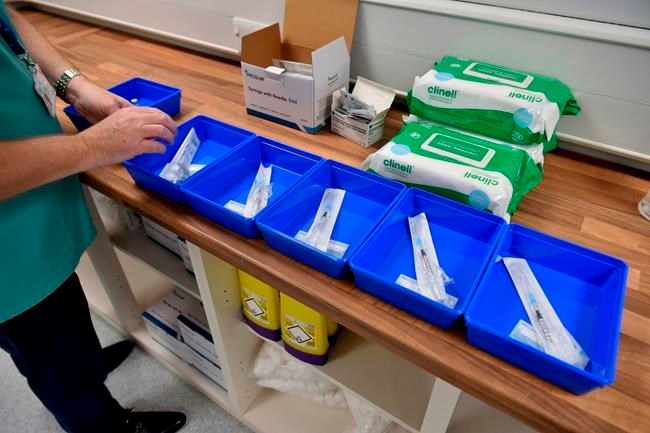
HOW DOES THE VACCINE WORK?
Pfizer developed its vaccine with a novel technique of using messenger RNA (mRNA), which essentially teaches our cells how to make the coronavirus’s spike protein and trigger an immune response if we become infected with the virus in the future.
Pfizer’s vaccine uses a synthetically-produced mRNA that’s packaged in a fat, or lipid, coating. When injected into the arm muscle, the lipid hooks onto cells and dumps the mRNA there. It’s then translated into protein to make the antibody.
Another leading vaccine candidate from Moderna also uses mRNA. One from AstraZeneca uses a non-replicating viral vector — a virus that has been stripped of its genetic material and replaced with the spike protein gene of the coronavirus. That viral vector makes an mRNA molecule, andfrom there the protein and antibodies.
HOW EFFECTIVE IS IT?
Pfizer’s vaccine is 95 per cent effective in preventing SARS-CoV-2 infection beginning one week after the second dose, and Health Canada specifies on its website that people may not be protected against COVID-19 until at least seven days after the second dose.
The efficacy rate is based on studies in about 44,000 participants.
AstraZeneca says its vaccine was up to 90 per cent effective when a half dose was followed by a full dose a month later. Another method, where two full doses were distributed a month apart, showed to be 62 per cent effective.
Moderna’s preliminary data showed a 94.5 per cent efficacy.
What’s not known is how long immunity lasts with any of the leading vaccine candidates.
WHAT ARE THE SIDE EFFECTS?
Health Canada says the side effects from Pfizer’s clinical trials were found to be “mild or moderate” and included things like pain at the site of injection, body chills and feeling tired and feverish.
The organization says those are common side effects of many vaccines, and “do not pose a risk to health.”
“As with all vaccines, there’s a chance that there will be a serious side effect, but these are rare,” the website says. “A serious side effect might be something like an allergic reaction.”
Moderna and AstraZeneca recorded similar side effects from their clinical trials.
Britain’s medical regulator, meanwhile, warned Wednesday that people with a history of serious allergic reactions shouldn’t receive Pfizer’s vaccine. Britain began its COVID vaccination program on Tuesday and investigators are looking into whether two reactions were linked to the shot.
WHAT ARE THE HURDLES FACING DISTRIBUTION?

Pfizer’s vaccine, like Moderna’s and AstraZeneca’s, requires two doses injected roughly three weeks apart.
Tracking will become particularly important with a two-dose vaccine, to make sure people are going back to their doctor or pharmacy to get their second dose, and to ensure they’re receiving the right vaccine if more than one option is available.
Storage could also prove problematic with Pfizer’s product, which requires ultra-low freezers that can keep it at minus 70 C until a short time before it’s injected. Moderna’s needs a temperature around minus 20 C – about the same as a regular freezer.
Pfizer and Moderna need cooler temperatures for their vaccines because of the instability of the mRNA. AstraZeneca’s vaccine, meanwhile, can be stored in a fridge.
This report by The Canadian Press was first published Dec. 9, 2020.
Related Articles
Manitoba critical care unit workers first up for vaccine
Advertisement Advertise With Us
Advertisement Advertise With Us