Moderna plans to test its COVID-19 vaccine on Canadian children
Advertisement
Read this article for free:
or
Already have an account? Log in here »
To continue reading, please subscribe:

Digital Subscription
One year of digital access for only $205*
- Enjoy unlimited reading on winnipegfreepress.com
- Read the E-Edition, our digital replica newspaper
- Access News Break, our award-winning app
- Play interactive puzzles
*First annual payment billed as $205.00 + GST for one year. This annual subscription will automatically renew at $233.00 + GST every 52 weeks (10% off the regular annual price of $259.35). Offer available to new and qualified returning subscribers only. Cancel any time.
To continue reading, please subscribe:
Add Free Press access to your Brandon Sun subscription for only an additional
$1 for the first 4 weeks*
- Enjoy unlimited reading on winnipegfreepress.com
- Read the E-Edition, our digital replica newspaper
- Access News Break, our award-winning app
- Play interactive puzzles
*Your next Brandon Sun subscription payment will increase by $1.00 and you will be charged $17.95 plus GST for four weeks. After four weeks, your payment will increase to $24.95 plus GST every four weeks.
Read unlimited articles for free today:
or
Already have an account? Log in here »
Hey there, time traveller!
This article was published 17/03/2021 (2025 days ago), so information in it may no longer be current.
TORONTO – By most accounts, Canadian kids are not expected to receive a COVID-19 vaccine this year, let alone before the new school year in September.
But a select few may be able to receive an early dose through clinical trials expected to launch in various locales.
Moderna said this week it wants to recruit an unspecified number of Canadian children aged six months to 12 years for upcoming trials of its COVID-19 vaccine, while Johnson & Johnson is poised to run trials for its vaccine with 12- to 17-year-olds.
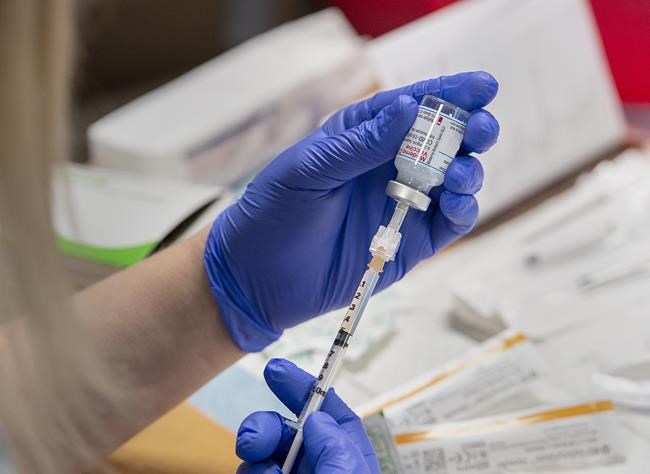
Pediatrician and professor Dr. Jim Kellner of Alberta Children’s Hospital says it’s a great opportunity for Canada to play an important role in the COVID-19 effort, and can ultimately speed Health Canada’s analysis when it comes time for the regulator to consider approving the vaccine for kids.
He notes the regulator evaluates all data on their merits, but a Canadian trial with Canadian volunteers “won’t hurt.”
“I wouldn’t expect that there’s any (advantage) getting us to the front of the line, particularly, but what conducting the trials in Canada does is it will help Health Canada, for example, in its evaluation of the data,” says Kellner, who sits on Canada’s COVID-19 Immunity Task Force.
In addition to Moderna, Canada has approved vaccines from Pfizer-BioNTech, Oxford-AstraZeneca and Johnson & Johnson, developed by subsidiary Janssen Pharmaceuticals. They’re all approved for adult use, although the Pfizer product can be used by people as young as 16.
AstraZeneca has also started a trial with younger age groups, while this spring, Johnson & Johnson is expected to study its vaccine with volunteers aged 12- to 17-years-old in sites including Toronto and Burlington, Ont.
The chair of Canada’s National Advisory Committee on Immunization said Tuesday that a vaccine for kids wasn’t expected before the end of the year, although trial data from Pfizer involving 12-to-15-year-olds could arrive in two-to-three months.
In the meantime, Kellner notes NACI has given clinicians some leeway to consider offering the Pfizer vaccine to 12-to-15-year-olds who have significant underlying conditions that put them at particular risk.
He says that decision was made by extrapolating data on vaccinated young adults, and suggested the same thing could be done to approve use in older kids when the data on teens becomes available.
“Adding in younger children could be done sequentially. It’s not like we have to wait, I don’t think, until all childhood ages have been tested before approving the vaccine,” he says.
“Then the issue becomes: When does the data become available? And most of the vaccine companies are taking a sequential approach – teenagers first. Then once you’ve figured out teenagers you look at school aged children, sort of six to 11, and at the same time those are being figured out you look at younger children, five and under.”
Earlier this month, Health Canada’s chief medical adviser also doubted that a vaccine would be ready for children by the time school starts in September, noting trials with younger participants tend to take more time.
“It’s not inconceivable that we might have some data in the summer, and potentially by the end of this calendar year we might have some indications in children, but that’s still pretty optimistic,” said Dr. Supriya Sharma.
Moderna has said its Phase 2/3 study would involve 6,750 healthy pediatric participants aged six months to 12 years. Initial participants are based in the United States but the biotech company said Canadian sites would be added as the trial progresses.
Those Canadian sites have not yet been chosen, nor have Canadian participants.
The trial will evaluate the safety and effectiveness of two doses given 28 days apart. Participants will be followed for one year after the second vaccination.
Recruitment and retainment is an issue with children, says Karri Venn, research president at LMC Manna, which will run J&J’s teenage trials in Toronto and Burlington.
However, as with all things COVID-19, she allowed that interest could be different in this case, suspecting many families would be enticed by the possibility that enrolment would speed their teen or child’s return to COVID-prohibited activities like group sports.
Venn says her firm expects to begin its COVID-19 vaccine trials in May, but protocols have not yet been approved, delaying recruitment.
She says LMC Manna would not be interested in running a clinical trial for younger kids.
“We’re comfortable (with) 12 and up because you can actually have conversations with them, they’re a part of the process when you go through it,” says Venn.
“But having an infant or a six-year-old, asking them to do blood work – not easy, right? And there’s still so much growth and development during those stages.”
Kellner says children too young to give consent must still give their assent, which isn’t complete consent but reflects a child’s willingness to take part in the study. That’s in addition to securing their parents’ agreement.
And just as with adult trials, participants can leave at any time, for any reason.
Kellner estimates the dropout rate among kids and teens to be between 10 per cent and 15 per cent, depending on the demands of the trial.
He says trials like the proposed Moderna study typically have participants draw blood before and after each dose during the study.
“At a minimum, you’d probably be looking at four blood tests for a two-dose vaccine.”
A local ethics board will have guidelines on how much is acceptable to draw from a child, which will depend on their size, he adds.
Kellner says he’s been doing vaccine clinical trials with children for more than 20 years and does not find it difficult to find volunteers.
“Canadian families are amazingly enthusiastic and willing to participate in important clinical trials that will help lead to things like safe and effective vaccines. It’s quite inspiring, actually.”
This report by The Canadian Press was first published March 17, 2021.